Nausea During Perimenopause: What Else Could Be Going On?
Nausea may coincide with changing periods, but its timing, accompanying symptoms and any new medicines offer better clues than age alone.
Perimenopause can change when your periods arrive, but nausea alone doesn’t establish that the transition is causing it. Nausea with menstrual cramps may be related to period pain; a late period also leaves pregnancy worth considering. Hormone therapy and some medicines used for hot flashes can cause nausea, too.67183 If nausea doesn’t improve in a few days or keeps returning, arrange a routine assessment. Seek prompt medical advice if vomiting makes it hard to keep fluids down.1011
Start with what changed
If you feel queasy around the same time your periods have become unpredictable, it’s reasonable to wonder whether the two are connected. Periods often become more or less frequent during perimenopause, and bleeding may become heavier or lighter. Nausea, though, isn’t enough on its own to identify perimenopause as the cause. Look at when it happens and what comes with it rather than assuming every new symptom has the same explanation.69
Nausea with cramps points toward period pain
Menstrual cramps can come with nausea, diarrhea, lower-back pain or headaches. Prostaglandins, chemicals made by the uterus, cause the contractions behind common period cramps. If your nausea shows up alongside familiar lower-abdominal cramps when bleeding starts, period pain is one plausible explanation. That doesn’t prove a new pattern of nausea is caused by hormone changes in perimenopause.7
The distinction matters if the pain itself has changed. Cramps that suddenly get worse, severe cramps that begin for the first time after age 25, or pain when you’re not having a period are reasons to arrange a medical assessment. Those patterns deserve more than an assumption that your cycle is simply changing.7
A late period doesn’t rule out pregnancy
Irregular periods are common in perimenopause, but pregnancy is still possible during this stage. If pregnancy could be possible for you, consider a pregnancy test rather than treating a missed or unusually late period plus nausea as confirmation of menopause. Pregnancy is among the recognized causes of nausea, and pregnancy testing may be part of a medical evaluation for it.61
Menopause is generally defined as 12 months without a period when you’re not using hormonal contraception. Hormonal contraception can also affect bleeding, making changes in your periods harder to interpret.96
Check the timing of medicines and supplements
Did the nausea begin after you started or changed something you take? Estrogen used in hormone therapy can cause nausea. Nausea is also a reported side effect of some nonhormonal medicines used for hot flashes, including paroxetine and desvenlafaxine. Even an herbal product marketed for cycle or menopause symptoms isn’t automatically stomach-friendly: a review of reports about vitex listed nausea among its most frequent adverse events.8354
That timing is a clue, not proof that a medicine is responsible. If a treatment seems to coincide with nausea, tell the prescriber what you take and when the symptoms began. Changes to the type or way hormone therapy is taken are among the options a clinician may consider for side effects. If you’re pregnant, talk with your care team before starting or stopping a medicine.82
When nausea needs more attention
Nausea and vomiting have many possible causes, so a pattern outside your period or a recent treatment change does not establish that perimenopause is the cause.1 Other symptoms can offer clues: nausea with diarrhea or vomiting may occur with a stomach bug or food poisoning; heartburn or bloating after eating may point toward acid reflux. A headache with fever may suggest an infection, while a headache with sensitivity to light or sound may suggest migraine. These pairings are possibilities, not diagnoses.10 If nausea doesn’t improve in a few days or keeps returning, arrange a routine assessment to explore what else might be going on.10 An assessment may include questions about your symptoms and medicines, an examination, and sometimes tests such as a pregnancy test.1
If you’re vomiting, pay closer attention to whether you can stay hydrated. Try small sips of fluid if you feel sick. If you keep vomiting and can’t keep fluids down, seek urgent medical advice. Dry mouth, urinating less often or dark urine are signs of dehydration for which MedlinePlus advises contacting a healthcare provider immediately. While you’re sorting out the cause, avoiding strong smells may help if they trigger your nausea.111
The useful question isn’t just “Could this be perimenopause?” It’s “Does this happen with cramps, after a missed period, after a treatment change, or without a clear pattern?” Those differences point toward different next steps, and none requires you to dismiss how you feel.6718
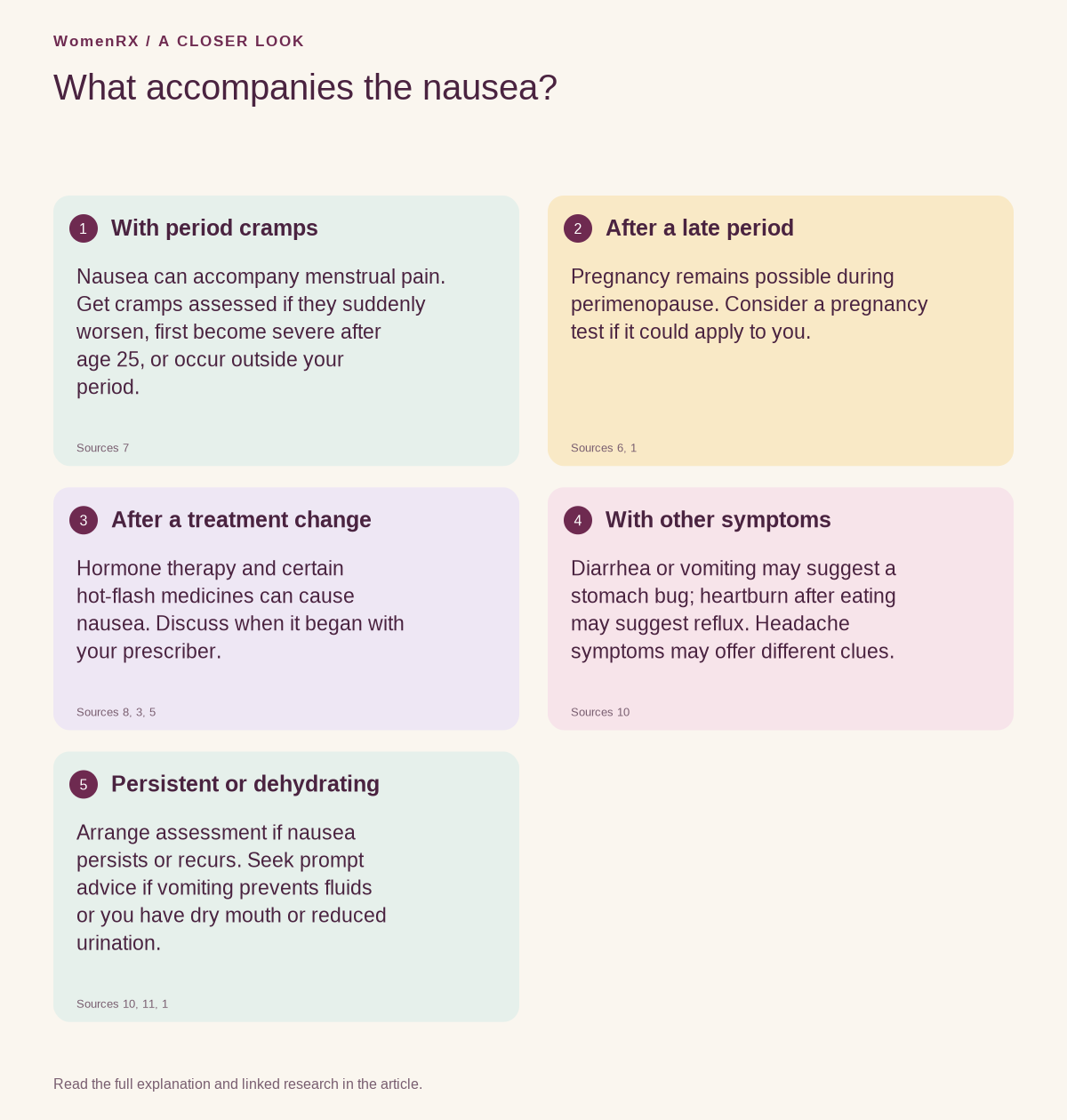
What accompanies the nausea?
With period cramps: Nausea can accompany menstrual pain. Get cramps assessed if they suddenly worsen, first become severe after age 25, or occur outside your period.7
After a late period: Pregnancy remains possible during perimenopause. Consider a pregnancy test if it could apply to you.61
After a treatment change: Hormone therapy and certain hot-flash medicines can cause nausea. Discuss when it began with your prescriber.835
With other symptoms: Diarrhea or vomiting may suggest a stomach bug; heartburn after eating may suggest reflux. Headache symptoms may offer different clues.10
Persistent or dehydrating: Arrange assessment if nausea persists or recurs. Seek prompt advice if vomiting prevents fluids or you have dry mouth or reduced urination.10111
Read the figure as text
Compare the timing and symptoms that fit your situation. Each clue suggests a possible next step, not a diagnosis.- With period cramps: Nausea can accompany menstrual pain. Get cramps assessed if they suddenly worsen, first become severe after age 25, or occur outside your period.7
- After a late period: Pregnancy remains possible during perimenopause. Consider a pregnancy test if it could apply to you.61
- After a treatment change: Hormone therapy and certain hot-flash medicines can cause nausea. Discuss when it began with your prescriber.835
- With other symptoms: Diarrhea or vomiting may suggest a stomach bug; heartburn after eating may suggest reflux. Headache symptoms may offer different clues.10
- Persistent or dehydrating: Arrange assessment if nausea persists or recurs. Seek prompt advice if vomiting prevents fluids or you have dry mouth or reduced urination.10111
More questions, answered
Can a hot flash make me feel nauseated?
You might feel nauseated at the same time as a hot flash, but that doesn’t show the flash caused it. Hot flashes can bring sweating, palpitations, anxiety or dizziness; nausea isn’t among the accompanying symptoms listed in this clinical description. Consider other possible causes, including medicines.618
Sources you can check
- Nausea | Vomiting | MedlinePlusAccessed 2026-09-25Return to first citation
- Pregnancy and Medicines | MedlinePlusAccessed 2026-09-25Return to first citation
- A Clinical Review on Paroxetine and Emerging Therapies for the Treatment of Vasomotor Symptoms.David PS, Smith TL, Nordhues HC, Kling JM. · International journal of women's health · 2022Return to first citation
- Vitex agnus castus: a systematic review of adverse events.Daniele C, Thompson Coon J, Pittler MH, Ernst E. · Drug safety · 2005Return to first citation
- Is desvenlafaxine effective and safe in the treatment of menopausal vasomotor symptoms? A meta-analysis and meta-regression of randomized double-blind controlled studies.Berhan Y, Berhan A. · Ethiopian journal of health sciences · 2014Return to first citation
- Symptoms of menopause and perimenopause - NHSAccessed 2026-09-25Return to first citation
- Period Pain | Menstrual Cramps | MedlinePlusAccessed 2026-09-25Return to first citation
- Side effects of hormone replacement therapy (HRT) - NHSAccessed 2026-09-25Return to first citation
- What are menopause and perimenopause? - NHSAccessed 2026-09-25Return to first citation
- Feeling sick (nausea) - NHSAccessed 2026-09-25Return to first citation
- Diarrhoea and vomiting - NHSAccessed 2026-09-25Return to first citation