Perimenopause and Menopause: Where to Start
Your bleeding pattern can help orient you, but the symptom or decision bothering you most is the better place to begin.
Perimenopause often begins with changing periods; menopause is identified after 12 months without a period if you’re not using hormonal contraception. Symptoms can start before that point and continue afterward. Start with your main question: Is this bleeding expected? Could these symptoms fit? Or which treatment makes sense for my health history? Those questions call for different answers. 789
First, find your place in the transition
Perimenopause is the transition leading up to menopause. Periods may come more or less often, and bleeding may become heavier or lighter. Menopause is identified after 12 months without a period when you’re not using hormonal contraception; the time after that is postmenopause. These are useful landmarks, not a schedule everyone follows. Menopause usually happens between ages 45 and 55, but it can happen earlier, including after surgery to remove the ovaries. 78
If you’re wondering whether you need a hormone test, the starting point is usually your age, symptoms and period history. There’s no routine test for perimenopause or menopause. Bleeding patterns are also central to reproductive-stage research, while hormone measurements serve as supporting information rather than the primary marker. Hormonal contraception complicates the picture because it can change your bleeding or stop it altogether. 748
Start here if your periods are changing: Ask whether your new pattern fits the transition and whether the amount of bleeding needs attention. Irregularity can be part of perimenopause, but don’t dismiss bleeding that’s becoming heavier than it used to be simply because you’re in midlife. That’s a reason to discuss the change with a clinician. 8
Let the symptom lead to the next question
You don’t have to have stopped menstruating for symptoms to matter. Hot flashes, sleep problems, low mood and memory problems can occur around the transition; some symptoms continue after menopause. For example, if you’re still getting periods but night sweats are disrupting sleep, a guide to hot flashes and their treatment options is more useful than waiting to decide whether you’ve officially reached menopause. 78
Symptoms also vary. A systematic review of studies involving women ages 40 to 60 found associations between symptom patterns and factors including smoking, obesity and ethnicity. Those are population-level associations, not a way to predict what any one woman will experience or proof that a symptom has only one cause. 3
If concentration is your main concern, it deserves its own conversation rather than being folded into a general list of menopause symptoms. An analysis of 26 studies found differences in cognitive outcomes between perimenopausal and premenopausal groups, but results depended in part on how researchers defined each stage and measured cognition. That leaves room to take your experience seriously without assuming every memory change is caused by perimenopause. 5
Match care to what’s bothering you
For disruptive hot flashes, the useful question is not simply “Should I take hormones?” It’s which approaches fit your symptoms, preferences and medical history. Menopausal hormone therapy can help relieve menopausal symptoms, but its risks vary with the type used, duration and individual health history. Whether you have a uterus also affects which hormones may be used: estrogen-only therapy may be considered after a hysterectomy, while estrogen plus progesterone or a progestin may be considered if you still have a uterus. 9
There are nonhormonal approaches worth discussing too. In one small, non-blinded trial, 50 postmenopausal Korean women were assigned to group cognitive behavioral therapy or a wait-list. The therapy group reported improvements in hot-flash frequency, distress and daily interference compared with the wait-list group. That’s a promising option to ask about, not a guarantee of the same result for everyone. 2
If vaginal dryness or pain during sex is the concern, say so directly. These symptoms can persist after periods stop, and the care conversation may differ from one focused on hot flashes. Likewise, if you have little or no symptom burden, you don’t need to choose a symptom treatment just because you’ve entered a new stage. 891
Know when bleeding changes the plan
The clearest dividing line is bleeding after menopause. If you’ve gone at least 12 months without a period and then have vaginal bleeding, have it checked, even if it seems slight or you’re unsure it’s blood. Postmenopausal bleeding is often not serious, but it can be a sign of cancer. Bleeding that becomes heavier while you’re still having periods also deserves a conversation rather than an automatic assumption that it’s perimenopause. 8
The practical starting point is therefore different at each moment: changing cycles call for a look at the bleeding pattern; disruptive symptoms call for a treatment discussion centered on the symptom; bleeding after menopause calls for evaluation. You can be uncertain about your exact stage and still know which question to bring forward. 789
Three landmarks, three starting questions
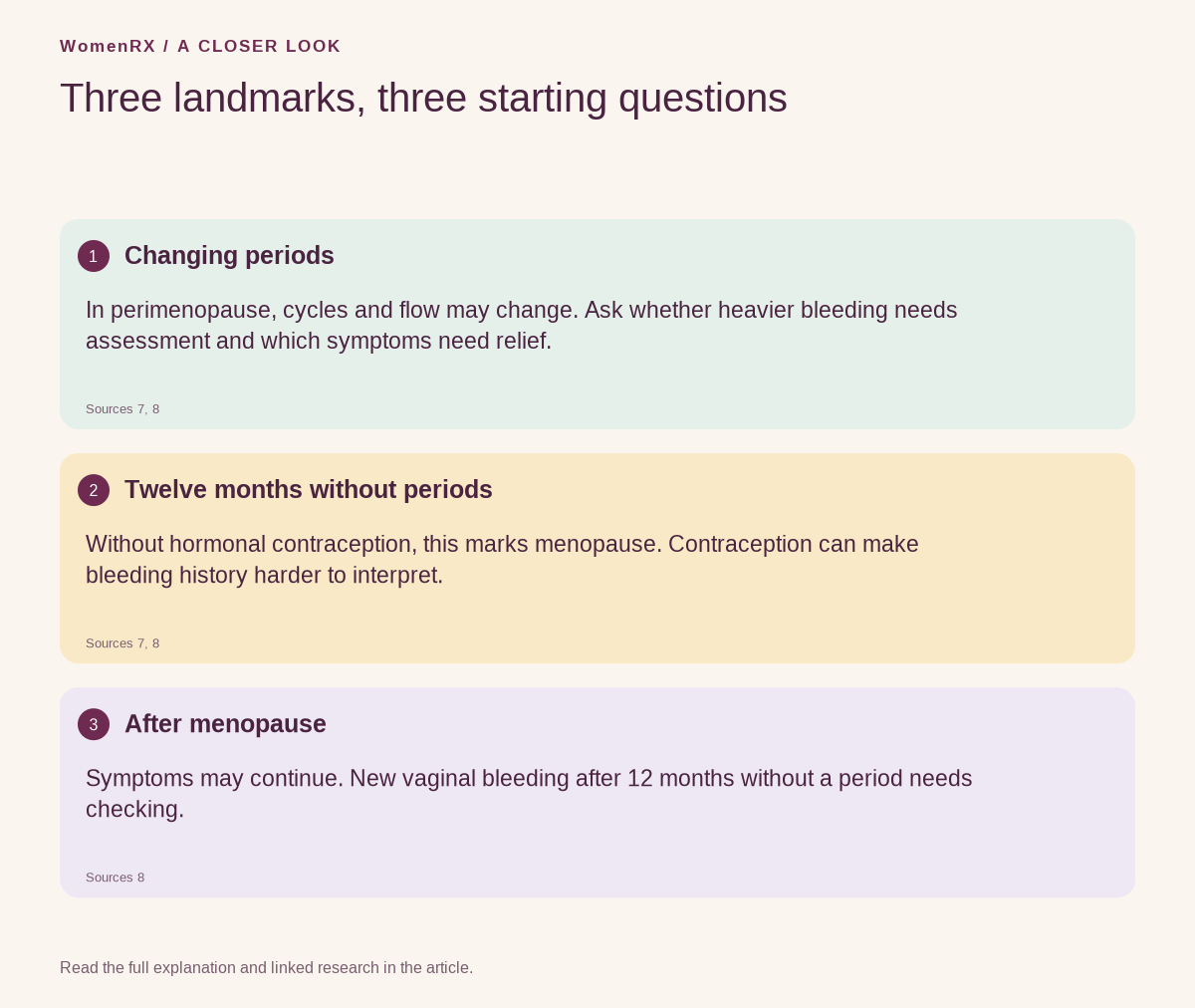
Changing periods: In perimenopause, cycles and flow may change. Ask whether heavier bleeding needs assessment and which symptoms need relief.78
Twelve months without periods: Without hormonal contraception, this marks menopause. Contraception can make bleeding history harder to interpret.78
After menopause: Symptoms may continue. New vaginal bleeding after 12 months without a period needs checking.8
Read the figure as text
Use the stage that best fits your current bleeding history, then follow the question most relevant to you. Symptoms don’t follow a fixed schedule.- Changing periods: In perimenopause, cycles and flow may change. Ask whether heavier bleeding needs assessment and which symptoms need relief.78
- Twelve months without periods: Without hormonal contraception, this marks menopause. Contraception can make bleeding history harder to interpret.78
- After menopause: Symptoms may continue. New vaginal bleeding after 12 months without a period needs checking.8
More questions, answered
Can I still get pregnant during perimenopause?
Yes. Periods may be unpredictable, but pregnancy is still possible during perimenopause. If you want to avoid pregnancy, don’t treat irregular periods as proof that contraception is no longer needed. Hormonal contraception can also make it harder to tell when you’ve reached menopause. 8
What if menopause seems to be starting before 45?
Menopause can happen before 45, sometimes after surgery to remove the ovaries and sometimes without a known reason. Because age and medical history affect how the change is assessed and managed, bring up new cycle changes or symptoms rather than assuming they’re routine perimenopause. 76
Sources you can check
- Managing menopause.Reid R, Abramson BL, Blake J, Desindes S, Dodin S, Johnston S, Rowe T, Sodhi N, Wilks P, Wolfman W, MENOPAUSE AND OSTEOPOROSIS WORKING GROUP. · Journal of obstetrics and gynaecology Canada : JOGC = Journal d'obstetrique et gynecologie du Canada : JOGC · 2014Return to first citation
- Redefining menopausal care: a randomized trial of group CBT for vasomotor symptoms in Korean women.Jung D, Park JY, Chung KM, Kim MR. · Climacteric : the journal of the International Menopause Society · 2026Return to first citation
- Factors Associated With Menopause Symptoms: A Systematic Review and Meta-Analysis.Hoang J, Halliday K, Allen D, Mtika WM, Tranter E, Glover G, Tatnell L, Hippisley-Cox J, Coupland C, Hillman S, Hirst J. · BJOG : an international journal of obstetrics and gynaecology · 2026Return to first citation
- Considerations and practical recommendations for identifying perimenopause in longitudinal research.Huibregtse ME, Taylor L, Prochaska T, Arnold AR, Epperson CN, Chahine EB, Smith AK, Powers A, Michopoulos V, Stevens JS. · Psychoneuroendocrinology · 2026Return to first citation
- Cognitive functioning in perimenopause: An updated systematic review and meta-analysis.Bangle A, Williams D, Walters J, Nguyen L. · Psychology and aging · 2026Return to first citation
- Recommendations | Menopause: identification and management | Guidance | NICEAccessed 2026-09-25Return to first citation
- What are menopause and perimenopause? - NHSAccessed 2026-09-25Return to first citation
- Symptoms of menopause and perimenopause - NHSAccessed 2026-09-25Return to first citation
- Hormone Therapy for Menopause | MedlinePlusAccessed 2026-09-25Return to first citation