How Perimenopause Is Assessed and When Tests Help
Changing periods and new hot flashes often tell a clinician more than a single hormone result, but age, contraception, and bleeding patterns can change the assessment.
Perimenopause is usually assessed through your age, changes in your periods, and symptoms such as newly starting hot flashes or night sweats. There’s no routine test that confirms it. Blood tests may be more useful when symptoms begin before 45 or when another cause needs checking. Hormonal contraception, a hysterectomy, or unusual bleeding changes what a clinician can learn from your cycle.6789

The first question is what has changed
Perimenopause is the transition leading up to your final period. Cycles often become less predictable: periods may come closer together or farther apart, and bleeding may be lighter or heavier. Hot flashes, night sweats, sleep problems, and mood changes can also be part of the picture. Menopause is different: it’s identified after 12 months without a period when you’re not using hormonal contraception.478
A clinician will usually start with your age and the pattern of change, rather than order a hormone panel. For example, if your periods have become less regular and you’ve recently begun having hot flashes, those clues together may point toward perimenopause. They don’t mean that every new symptom or change in bleeding should automatically be attributed to it.678
Why a single FSH result rarely settles it
Follicle-stimulating hormone, or FSH, is sometimes discussed as a “menopause test.” But there’s no routine blood test for perimenopause or menopause, and an FSH result isn’t a universal answer to whether you’re in the transition. Clinical guidance instead emphasizes symptoms and menstrual history, with testing considered in particular circumstances.67
Age is one circumstance that matters. If you’re under 45 and having symptoms that suggest early menopause, a clinician may sometimes order blood tests. If you’re under 40, the question may be premature ovarian insufficiency rather than the usual midlife transition. NICE guidance calls for elevated FSH on two blood samples taken 4 to 6 weeks apart to diagnose that condition; it specifically says not to rely on a single result.69
That distinction is useful when deciding what you want a test to answer. “Could this be perimenopause?” and “Could my ovarian function be changing unusually early?” aren’t quite the same question. Testing may also be directed at another possible explanation for changed periods, rather than at confirming perimenopause itself.3679
When your period history is harder to read
Hormonal contraception can change or stop bleeding, so the pattern you see may reflect the method as well as any menopausal transition. A hormonal IUD or contraceptive injection can make periods irregular or stop them; a combined pill can produce monthly bleeding while you take it. NICE advises against using FSH to identify menopause in people using combined estrogen-progestogen contraception or high-dose progestogen.68
If you’ve had a hysterectomy, you can’t use a final period as a marker. A clinician may instead consider the type and combination of symptoms you’re having, including hot flashes. It’s also worth distinguishing a hysterectomy from surgery to remove the ovaries: removal of the ovaries can cause early menopause.69
Changed bleeding may need its own assessment
Irregular periods can happen during perimenopause, but the amount and timing of bleeding still matter. Heavy bleeding that affects your daily life, severe period pain, or bleeding between periods or after sex deserves assessment rather than a blanket explanation of “hormones.” Bleeding after you’ve gone more than 12 months without a period also needs checking, even if it’s only spotting.18
Depending on your history, an evaluation of abnormal bleeding may include a pregnancy test, a blood count to look for anemia, or a thyroid test. Persistent symptoms or findings on examination may lead to imaging; sometimes the lining of the uterus needs to be sampled. These tests look for causes or effects of bleeding, not for a positive or negative perimenopause result. Fibroids and other conditions can coexist with changes associated with perimenopause.1235
The practical starting point is to describe what changed: the spacing of your periods, how much you bleed, symptoms that are new for you, and whether contraception or surgery makes your cycle difficult to interpret. Those details help determine whether a clinical assessment is enough, whether testing could clarify an early transition, or whether the bleeding itself needs investigation.13689
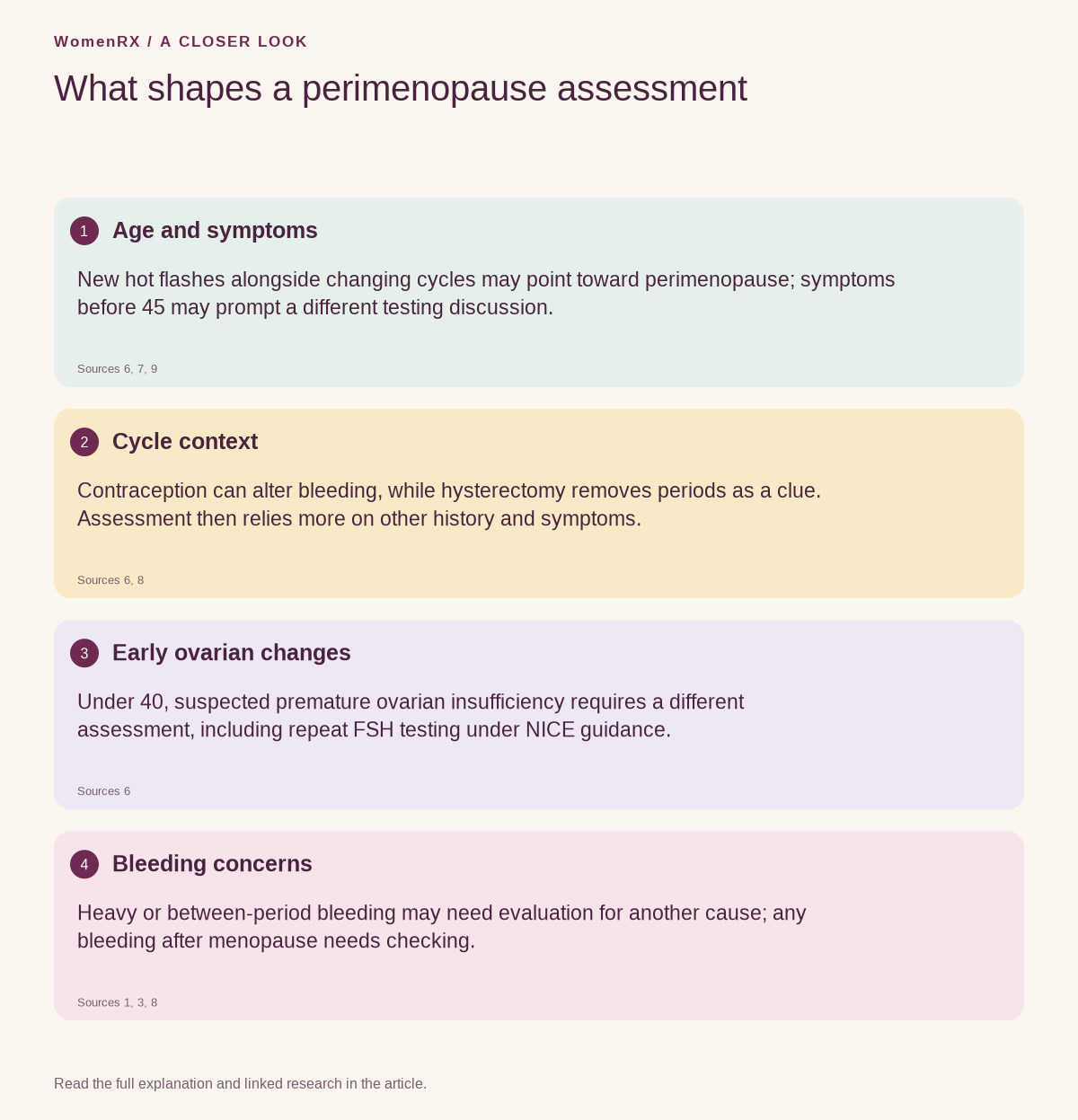
What shapes a perimenopause assessment
Age and symptoms: New hot flashes alongside changing cycles may point toward perimenopause; symptoms before 45 may prompt a different testing discussion.679
Cycle context: Contraception can alter bleeding, while hysterectomy removes periods as a clue. Assessment then relies more on other history and symptoms.68
Early ovarian changes: Under 40, suspected premature ovarian insufficiency requires a different assessment, including repeat FSH testing under NICE guidance.6
Bleeding concerns: Heavy or between-period bleeding may need evaluation for another cause; any bleeding after menopause needs checking.138
Read the figure as text
Follow the question each part of the history helps answer; the paths can overlap.- Age and symptoms: New hot flashes alongside changing cycles may point toward perimenopause; symptoms before 45 may prompt a different testing discussion.679
- Cycle context: Contraception can alter bleeding, while hysterectomy removes periods as a clue. Assessment then relies more on other history and symptoms.68
- Early ovarian changes: Under 40, suspected premature ovarian insufficiency requires a different assessment, including repeat FSH testing under NICE guidance.6
- Bleeding concerns: Heavy or between-period bleeding may need evaluation for another cause; any bleeding after menopause needs checking.138
More questions, answered
Can I still get pregnant if I think I’m in perimenopause?
Yes. Pregnancy is still possible during perimenopause, so an unexpected missed period shouldn’t automatically be taken as proof that you’ve reached menopause. A pregnancy test may be part of an assessment of abnormal bleeding when relevant.38
Sources you can check
- Heavy periods - NHSAccessed 2026-09-25Return to first citation
- Evaluation and Treatment Options for Abnormal Uterine Bleeding in Premenopausal Patients With a History of Breast Cancer.Nelis M, Chichura A. · O&G open · 2026Return to first citation
- 2020 Hong Kong College of Obstetricians and Gynaecologists guideline on investigations of premenopausal women with abnormal uterine bleeding.Lee JHS, Cheng EOL, Choi KM, Ngu SF, Cheung RYK, Hong Kong College of Obstetricians and Gynaecologists. · Hong Kong medical journal = Xianggang yi xue za zhi · 2020Return to first citation
- Hormone Therapy for the Primary Prevention of Chronic Conditions in Postmenopausal Persons: US Preventive Services Task Force Recommendation Statement.US Preventive Services Task Force, Mangione CM, Barry MJ, Nicholson WK, Cabana M, Caughey AB, Chelmow D, Coker TR, Davis EM, Donahue KE, Jaén CR, Kubik M, Li L, Ogedegbe G, Pbert L... · JAMA · 2022Return to first citation
- Complex benign gynecology in perimenopause: current evidence and future directions.Goren R, Shats M, Ciesielski K, Siedhoff M, Meyer R. · Current opinion in obstetrics & gynecology · 2026Return to first citation
- Recommendations | Menopause: identification and management | Guidance | NICEAccessed 2026-09-25Return to first citation
- What are menopause and perimenopause? - NHSAccessed 2026-09-25Return to first citation
- Symptoms of menopause and perimenopause - NHSAccessed 2026-09-25Return to first citation
- Early or premature menopause - NHSAccessed 2026-09-25Return to first citation