Do Estrogen Levels Need to Be Tested During Perimenopause or Menopause?
An estradiol result is a snapshot, and its usefulness depends on what question it’s meant to answer.
Usually, one estradiol test can’t confirm perimenopause or show that a symptom is caused by estrogen. Estradiol and FSH fluctuate during the transition, so menstrual history and age may be more useful for identifying it. After menopause, a result still needs context: it doesn’t by itself explain symptoms or determine whether hormone therapy is right for you. 3 4 2
First ask what the test is meant to answer
An estradiol blood test measures the level in one sample. It doesn’t summarize how your levels have changed over time. That distinction matters because hormone levels can fluctuate during perimenopause, alongside changes in cycle length and ovulation. 4
If the question is whether you’re in perimenopause, one estradiol result usually won’t settle it. In a retrospective study of 116 women seen at a menopause clinic, FSH and estradiol levels weren’t accurate enough by themselves to rule perimenopause in or out. The study authors pointed to age and menstrual history as more useful context. 3
If you still have regular or changing cycles
A blood draw is a snapshot taken during a cycle that may be changing. Estradiol can be maintained or increased earlier in the transition, while estradiol and FSH fluctuate more as perimenopause progresses. So a result that looks high or low on one day may not describe the larger pattern. 4
If you’re having regular periods, ask why the test is being ordered and whether the timing of the blood draw matters for that particular question. If the only goal is to identify perimenopause, a single hormone result may add less than your age and menstrual history. 3 4
If your periods have ended
A single estradiol result tells you the level measured in that blood sample. It cannot, by itself, show that a symptom is caused by estrogen or determine whether menopause hormone therapy is appropriate. A small retrospective clinic study found different average estradiol levels among women classified as perimenopausal, naturally postmenopausal, or postmenopausal after surgery. Those group averages do not establish a personal cutoff or tell you what is causing your symptoms. 3
For hormone therapy, the North American Menopause Society describes decisions as individualized. Symptoms and factors such as age, time since menopause, and treatment type and route are part of weighing benefits and risks. The guidance does not make one estradiol result the treatment decision. 2
If you use estradiol medicine
Tell the person ordering the test what estradiol product you use. For example, prescribing information for one estradiol patch reports measurable serum estradiol in postmenopausal women using that product. That illustrates why treatment context matters, but it does not establish how every estrogen product or testing situation will affect a result. 1
A quick decision path
- The question is “Am I in perimenopause?” Start with age and menstrual history. A single estradiol or FSH result may not answer it. 3 4
- Your cycles are changing. Ask how the timing of the test relates to its purpose; hormone levels can fluctuate during the transition. 4
- Your periods have ended and you have symptoms. A result alone can’t identify the cause of those symptoms or choose treatment. Ask what decision the test is meant to inform. 2 3
- You use estradiol. Share the product and route so the result can be considered alongside treatment. 1
Before testing, one useful question is: “What would we do differently depending on the result?” If there isn’t a clear answer, ask how the test could change the next step in your care.
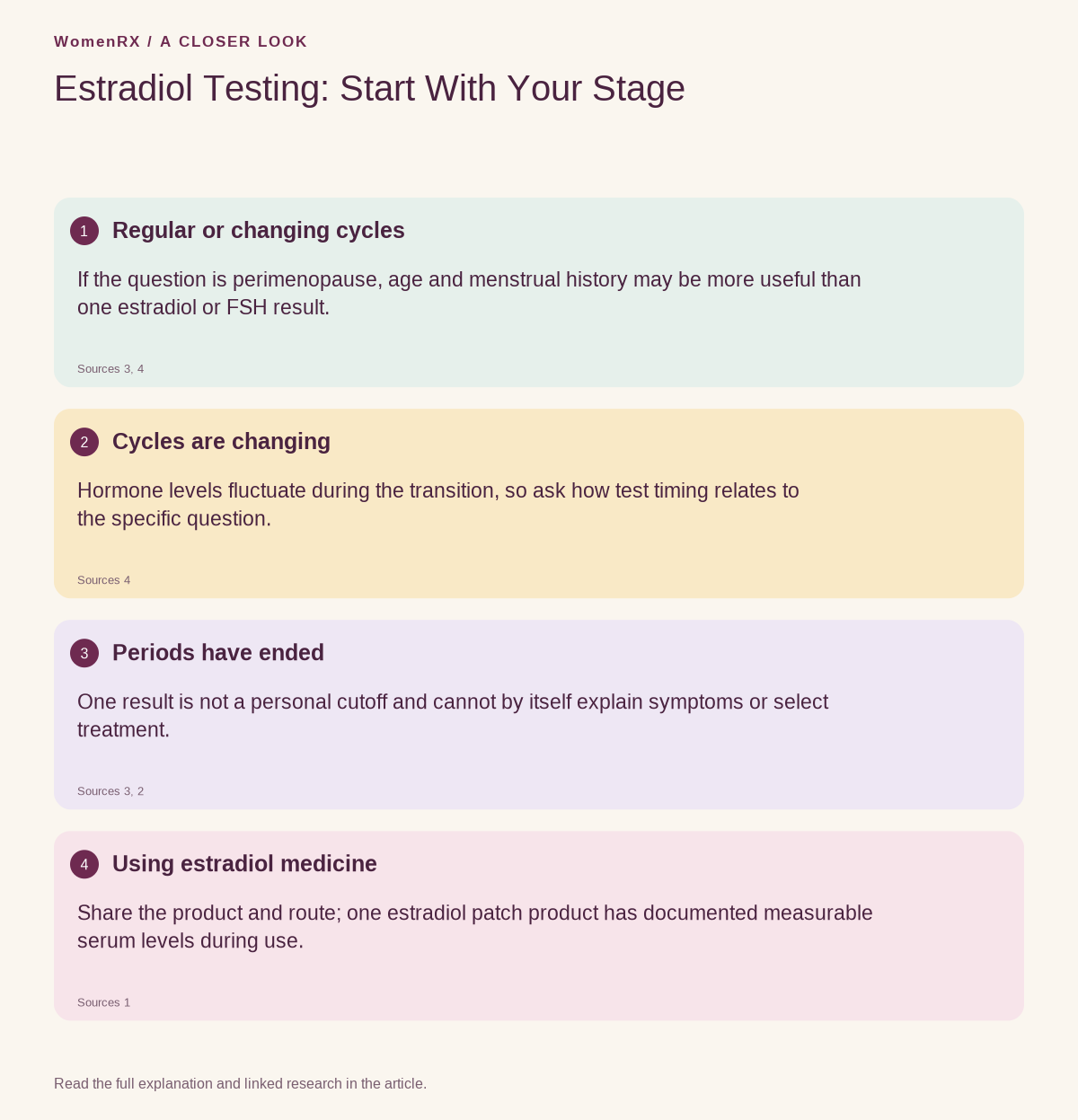
Estradiol Testing: Start With Your Stage
Regular or changing cycles: If the question is perimenopause, age and menstrual history may be more useful than one estradiol or FSH result.34
Cycles are changing: Hormone levels fluctuate during the transition, so ask how test timing relates to the specific question.4
Periods have ended: One result is not a personal cutoff and cannot by itself explain symptoms or select treatment.32
Using estradiol medicine: Share the product and route; one estradiol patch product has documented measurable serum levels during use.1
Read the figure as text
Follow the life-stage path to see what a single result may help answer and where it has limits.- Regular or changing cycles: If the question is perimenopause, age and menstrual history may be more useful than one estradiol or FSH result.34
- Cycles are changing: Hormone levels fluctuate during the transition, so ask how test timing relates to the specific question.4
- Periods have ended: One result is not a personal cutoff and cannot by itself explain symptoms or select treatment.32
- Using estradiol medicine: Share the product and route; one estradiol patch product has documented measurable serum levels during use.1
Sources you can check
- CLIMARA (ESTRADIOL) PATCH [BAYER HEALTHCARE PHARMACEUTICALS INC.] | US prescribing information and patient instructionsAccessed 2026-09-25Return to first citation
- The 2022 hormone therapy position statement of The North American Menopause Society.“The 2022 Hormone Therapy Position Statement of The North American Menopause Society” Advisory Panel. · Menopause (New York, N.Y.) · 2022Return to first citation
- Serum follicle stimulating hormone and estradiol in peri/postmenopausal women attending Siriraj Menopause Clinic: a retrospective study.Angsuwathana S, Tanmahasamut P, Rattanachaiyanont M, Dangrat C, Techatrisak K, Indhavivadhana S, Leerasiri P. · Journal of the Medical Association of Thailand = Chotmaihet thangphaet · 2006Return to first citation
- Nomenclature and endocrinology of menopause and perimenopause.Burger H, Woods NF, Dennerstein L, Alexander JL, Kotz K, Richardson G. · Expert review of neurotherapeutics · 2007Return to first citation