What an Estradiol Test Can Tell You About Menopause
An estradiol result shows the hormone level in one blood sample, but your cycle history and the reason for testing give it meaning.
An estradiol blood test measures a hormone that generally falls after menopause, but one result cannot tell the whole story. Estradiol changes across the menstrual cycle, and a low level can also occur for reasons other than menopause. The result is most useful alongside your period history, symptoms, medicines, and, when periods have stopped unexpectedly, other tests.34
A number is a snapshot, not a menopause diagnosis
Estradiol, often called E2 on a lab report, is an estrogen produced primarily by the ovaries during the cycling years. Levels change substantially within a menstrual cycle: they’re relatively low early in the cycle, rise before ovulation, and change again afterward. They’re generally much lower after menopause than before it.3
That makes the number useful, but also easy to overread. For example, a result collected early in a cycle may be lower than one collected near ovulation without either result settling whether you’re in perimenopause. Likewise, a low estradiol result doesn’t identify why a person has stopped having periods. The American Society for Reproductive Medicine (ASRM) describes low estradiol in both ovarian insufficiency and functional hypothalamic amenorrhea, a condition in which signals from the brain to the ovaries are reduced. Other hormone results help distinguish those patterns.34
If your report labels a value “normal,” ask what reference range it uses and whether that range fits your situation. A range is a comparison, not a verdict on your symptoms. Medicines can affect laboratory results, and the question a test is meant to answer matters to its interpretation.1
Why the reason for testing changes the answer
If you’re having symptoms and changing periods around the menopausal transition, the date and pattern of your periods provide context a single estradiol measurement cannot. A level drawn on one day can’t show the pattern across changing cycles. It may still contribute to an assessment, but it shouldn’t be treated as a stand-alone yes-or-no test.3
A different question arises if periods have stopped unexpectedly, particularly earlier in life. In an evaluation of absent periods, clinicians look beyond estradiol: the history can include previous cycle patterns, eating and exercise changes, stress, medications, and other symptoms. Testing may include pregnancy and thyroid tests as well as reproductive hormones.24 ASRM explains that estradiol considered with follicle-stimulating hormone (FSH) and other findings can help separate possible ovarian causes from other causes of absent periods. A low estradiol value with elevated gonadotropins points to a different pattern than low estradiol with low or low-normal gonadotropins.4
This is why your age and circumstances matter. A low result in someone whose periods stopped unexpectedly at a younger age raises a different set of questions from a low result after the menopausal transition. The test contributes to those questions; it doesn’t answer them by itself.34
Medicines and the measurement method matter
Tell the person interpreting the result if you use hormone therapy or other hormonal medicines. For a concrete example, an estradiol patch increased blood estradiol above baseline in studies of postmenopausal women described in its prescribing information. A measured level while using such a patch therefore isn’t simply a reading of estradiol your body made on its own.5
The laboratory method can matter too, especially when levels are low or a result seems out of step with the clinical picture. Mayo Clinic Laboratories notes that more sensitive estradiol assays are needed for some clinical uses. It also identifies a specific interference: the medicine fulvestrant can produce falsely high estradiol results with some immunoassays, while mass-spectrometry measurement has far less cross-reactivity.3 That doesn’t mean every unexpected result is a lab error. It means the medication list and the test method are worth checking before drawing a big conclusion from one number.
How to put your result to work
Bring the actual report, including its units and reference range, and describe what prompted the test. Was the question about symptoms during changing cycles, periods that stopped unexpectedly, or a result obtained while using hormone therapy? Those situations call for different interpretations.2345
The useful next question is: What does this result add to what we already know about my periods, symptoms, and medicines? If it doesn’t fit, ask whether the timing of the sample, other hormone findings, or the assay method could change its meaning. That turns a single number into one piece of a clearer assessment, rather than an answer you have to decode alone.34
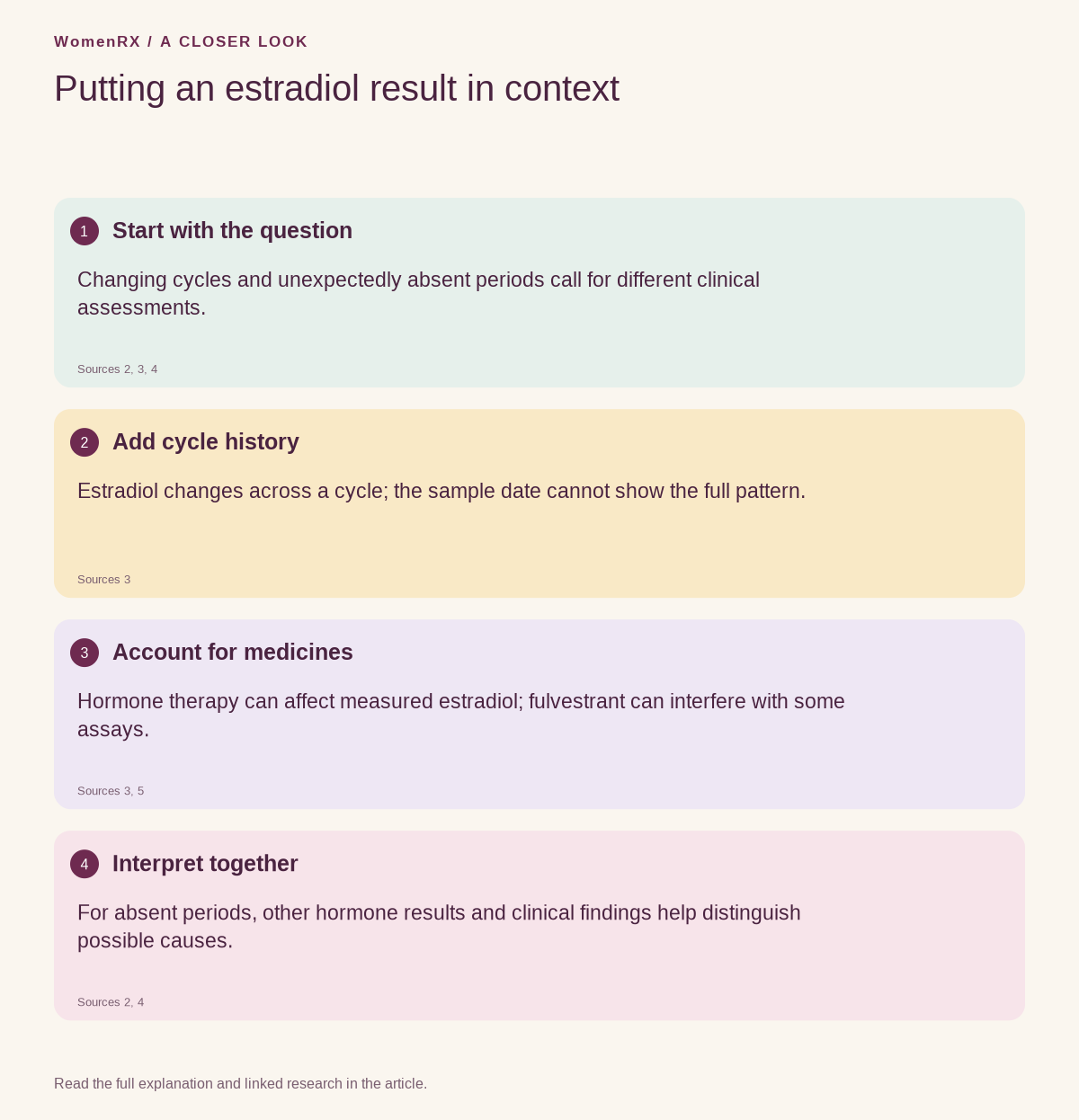
Putting an estradiol result in context
Start with the question: Changing cycles and unexpectedly absent periods call for different clinical assessments.234
Add cycle history: Estradiol changes across a cycle; the sample date cannot show the full pattern.3
Account for medicines: Hormone therapy can affect measured estradiol; fulvestrant can interfere with some assays.35
Interpret together: For absent periods, other hormone results and clinical findings help distinguish possible causes.24
Read the figure as text
A result becomes more useful when you connect it to the question that led to testing.- Start with the question: Changing cycles and unexpectedly absent periods call for different clinical assessments.234
- Add cycle history: Estradiol changes across a cycle; the sample date cannot show the full pattern.3
- Account for medicines: Hormone therapy can affect measured estradiol; fulvestrant can interfere with some assays.35
- Interpret together: For absent periods, other hormone results and clinical findings help distinguish possible causes.24
More questions, answered
Can low estradiol mean something other than menopause?
Yes. In people with absent periods, ASRM describes low estradiol both when ovarian function is reduced and in functional hypothalamic amenorrhea. FSH and other findings help distinguish the causes.4
Does a result marked “normal” rule out perimenopause?
No. Estradiol changes considerably across the menstrual cycle, so a result within the lab’s reference range describes that sample, not the pattern of your cycles or symptoms over time.13
Sources you can check
- Laboratory Tests: MedlinePlusAccessed 2026-09-25Return to first citation
- Amenorrhea: A Practical Approach to Diagnosis and Management.Klein DA, Sylvester JE, Paradise SL. · American family physician · 2026Return to first citation
- EEST - Overview: Estradiol, SerumAccessed 2026-09-25Return to first citation
- Current evaluation of amenorrhea: a committee opinion (2024) | American Society for Reproductive Medicine | ASRMAccessed 2026-09-25Return to first citation
- DOTTI (ESTRADIOL) PATCH, EXTENDED RELEASE [BRYANT RANCH PREPACK] | US prescribing information and patient instructionsAccessed 2026-09-25Return to first citation