Low or High Estradiol: What Your Result Can Tell You
An estradiol result makes more sense alongside the reason for the test, your menstrual or menopause stage, and any hormones you use.
An estradiol (E2) blood test measures a hormone that changes across the menstrual cycle and with the transition to menopause. A result marked low or high needs the test’s reference range and your circumstances to mean much. One number cannot identify the cause of a symptom or, by itself, determine whether you need hormone treatment. 567
Start with what the test was meant to answer
An estradiol result is a measurement at one moment, not a verdict on your estrogen health. If you have periods, where you were in your cycle matters: estrogen rises as an egg develops and falls, along with progesterone, if pregnancy doesn’t occur. A result drawn near a period may therefore answer a different question from one drawn later in the cycle. 7
The laboratory’s reference range matters, too. Ranges are not a single universal definition of healthy estradiol. A 2025 laboratory-medicine review found that reference intervals for estradiol remain incomplete. In a study of adult women tested during part of the follicular phase, the researchers found that the estradiol interval did not transfer satisfactorily from the test manufacturer’s range to their study population. That’s a reason to read the number together with its units, the laboratory’s range, and the reason the test was ordered, rather than comparing it with an isolated number online. 56
What might a low result mean?
After menopause, a lower estradiol result has a different context than it does during the cycling years. Before menopause, ovarian follicles are the main source of estradiol. After menopause, the pattern of estrogen production changes, and estrone becomes a more abundant circulating estrogen than estradiol. A low result alone cannot establish why it was measured or what caused a symptom; read it alongside the reason for testing and the laboratory’s reference range. 1256
If you still have periods, a low result deserves a more specific question: low compared with what was expected at the time of the draw? Estradiol changes over the cycle, so a single measurement cannot show whether a lower value is your usual pattern or an unexpected finding. Menstrual history and the purpose of the test help determine what the result can contribute. 67
If you are in perimenopause and still having periods, cycle timing remains relevant to a blood draw. One estradiol result cannot establish whether symptoms reflect the menopause transition. 57
If the test was ordered because of hot flashes or other possible menopause symptoms, the number may not settle whether those symptoms are menopause-related. A laboratory-medicine review reports that measuring estradiol does not generally help guide care for women who may be experiencing menopausal symptoms or who take hormone therapy. Treatment decisions for bothersome symptoms are individualized rather than based on reaching a particular estradiol result. 53
What might a high result mean?
First, check what “high” is being compared with. Estradiol rises during a menstrual cycle, and a reference range that does not fit the timing of your sample may make a result look more surprising than it is. That does not mean every high result is explained by cycle timing; it means the label alone cannot identify a cause. 67
Hormone use can change the question as well. Estradiol is used in prescription hormone products, and a laboratory review identifies exogenous estrogen use in several settings. Tell the clinician interpreting your test which hormones you use and why the test was ordered. A blood value measured during treatment should not automatically be judged against expectations for someone who is not using hormones. 25
Pregnancy needs a different comparison from a nonpregnant menstrual-cycle result. The follicular-phase reference-interval study reports results for women sampled during cycle days 3 to 15; it does not establish a pregnancy reference range. 6
Fertility treatment has its own context. In a randomized trial of women undergoing frozen embryo transfer, estradiol levels on the day of transfer differed between treatment regimens. That finding shows why the treatment plan can matter when interpreting a result; it does not provide a general pregnancy range or reveal what caused an individual high reading. 4
Use the result to sharpen the next question
A useful interpretation brings three things together: the question that prompted testing, what was happening in your body when blood was drawn, and what comparison the laboratory used. For example, if your report flags a value as low but you have regular periods, the useful question is whether the draw’s cycle timing fits the comparison being made. If you’re postmenopausal and seeking help for hot flashes, ask how the result changes the discussion, if at all, since symptom care is not guided by an estradiol target alone. 567
The number alone cannot distinguish among possible underlying causes. Ask what finding the test was intended to check and what other information would actually change the clinician’s interpretation. That keeps the focus on your situation, not just the flag beside a lab value.
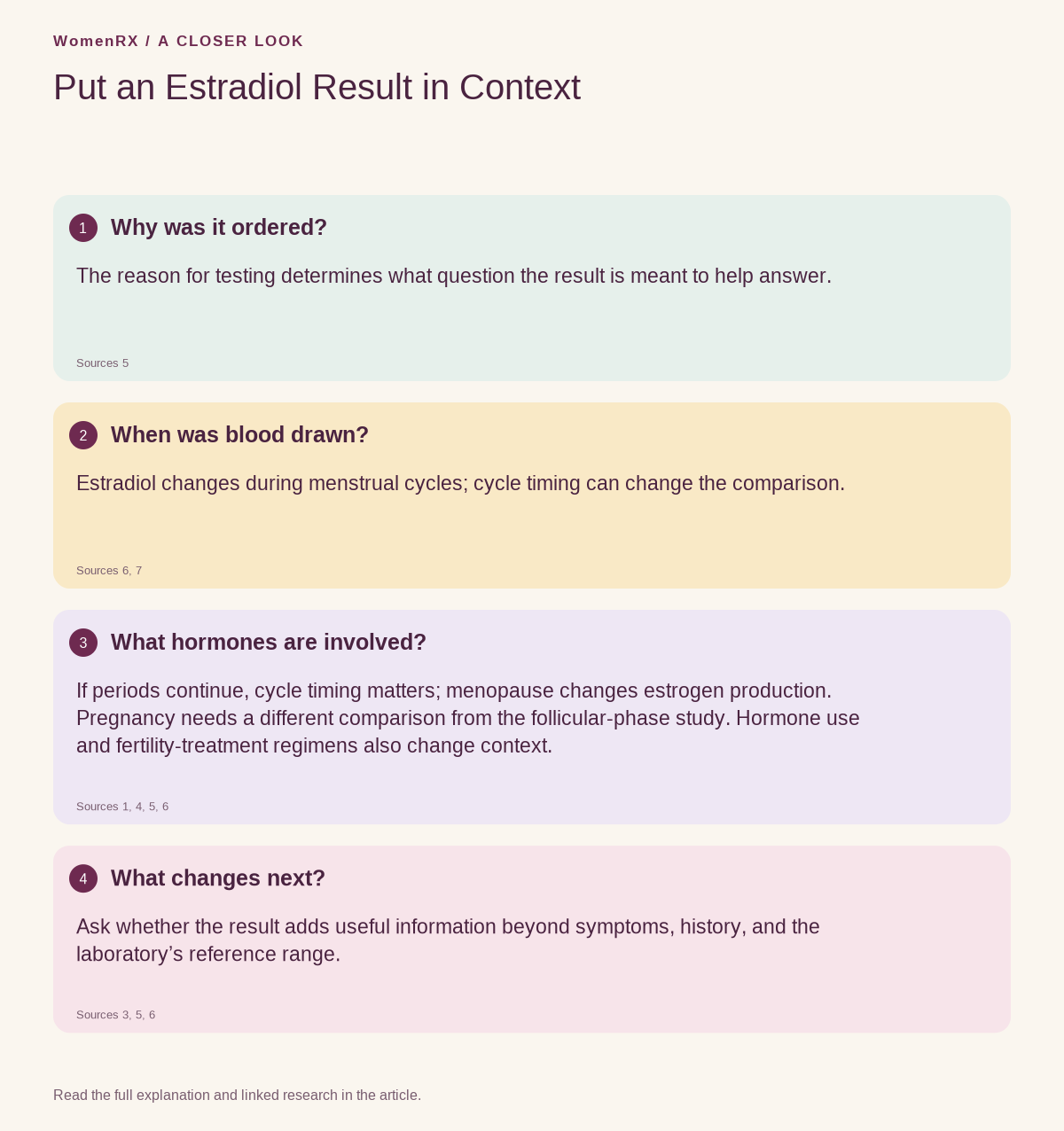
Put an Estradiol Result in Context
Why was it ordered?: The reason for testing determines what question the result is meant to help answer.5
When was blood drawn?: Estradiol changes during menstrual cycles; cycle timing can change the comparison.67
What hormones are involved?: If periods continue, cycle timing matters; menopause changes estrogen production. Pregnancy needs a different comparison from the follicular-phase study. Hormone use and fertility-treatment regimens also change context.1456
What changes next?: Ask whether the result adds useful information beyond symptoms, history, and the laboratory’s reference range.356
Read the figure as text
These questions show why the same flagged result can lead to different interpretations.- Why was it ordered?: The reason for testing determines what question the result is meant to help answer.5
- When was blood drawn?: Estradiol changes during menstrual cycles; cycle timing can change the comparison.67
- What hormones are involved?: If periods continue, cycle timing matters; menopause changes estrogen production. Pregnancy needs a different comparison from the follicular-phase study. Hormone use and fertility-treatment regimens also change context.1456
- What changes next?: Ask whether the result adds useful information beyond symptoms, history, and the laboratory’s reference range.356
Sources you can check
- CLIMARA PRO (ESTRADIOL AND LEVONORGESTREL) PATCH [BAYER HEALTHCARE PHARMACEUTICALS INC.] | US prescribing information and patient instructionsAccessed 2026-09-25Return to first citation
- CLIMARA (ESTRADIOL) PATCH [BAYER HEALTHCARE PHARMACEUTICALS INC.] | US prescribing information and patient instructionsAccessed 2026-09-25Return to first citation
- The 2022 hormone therapy position statement of The North American Menopause Society.“The 2022 Hormone Therapy Position Statement of The North American Menopause Society” Advisory Panel. · Menopause (New York, N.Y.) · 2022Return to first citation
- Estradiol and progesterone levels in early pregnancy after modified natural, programmed, and gonadotrophin-stimulated frozen embryo transfer cycles: a randomized controlled trial.Mørch NF, Udengaard H, Borch ML, Saltoft Skovrup M, Nøhr B, Svendsen PF. · Human reproduction (Oxford, England) · 2025Return to first citation
- A Comprehensive Review of Estradiol, Progesterone, Luteinizing Hormone, and Follicle-Stimulating Hormone in the Context of Laboratory Medicine to Support Women's Health.Greene DN, Ahmed SB, Daccarett S, Kling JM, Lorey TS, Rytz CL, Smock KJ, Winston-McPherson G. · Clinical chemistry · 2025Return to first citation
- Reference intervals of the sex hormonal profile in healthy women: A retrospective single-center study in Peru.Moya-Salazar J, Cerda SP, Cañari B, Moya-Salazar MM, Contreras-Pulache H. · Heliyon · 2022Return to first citation
- Periods and fertility in the menstrual cycle - NHSAccessed 2026-09-25Return to first citation