Grip Strength: What One Result Can Tell You
A grip-strength score can offer a useful clue about muscle function, but its meaning depends on how it was measured and who you’re being compared with.
Grip strength is a quick measure of how much force you can produce with your hand. It can help screen for muscle weakness and changes in physical function, but one score can’t diagnose a condition or predict your individual lifespan. Ask how the test was done, compare it with an appropriate age- and sex-based reference, and pay attention to whether everyday tasks are getting harder. 3 4
What the number measures
A handgrip test uses a handheld dynamometer to measure how firmly you can squeeze. It’s a practical way to assess hand and forearm strength, and it can serve as a clue to broader muscle function. It’s a screening measure, though, not a complete picture of how you move or manage daily activities. 3 4
A score is easier to interpret when you know the testing method. Studies may test the dominant or non-dominant hand, ask for more than one squeeze, and use either the highest result or an average. Posture and instructions matter too. For example, one study protocol tested the non-dominant hand while seated, with the elbow bent, and averaged three attempts; a study of older adults used the dominant hand and recorded the higher of two attempts. Those methods can produce results that aren’t directly interchangeable. 1 4
If you’re comparing results over time, ask whether the same hand, device, position, and scoring method were used. A result taken under different conditions may look like a change even when the testing itself changed. In people receiving hemodialysis, for instance, average grip strength was lower at the end of a session than at the beginning. That finding applies to that specific group, but it illustrates why the timing and circumstances of a test can matter. 2
Compare like with like
Grip strength differs across age and sex groups, so a result needs a relevant reference group. It also matters where that reference came from. A study of adults recruited from a respiratory rehabilitation center in Lima, Peru, reported age- and sex-specific patterns and lower values than commonly used international reference standards. A separate study of community-dwelling Malaysian adults aged 60 and older found that two different definitions of “low” grip strength classified quite different proportions of participants. These results show why a cutoff developed in one population may not fit everyone. They are not, by themselves, US reference values. 3 4
There’s also a difference between a reference value and a diagnostic threshold. A reference describes how a measured group performed. A threshold is meant to help identify people at risk. In the Lima study, the proposed cutoff was based on a percentile in a cross-sectional sample, not validated against future outcomes. In the Malaysian study, both definitions were associated with sarcopenia-related outcomes, but their relative clinical value still needs longitudinal confirmation. A low result can prompt a closer look; it doesn’t establish a diagnosis on its own. 3 4
A clue about function, not a personal forecast
Lower grip strength can be relevant because strength is one part of physical function. But one hand squeeze doesn’t measure walking, balance, leg strength, or how you handle daily tasks. Even research that follows grip strength over time measures one aspect of function alongside others, such as walking speed and chair-rise performance. 6
That distinction matters when you hear that grip strength is linked with health or aging. Associations seen across groups can help researchers identify patterns, but they don’t tell you exactly what will happen to one person. A single result isn’t a longevity test. 3 4
When a change deserves attention
A result is more worth following up when it fits a change you’ve noticed, such as increasing difficulty opening jars, carrying groceries, or turning a key, or when repeat tests show a decline using a comparable method. If a result is labeled low, ask which reference was used and whether it matches your age and sex. You can also ask whether the finding should be considered alongside other measures of movement or strength rather than on its own.
Pain or difficulty performing the squeeze can affect whether a test reflects your usual strength; research protocols have excluded people unable to make a valid effort for those reasons. Mention these circumstances when discussing a result, since they change how confidently it can be interpreted. 5
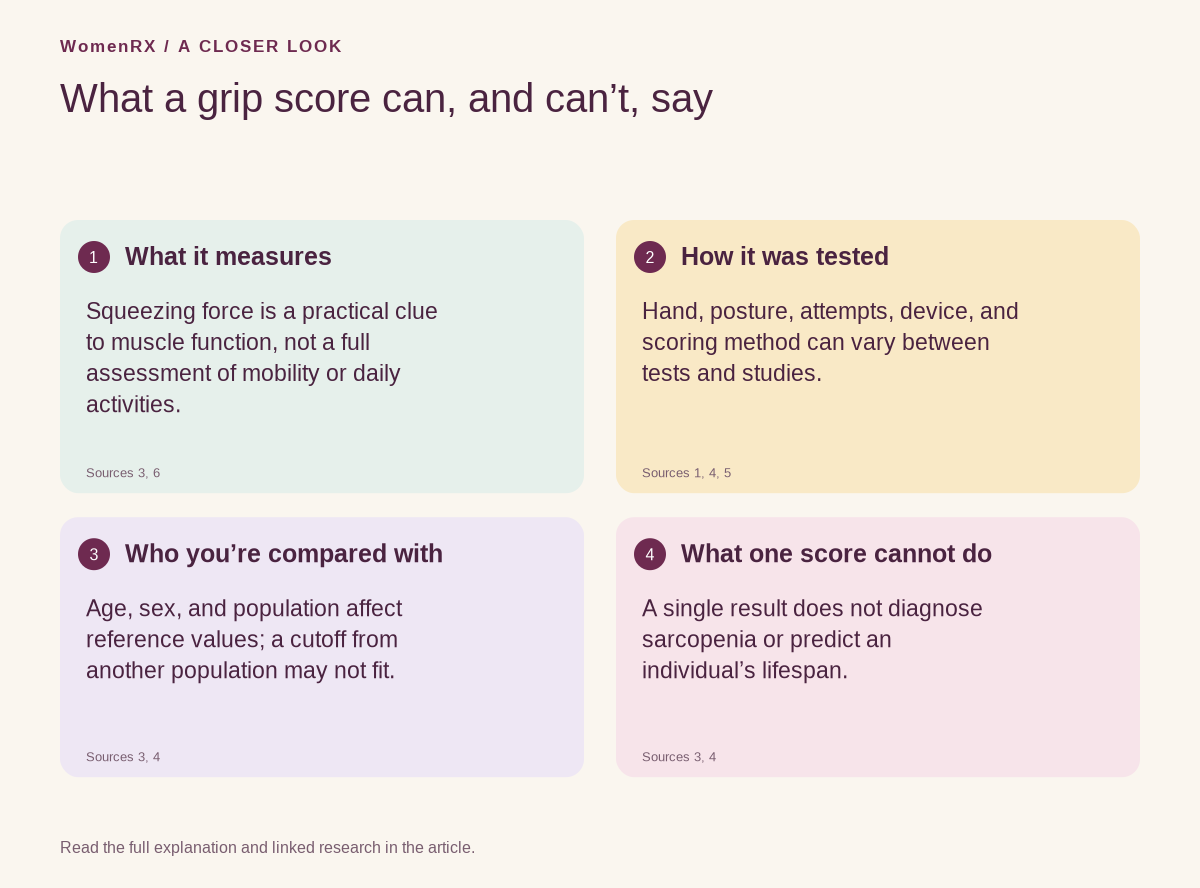
What a grip score can, and can’t, say
What it measures: Squeezing force is a practical clue to muscle function, not a full assessment of mobility or daily activities.36
How it was tested: Hand, posture, attempts, device, and scoring method can vary between tests and studies.145
Who you’re compared with: Age, sex, and population affect reference values; a cutoff from another population may not fit.34
What one score cannot do: A single result does not diagnose sarcopenia or predict an individual’s lifespan.34
Read the figure as text
A grip test offers one piece of information about strength. These distinctions help put a score in context before treating it as a diagnosis or prediction.- What it measures: Squeezing force is a practical clue to muscle function, not a full assessment of mobility or daily activities.36
- How it was tested: Hand, posture, attempts, device, and scoring method can vary between tests and studies.145
- Who you’re compared with: Age, sex, and population affect reference values; a cutoff from another population may not fit.34
- What one score cannot do: A single result does not diagnose sarcopenia or predict an individual’s lifespan.34
More questions, answered
Does a low grip-strength result mean I have sarcopenia?
No. Grip strength can be part of screening for muscle weakness, but a score alone doesn’t establish sarcopenia. The threshold used and the rest of your functional picture matter. 3 4
Why might two grip-strength tests give different results?
The hand tested, device, posture, instructions, number of attempts, and whether the highest or average attempt is recorded can differ. Health circumstances and test timing can matter too, as shown in a study of people receiving hemodialysis. 1 2 4
Sources you can check
- Effectiveness of intensive perioperative nutrition therapy among adults undergoing gastrointestinal and oncological surgery in a public hospital: study protocol for a pragmatic randomized control trial.A'zim AZA, Zaid ZA, Yusof BNM, Jabar MF, Shahar ASM. · Trials · 2022Return to first citation
- Impact of hemodialysis session on handgrip strength.Pinto AP, Ramos CI, Meireles MS, Kamimura MA, Cuppari L. · Jornal brasileiro de nefrologia · 2015Return to first citation
- Handgrip strength reference values and dynapenia risk thresholds in an urban adult sample from Lima, Peru.Chero-Pisfil SL, Díaz-Mau AY, Huamanchumo-Barrientos VE, Samame-Pérez RM, Sosa-Quispe EE, Tipula-Tipula EM, Rueda-Villegas ÁE, Munarriz-Medina R, Esquinas A. · Frontiers in rehabilitation sciences · 2026Return to first citation
- Rethinking Low Handgrip Strength: Normative Values, Diagnostic Thresholds, and Sarcopenia Risk in Malaysian Older Adults.Ooi TC, Rivan NFM, Shahar S, Ibrahim AM, Singh DKA. · Clinical interventions in aging · 2026Return to first citation
- Extracellular water may increase with age and be independently and negatively associated with muscle strength and physical function in older adults: A cross-sectional study.Asano Y, Yoshida T, Tsunoda K, Yokoyama K, Watanabe Y, Yoshinaka Y, Okura T, Kimura M, Yamada Y. · Physiological reports · 2026Return to first citation
- Trajectories of physical function and biological aging in generally healthy older adults with and without incident invasive cancer over a three-year follow-up: findings from the DO-HEALTH study.Rösler W, Kistler-Fischbacher M, Gängler S, Manz MG, Reto KW, Orav JE, Dawson-Hughes B, Ryan J, Belsky DW, Horvath S, Willett WC, Wieczorek M, Bischoff-Ferrari HA. · npj aging · 2026Return to first citation