Sarcopenia: What Muscle Assessments Can Tell You
A useful assessment separates muscle strength, muscle quantity, and everyday performance instead of treating any age-related muscle change as a diagnosis.
Sarcopenia assessment starts with muscle strength, then checks muscle quantity to confirm the diagnosis; poor physical performance can indicate a more severe problem. Grip strength, chair-rise ability, and muscle-mass measurements each answer different questions. For women, the reference values matter, but cutoffs developed in one study aren't universal standards. Ask which criteria and reference population are being used. 5 3
Three measures, three different questions
Muscle health isn’t captured by one number. In a framework summarized in a recent systematic review, low strength raises suspicion of sarcopenia; low muscle quantity confirms it; and impaired physical performance marks a more severe level. These features can occur separately, so a change in muscle size alone doesn’t establish sarcopenia. 5
A clinician might assess strength with a grip test. Muscle quantity can be estimated using methods such as bioelectrical impedance. Performance looks at what happens when you move, such as how readily you can rise from a chair or walk. Each provides a different piece of the picture. 5 3
That distinction can matter in everyday life. For example, a woman may notice she needs her arms to push up from a low chair, even if her weight and appearance haven’t changed much. That observation is worth discussing, but it isn’t a diagnosis by itself.
How reference values affect results for women
Strength results are interpreted against a threshold, not in isolation. The cutoff matters because a result considered low under one standard may not be classified the same way under another. A recent study of community-dwelling older adults used age- and sex-specific cutoffs for a research measure called muscle-specific strength, which relates grip strength to arm muscle mass. Its thresholds were based on that study’s own sample, not established as universal cutoffs for women. 3
The study also found that people with low muscle-specific strength could have more muscle mass but weaker grip. This illustrates why muscle quantity alone can miss a strength problem. However, the study’s findings do not set a general clinical standard: it included men and women, and the reported association with impaired chair-rise performance was especially evident in men and participants aged 65 or older. It does not tell us exactly how well that measure identifies sarcopenia in older women. 3
A useful question is: Which definition and reference values are you using, and are they appropriate for my age and sex? If results seem inconsistent, ask how strength, muscle quantity, and function fit together rather than relying on a single measurement.
What may help, and what supplements can’t replace
Resistance or functional exercise is a foundation of sarcopenia care. Research also asks whether protein or protein-related supplements add benefit to exercise. A 2026 review of 18 randomized trials involving 1,341 older adults with sarcopenia or elevated risk found that adding supplements to exercise improved grip strength and muscle-mass measures on average, but did not clearly improve timed up-and-go performance. The review rated the overall evidence as very low certainty, and it could not establish one best supplement strategy. 4
That means a supplement isn’t automatically the next step. The studies tested different products and programs, and the results varied by outcome. It’s reasonable to discuss food intake, exercise that fits your abilities, and whether a supplement is relevant to your situation, rather than assuming a product can restore strength or independence on its own. 4
Muscle loss can also have more than one contributor. The review describes factors including aging, reduced activity, inadequate nutrition, and chronic disease. Assessment can therefore include considering whether another health problem or nutritional issue is part of the picture, not just measuring muscle. 5
If you’re losing weight without trying, that deserves evaluation. Unintentional weight loss can have a range of causes, including illness or poor nutrition, and identifying the cause can guide what happens next. 1
The practical takeaway
A change in strength or mobility is a useful reason to ask about assessment, not proof that you have sarcopenia. The clearest explanation should connect three things: how strong you are, how much muscle you have, and how well you move. For women, ask what reference values were applied and whether those values have been shown to fit people like you. Then discuss exercise, nutrition, and possible underlying causes as parts of the same picture.
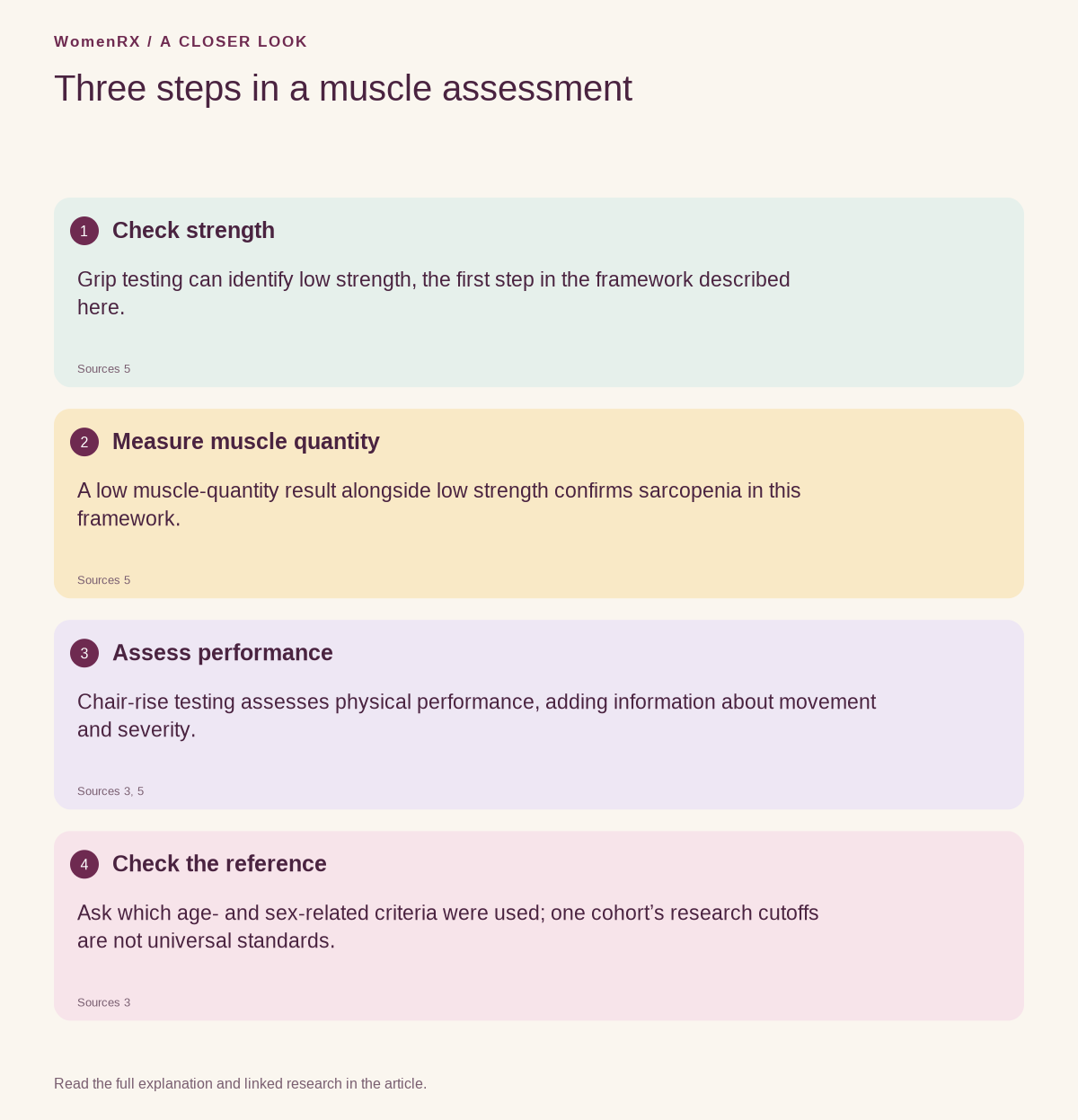
Three steps in a muscle assessment
Check strength: Grip testing can identify low strength, the first step in the framework described here.5
Measure muscle quantity: A low muscle-quantity result alongside low strength confirms sarcopenia in this framework.5
Assess performance: Chair-rise testing assesses physical performance, adding information about movement and severity.35
Check the reference: Ask which age- and sex-related criteria were used; one cohort’s research cutoffs are not universal standards.3
Read the figure as text
Each stage answers a different question: strength raises concern, muscle quantity helps confirm the diagnosis, and performance shows how much movement is affected.- Check strength: Grip testing can identify low strength, the first step in the framework described here.5
- Measure muscle quantity: A low muscle-quantity result alongside low strength confirms sarcopenia in this framework.5
- Assess performance: Chair-rise testing assesses physical performance, adding information about movement and severity.35
- Check the reference: Ask which age- and sex-related criteria were used; one cohort’s research cutoffs are not universal standards.3
More questions, answered
Does a normal body weight rule out muscle loss?
No. Body weight includes muscle, fat, bone, and water, so the scale alone can’t show whether muscle or strength has changed. 2
Does an abnormal chair-rise result diagnose sarcopenia?
Not on its own. Chair-rise testing measures physical performance, which adds information about function and severity. The framework described here uses low strength and low muscle quantity to identify sarcopenia, so a chair-rise result should be interpreted alongside those measures and the criteria used. 3 5
Sources you can check
- Unintentional weight loss - NHSAccessed 2026-09-25Return to first citation
- Body Weight: MedlinePlusAccessed 2026-09-25Return to first citation
- Muscle-Specific Strength Better Predicts Physical Performance Decline Than Conventional Metrics: The I-Lan Longitudinal Aging Study.Chien WK, Lee WJ, Liang CK, Yen KH, Peng LN, Lin MH, Loh CH, Hsiao FY, Chen LK. · Journal of cachexia, sarcopenia and muscle · 2025Return to first citation
- Comparative effectiveness of protein or protein-related supplementation combined with resistance or functional exercise for sarcopenia in older adults: a systematic review and network meta-analysis.Yang B, Chen X, Yuan G, Zhang X, Lu D. · Frontiers in nutrition · 2026Return to first citation
- Synergistic Effects of Protein Intake and Exercise on Biomarkers of Sarcopenia: A Systematic Review.Cruz-Pierard S, Iñiguez-Jiménez S. · Biomolecules · 2026Return to first citation