L-Theanine: What the Evidence Can Tell You
L-theanine has been studied most for sleep, but promising results don’t make it a proven treatment for insomnia or anxiety.
L-theanine is a tea-derived amino acid studied for sleep, anxiety, mood, and cognition. Sleep reviews find some improvement in self-reported sleep measures, while a small trial in people with generalized anxiety disorder found no advantage over placebo for anxiety. The research doesn’t establish effects specific to women, pregnancy or breastfeeding safety, long-term safety, or reliable interactions with medicines.
L-theanine is an amino acid found in tea. If you’re considering it for winding down, sleeping better, or easing anxiety, the key distinction is between outcomes that have shown a signal in human studies and benefits that are not yet established. Sleep has the more encouraging evidence, but the findings are not a guarantee of meaningful relief for you.
Sleep: a signal, mostly in subjective measures
A 2025 systematic review and meta-analysis included 19 articles with 897 participants, with 18 studies included in its analysis. It found statistically significant improvements in participants’ own ratings of how long it took them to fall asleep, daytime dysfunction, and overall sleep quality. The pooled differences were small for time to fall asleep and larger, though still based on rating scales, for daytime dysfunction and overall sleep quality. The review also called for more research to clarify the effective dose and duration, and noted a shortage of studies using pure L-theanine. 3
A separate 2026 review identified 13 trials, including 11 randomized trials, with 550 participants. It focused on L-theanine as a standalone intervention and reported improvements across some objective and self-reported sleep measures. The authors described 200-450 mg per day as appearing safe and effective for supporting healthy sleep, but that is a summary of the trials, not a personalized recommendation or proof of long-term safety. The difference in review findings and scope is a reason to treat the evidence as promising, not settled. 23
In practical terms, a change in a sleep questionnaire doesn’t necessarily mean a large or reliable improvement in your nights. The evidence also doesn’t show that L-theanine treats the underlying causes of persistent insomnia.
Anxiety: results don’t support a treatment claim
In a randomized, placebo-controlled trial, 46 people diagnosed with generalized anxiety disorder took L-theanine or placebo alongside stable antidepressant treatment. L-theanine did not outperform placebo on the main anxiety measure or on overall insomnia severity. Participants reported greater satisfaction with sleep on one questionnaire item, and a subgroup with lower insomnia symptoms showed a favorable result. Those findings are narrower than evidence that L-theanine treats an anxiety disorder. 5
L-theanine is also discussed alongside green tea and other tea compounds in research on mood and cognition. That evidence can’t always identify which ingredient produced an effect: a systematic review noted that some cognitive findings involved caffeine and L-theanine together, while separate administration had less impact. A result for tea or a blend isn’t automatically a result for L-theanine alone. 4
If anxiety is persistent or interfering with work, relationships, or daily activities, don’t treat a supplement as a substitute for established care. Psychotherapy and medication are among the main treatments for anxiety disorders. 1
What the research says about women and safety
The trial and review summaries discussed here don’t report whether L-theanine works differently by sex. They also provide no pregnancy or breastfeeding findings, so they can’t establish safety during those stages. That’s an evidence gap, not proof that a particular effect or harm occurs.
Long-term safety and specific medicine interactions are also not established by these studies. The generalized-anxiety trial did test L-theanine alongside stable antidepressant treatment, but a small trial like this cannot answer whether it interacts safely with all antidepressants, other medicines, or combinations of supplements. 5
If you’re considering a product, check whether it contains L-theanine alone or combines it with tea extract, caffeine, or other active ingredients. The ingredient list matters because evidence from a combination product or tea may not tell you what L-theanine itself did. If you take medication, show a pharmacist the exact product label and ask about that combination rather than relying on a general claim that L-theanine is “natural.” 4
A useful way to weigh the choice
For sleep, human research offers a modest, still-developing signal, especially in self-reported outcomes. For anxiety, a small controlled trial in people with diagnosed generalized anxiety disorder did not show a benefit on its main measures. For women specifically, these studies don’t provide sex-specific results, and they don’t answer pregnancy or breastfeeding safety. Those distinctions are more useful than a broad claim that L-theanine is either a proven solution or a proven risk.
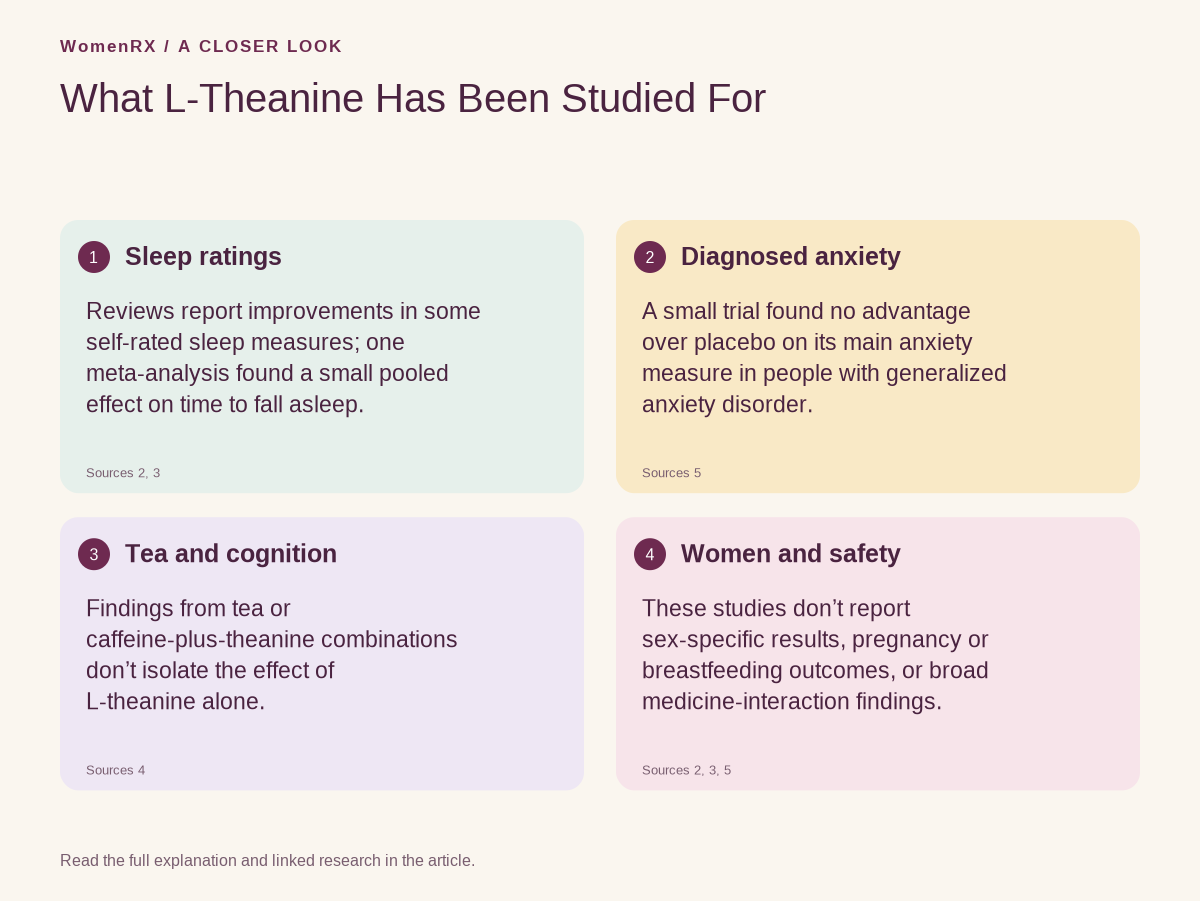
What L-Theanine Has Been Studied For
Sleep ratings: Reviews report improvements in some self-rated sleep measures; one meta-analysis found a small pooled effect on time to fall asleep.23
Diagnosed anxiety: A small trial found no advantage over placebo on its main anxiety measure in people with generalized anxiety disorder.5
Tea and cognition: Findings from tea or caffeine-plus-theanine combinations don’t isolate the effect of L-theanine alone.4
Women and safety: These studies don’t report sex-specific results, pregnancy or breastfeeding outcomes, or broad medicine-interaction findings.235
Read the figure as text
The evidence differs by outcome: sleep has a modest signal, anxiety results are less supportive, and several practical questions remain unanswered.- Sleep ratings: Reviews report improvements in some self-rated sleep measures; one meta-analysis found a small pooled effect on time to fall asleep.23
- Diagnosed anxiety: A small trial found no advantage over placebo on its main anxiety measure in people with generalized anxiety disorder.5
- Tea and cognition: Findings from tea or caffeine-plus-theanine combinations don’t isolate the effect of L-theanine alone.4
- Women and safety: These studies don’t report sex-specific results, pregnancy or breastfeeding outcomes, or broad medicine-interaction findings.235
More questions, answered
Does L-theanine work differently for women?
The trial and review summaries discussed here don’t report results by sex, so they don’t show whether effects differ for women. 235
Can you take L-theanine with medication?
A small trial tested it alongside stable antidepressant treatment, but that does not establish interaction safety across medicines or supplement combinations. Check the exact product ingredients with a pharmacist if you take medication. 5
Sources you can check
- Anxiety: MedlinePlusAccessed 2026-09-25Return to first citation
- Examining the effect of L-theanine on sleep: a systematic review of dietary supplementation trials.Cotter J, Caddick CE, Harper JL, Ebajemito JK. · Nutritional neuroscience · 2026Return to first citation
- The effects of L-theanine consumption on sleep outcomes: A systematic review and meta-analysis.Bulman A, D'Cunha NM, Marx W, Turner M, McKune A, Naumovski N. · Sleep medicine reviews · 2025Return to first citation
- Green tea effects on cognition, mood and human brain function: A systematic review.Mancini E, Beglinger C, Drewe J, Zanchi D, Lang UE, Borgwardt S. · Phytomedicine : international journal of phytotherapy and phytopharmacology · 2017Return to first citation
- L-theanine in the adjunctive treatment of generalized anxiety disorder: A double-blind, randomised, placebo-controlled trial.Sarris J, Byrne GJ, Cribb L, Oliver G, Murphy J, Macdonald P, Nazareth S, Karamacoska D, Galea S, Short A, Ee C, Birling Y, Menon R, Ng CH. · Journal of psychiatric research · 2019Return to first citation