L-Theanine: What to Check Before Trying a Supplement
Stress, anxiety, and sleep are different goals, and small trials of L-theanine don’t show the same results for each.
L-theanine hasn’t been shown consistently to reduce anxiety or improve sleep. In a small trial involving people with generalized anxiety disorder, it didn’t outperform placebo for anxiety or overall insomnia severity. Other small studies have mixed findings for stress and sleep. If you’re considering a supplement, check the amount per serving, added ingredients, and whether your medication or pregnancy and breastfeeding questions need a closer review. 2 3 4
Start with the outcome you want
A product marketed for “stress” isn’t automatically a treatment for an anxiety disorder, and a calming claim doesn’t establish that it will improve sleep. Those outcomes need to be considered separately.
In a randomized trial, 46 people with generalized anxiety disorder who were taking stable antidepressant treatment received L-theanine or placebo for eight weeks. L-theanine did not outperform placebo on anxiety scores. It also did not outperform placebo on overall insomnia severity, although one self-reported sleep-satisfaction item favored L-theanine. That single result isn’t the same as showing a dependable sleep benefit. 2
A separate randomized study tested L-theanine before a brief stress challenge in 80 young adults. It found no effect on the measured stress markers. This was a short-term challenge, not a test of long-term stress or treatment for an anxiety disorder. 3
Sleep findings are not a simple yes or no
A 28-day trial included 30 healthy adults with moderate stress, split between L-theanine and placebo. Perceived-stress scores fell in both groups by day 28, by similar amounts. The L-theanine group had less light sleep on some measures, but also spent less time asleep after 28 days. Those mixed findings don’t establish that L-theanine reliably improves sleep. 4
These trials looked at particular products and groups of adults. Their tested amounts can help you understand what was studied, but they aren’t a recommended dose or proof that another product will have the same effect.
Use the label to make a fair comparison
Before buying, look for the amount of L-theanine in each serving. A product’s total weight may include other ingredients, so it doesn’t tell you how much L-theanine it contains. Check the serving directions and the full ingredient list, too.
If L-theanine is included in a blend without its own amount listed, you can’t readily compare it with a trial that tested L-theanine separately. A combination product also makes it harder to tell which ingredient might be responsible for an effect or an unwanted reaction. Research on L-theanine alone doesn’t establish the effects or safety of a blend.
Be wary of a product claim that jumps from a small study to a promise to treat an anxiety disorder or fix sleep. A supplement label can tell you what’s in the product; it can’t make the research more conclusive.
Consider your circumstances
The small adult trials described above don’t establish whether L-theanine supplements are safe during pregnancy or breastfeeding. If either applies to you, don’t assume findings in other adults answer that question; review the exact product with your pregnancy or postpartum care team before trying it.
One small trial did give L-theanine alongside stable antidepressant treatment, but that doesn’t show that it’s safe with every medication or combination product. The studies summarized here don’t verify specific medication interactions. If you take medication, a pharmacist can review the full label and your medication list rather than relying on a general “natural” or “safe” claim. 2
The 30-person, 28-day study reported that adverse events had resolved by the end of the study period or follow-up, and that laboratory values and vital-sign changes were not considered clinically relevant. That’s a limited snapshot from a small, short study, not a guarantee about longer use or everyone who might take a supplement. 4
The stress-challenge trial included 34 women and 46 men, but its reported results don’t show whether responses differed by sex. There’s no basis from that study to claim that women respond differently. 3
A practical decision point
If you’re weighing L-theanine for occasional stress, consider whether an uncertain benefit is worth the product and its added ingredients. If you’re hoping to treat persistent anxiety or ongoing sleep problems, don’t let a supplement claim stand in for care. Anxiety disorders can involve persistent worry that interferes with daily life; psychotherapy and medicines are among their main treatments. 1
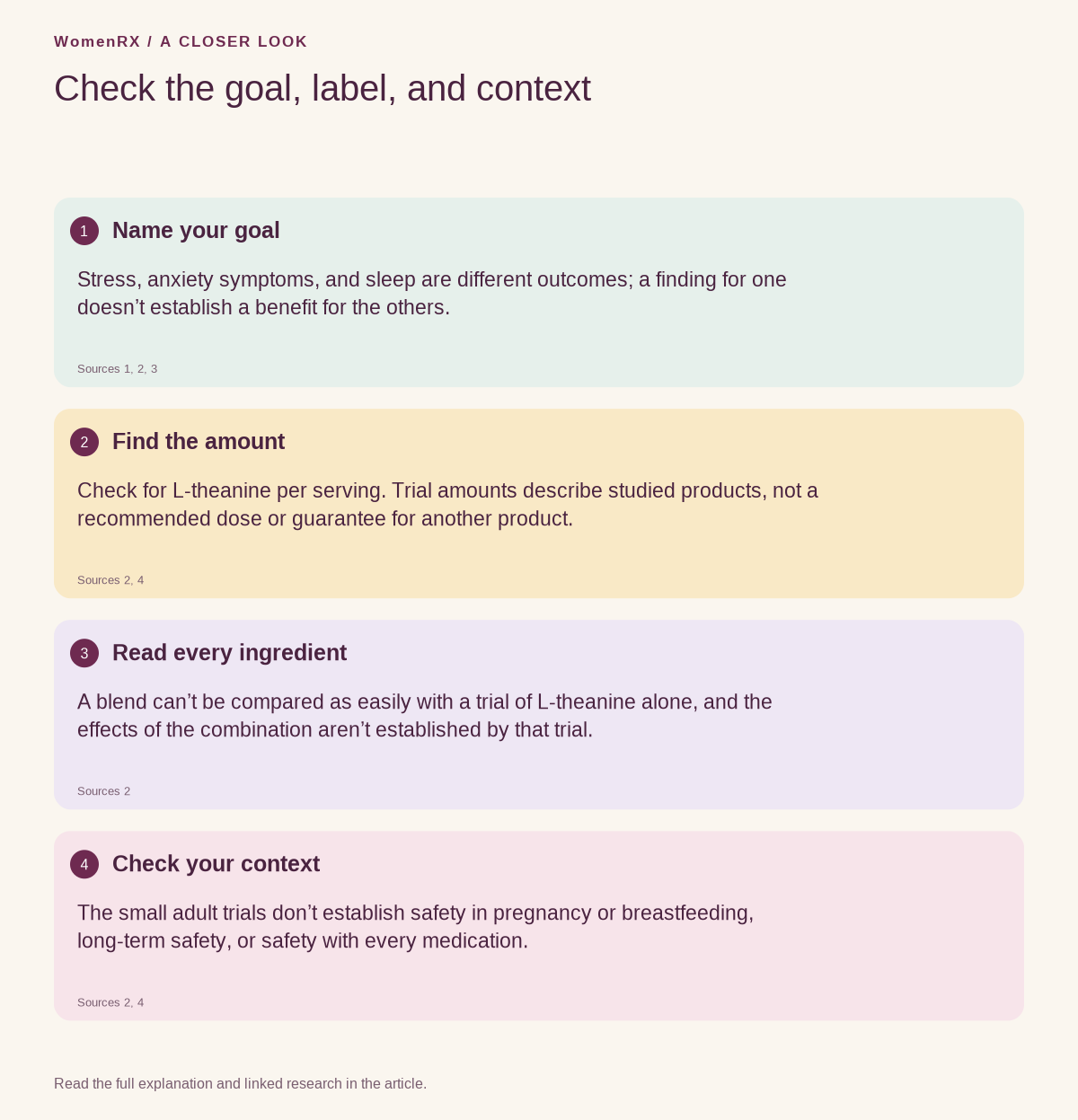
Check the goal, label, and context
Name your goal: Stress, anxiety symptoms, and sleep are different outcomes; a finding for one doesn’t establish a benefit for the others.123
Find the amount: Check for L-theanine per serving. Trial amounts describe studied products, not a recommended dose or guarantee for another product.24
Read every ingredient: A blend can’t be compared as easily with a trial of L-theanine alone, and the effects of the combination aren’t established by that trial.2
Check your context: The small adult trials don’t establish safety in pregnancy or breastfeeding, long-term safety, or safety with every medication.24
Read the figure as text
Use these checks to compare a product’s claims with what small adult trials actually measured.- Name your goal: Stress, anxiety symptoms, and sleep are different outcomes; a finding for one doesn’t establish a benefit for the others.123
- Find the amount: Check for L-theanine per serving. Trial amounts describe studied products, not a recommended dose or guarantee for another product.24
- Read every ingredient: A blend can’t be compared as easily with a trial of L-theanine alone, and the effects of the combination aren’t established by that trial.2
- Check your context: The small adult trials don’t establish safety in pregnancy or breastfeeding, long-term safety, or safety with every medication.24
More questions, answered
Does research show that L-theanine works differently for women?
One stress-challenge trial included 34 women, but the reported findings don’t compare women’s results with men’s. It doesn’t establish a women-specific benefit or difference in response. 3
Does a study with antidepressants prove L-theanine is safe with my medication?
No. A small trial alongside stable antidepressant treatment can’t establish safety with every medication or with combination supplements. A pharmacist can review the specific product and medication list. 2
Sources you can check
- Anxiety: MedlinePlusAccessed 2026-09-25Return to first citation
- L-theanine in the adjunctive treatment of generalized anxiety disorder: A double-blind, randomised, placebo-controlled trial.Sarris J, Byrne GJ, Cribb L, Oliver G, Murphy J, Macdonald P, Nazareth S, Karamacoska D, Galea S, Short A, Ee C, Birling Y, Menon R, Ng CH. · Journal of psychiatric research · 2019Return to first citation
- Impact of L-theanine and L-tyrosine on markers of stress and cognitive performance in response to a virtual reality based active shooter training drill.McAllister MJ, Martaindale MH, Dillard CC, McCullough R. · Stress (Amsterdam, Netherlands) · 2024Return to first citation
- Safety and Efficacy of AlphaWave® L-Theanine Supplementation for 28 Days in Healthy Adults with Moderate Stress: A Randomized, Double-Blind, Placebo-Controlled Trial.Moulin M, Crowley DC, Xiong L, Guthrie N, Lewis ED. · Neurology and therapy · 2024Return to first citation