L-Theanine: What Safety and Side Effects We Know
Short-term studies offer a limited safety snapshot, but they don’t establish long-term or pregnancy-related safety.
In a 28-day study of 30 healthy adults, 15 took a specific L-theanine supplement. Reported adverse events resolved by study end or follow-up, and laboratory and vital-sign changes were not judged clinically relevant. That limited snapshot cannot establish long-term safety. Caffeine-containing blends bring separate effects and medicine considerations, so check the whole product. 3 2
L-theanine is found naturally in tea and is also sold as a standalone supplement or mixed into products for focus, relaxation, or sleep. The key safety question is not just “Does L-theanine work?” It’s also “What else is in this product, and how much do we know about that combination?”
What a short safety study can, and can’t, tell you
The clearest short-term safety finding in the human evidence comes from a randomized trial of 30 healthy adults with moderate stress. Fifteen received a branded L-theanine supplement at 400 mg per day, and 15 received placebo for 28 days. The researchers reported that adverse events had resolved by the end of the study or follow-up, and that lab and vital-sign changes were not considered clinically relevant. The trial dose describes what was studied, not a recommended amount. 3
That is a small, short study, not a guarantee that every product is safe for every person. It doesn’t establish safety over months or years, and the study summary doesn’t report results separately for women. A broader 2026 review describes L-theanine as generally well tolerated in clinical trials, while calling for better research on safety and interactions with other bioactive compounds. 4
The 28-day trial reports adverse events in broad terms, while the review describes general tolerability; neither gives a side-effect frequency you can apply to your own product. 3 4 If you notice an unwanted effect after starting a supplement, consider whether other ingredients or recent changes could also be involved and discuss it with a pharmacist or prescriber. Keep the label so you can identify the exact product and ingredients.
L-theanine alone is not the same as a blend
For a standalone product, the evidence is mainly about L-theanine itself. Even then, studies have used different populations and measures. One small 28-day trial found some changes in perceived stress and a cognitive attention test, but the placebo group also improved on stress, and the study found no significant difference between groups in salivary cortisol. Those results don’t establish L-theanine as a treatment for an anxiety disorder or attention problem. 3
A product that combines L-theanine with caffeine is a different proposition. Reviews of human trials suggest the combination may improve some attention-task results, but the contribution of each ingredient is difficult to separate, and findings across studies are not fully consistent. 4 Caffeine can increase alertness. Too much caffeine can cause restlessness or shakiness, and some people are more sensitive to its effects than others. Those are caffeine effects to consider, not proof that L-theanine cancels them out. 2
Combination products may contain still other calming or stimulating ingredients. A result from a trial of L-theanine alone doesn’t establish the safety or effect of a blend. Check the complete ingredient list rather than relying on the front label’s “calm,” “focus,” or “sleep” language.
What the evidence says about stress, sleep, and focus
L-theanine is not a proven treatment for anxiety, insomnia, or ADHD. A recent review of human trials reports possible small benefits in some attention tasks, stress measures, or sleep-quality measures, but it also describes limitations and calls for more rigorous research. Sleep findings, in particular, don’t necessarily mean people sleep longer. 4
The 28-day study is a useful example of why results need context: a measure improving from a person’s starting point doesn’t automatically mean the supplement caused more improvement than placebo. In that study, both groups’ perceived-stress scores fell, while cortisol did not differ significantly between groups. 3
If anxiety is persistent, worsening, or interfering with daily life, a supplement shouldn’t take the place of care with evidence-based options. MedlinePlus describes psychotherapy and medicines as the main treatments for anxiety disorders. 1
Pregnancy, breastfeeding, and menopause
The studies summarized here don’t establish whether L-theanine supplements are safe during pregnancy or breastfeeding, or whether they have a distinct effect during menopause. They also don’t show that women need a different amount. That’s an evidence gap, not proof of harm or proof of safety. If you’re pregnant, breastfeeding, or considering a supplement during menopause, the exact product matters, especially if it contains caffeine or other active ingredients, so review the label with a pharmacist or care professional who knows your situation.
A practical way to compare labels
If you’re weighing products, start with the ingredient panel. A single-ingredient L-theanine product makes it easier to tell what you’re trying; a combination product may make it harder to know which ingredient caused a benefit or side effect. Check specifically for caffeine and any additional calming or stimulating ingredients. If you take medicines, the cited trial and review don’t provide a specific assessment of L-theanine interactions with prescription medicines. Caffeine is a separate consideration: it may interact with certain medicines, including stimulants, some antibiotics, asthma medicines, and heart medicines. Bring the full label to a pharmacist or prescriber to check the combination for your circumstances. 3 4 2
Tea is not a precise stand-in for a supplement. L-theanine content in brewed tea varies with the tea and preparation, so it doesn’t provide a standardized comparison with a capsule. 5
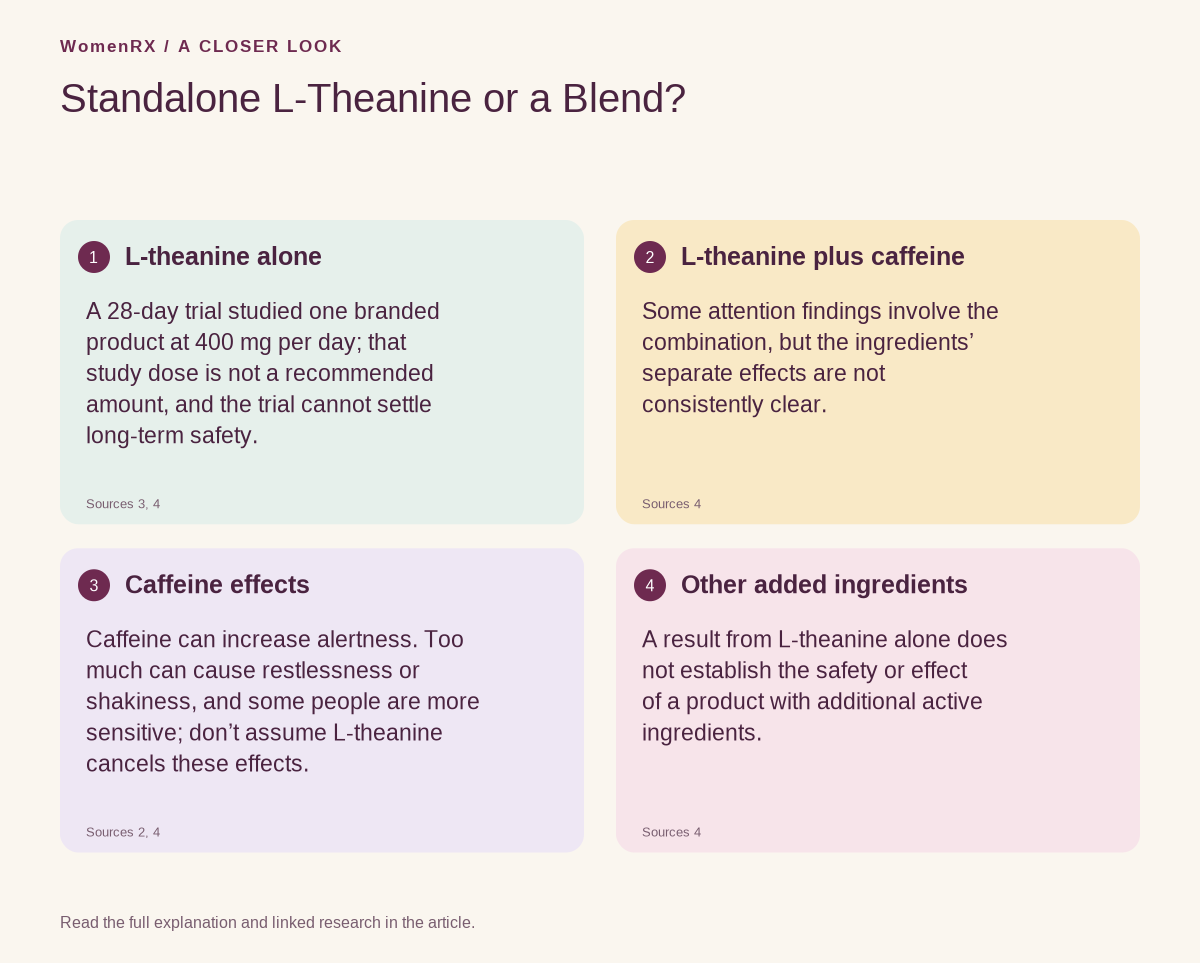
Standalone L-Theanine or a Blend?
L-theanine alone: A 28-day trial studied one branded product at 400 mg per day; that study dose is not a recommended amount, and the trial cannot settle long-term safety.34
L-theanine plus caffeine: Some attention findings involve the combination, but the ingredients’ separate effects are not consistently clear.4
Caffeine effects: Caffeine can increase alertness. Too much can cause restlessness or shakiness, and some people are more sensitive; don’t assume L-theanine cancels these effects.24
Other added ingredients: A result from L-theanine alone does not establish the safety or effect of a product with additional active ingredients.4
Read the figure as text
The ingredient list changes what a study can tell you. Compare the product in your hand with the type of product actually studied.- L-theanine alone: A 28-day trial studied one branded product at 400 mg per day; that study dose is not a recommended amount, and the trial cannot settle long-term safety.34
- L-theanine plus caffeine: Some attention findings involve the combination, but the ingredients’ separate effects are not consistently clear.4
- Caffeine effects: Caffeine can increase alertness. Too much can cause restlessness or shakiness, and some people are more sensitive; don’t assume L-theanine cancels these effects.24
- Other added ingredients: A result from L-theanine alone does not establish the safety or effect of a product with additional active ingredients.4
More questions, answered
Does L-theanine make caffeine safer or prevent jitters?
Research hasn’t established that L-theanine prevents restlessness or shakiness from too much caffeine. Combination studies have not clearly separated each ingredient’s contribution. 2 4
Do we know whether L-theanine interacts with prescription medicines?
The cited 28-day trial and review don’t provide a specific assessment of L-theanine interactions with prescription medicines. If your product also contains caffeine, that ingredient may interact with certain medicines, including stimulants, some antibiotics, asthma medicines, and heart medicines. Show a pharmacist or prescriber the full supplement label before combining them. 3 4 2
Sources you can check
- Anxiety: MedlinePlusAccessed 2026-09-25Return to first citation
- Caffeine: MedlinePlusAccessed 2026-09-25Return to first citation
- Safety and Efficacy of AlphaWave® L-Theanine Supplementation for 28 Days in Healthy Adults with Moderate Stress: A Randomized, Double-Blind, Placebo-Controlled Trial.Moulin M, Crowley DC, Xiong L, Guthrie N, Lewis ED. · Neurology and therapy · 2024Return to first citation
- Effects of L-theanine on cognition, mood and sleep: evidence from human trials.Cotter J, Kilpatrick HE. · Frontiers in nutrition · 2026Return to first citation
- l-theanine: From tea leaf to trending supplement - does the science match the hype for brain health and relaxation?Dashwood R, Visioli F. · Nutrition research (New York, N.Y.) · 2025Return to first citation