Should You Take L-Theanine With Food?
For at least one L-theanine product, the label gives a clear answer, but research on matcha doesn’t tell us whether meals change how an L-theanine supplement works.
Check the directions for the product you have before changing your routine. NOW L-Theanine 100 mg Veg Capsules, for example, say to take the capsule with food and not on an empty stomach. Those directions apply to that formulation, not every L-theanine supplement.4 A study comparing matcha tea with a matcha snack bar doesn’t establish whether food changes absorption or effects of L-theanine taken on its own.2
Start with the directions on your bottle
If your L-theanine bottle says to take it with food, the matcha drink-versus-bar study discussed below gives you no reason to skip the meal to try to make the supplement work better.2 The directions for NOW L-Theanine 100 mg Veg Capsules specifically call for taking the product with food, not on an empty stomach. This capsule also contains decaffeinated green tea leaf, so it isn’t an isolated L-theanine product.4 Its directions tell you how the manufacturer intends that product to be used. They aren’t evidence that food improves L-theanine absorption, and they don’t set a rule for every formulation.
If your own label gives different directions, use those rather than borrowing instructions from another bottle. If it says nothing about meals, the research discussed here doesn’t give you a reason to assume fasting will make L-theanine stronger or faster.
What a drink-versus-bar study can tell you
A small randomized study tested matcha as a drink and as a snack bar, each against a matching placebo, in 23 consumers. The drink performed better than the bar on most cognitive measures assessed, while the matcha products showed no significant change in mood compared with placebo.2
That’s a useful distinction, but it isn’t a fed-versus-fasted test of an L-theanine capsule. Both matcha formats contained other compounds, including caffeine and EGCG, and the comparison changed the format of the matcha itself. The study can’t tell you which ingredient accounted for a result, whether a meal changes L-theanine exposure in the body, or whether changing meal timing would improve the effect you’re hoping for.2 The study report also doesn’t provide a women-specific food-timing result.2
A different question during pregnancy or breastfeeding
Meal timing doesn’t settle whether a supplement is suitable during pregnancy or breastfeeding. If you’re pregnant, MedlinePlus advises checking before taking supplements because the decision depends on their risks and benefits, not simply whether they’re taken with food.1
For breastfeeding, LactMed reports that information on L-theanine supplement use is lacking. It distinguishes the amounts found in green tea from higher amounts in supplements and advises particular caution when nursing a newborn or preterm infant.3 That uncertainty is about supplement use while nursing, not proof that taking L-theanine with a meal makes it safer.
The practical move is straightforward: follow the food instruction on your actual product. Treat claims about a special fasting advantage as a separate claim that needs direct human evidence, rather than as a reason to override the label.
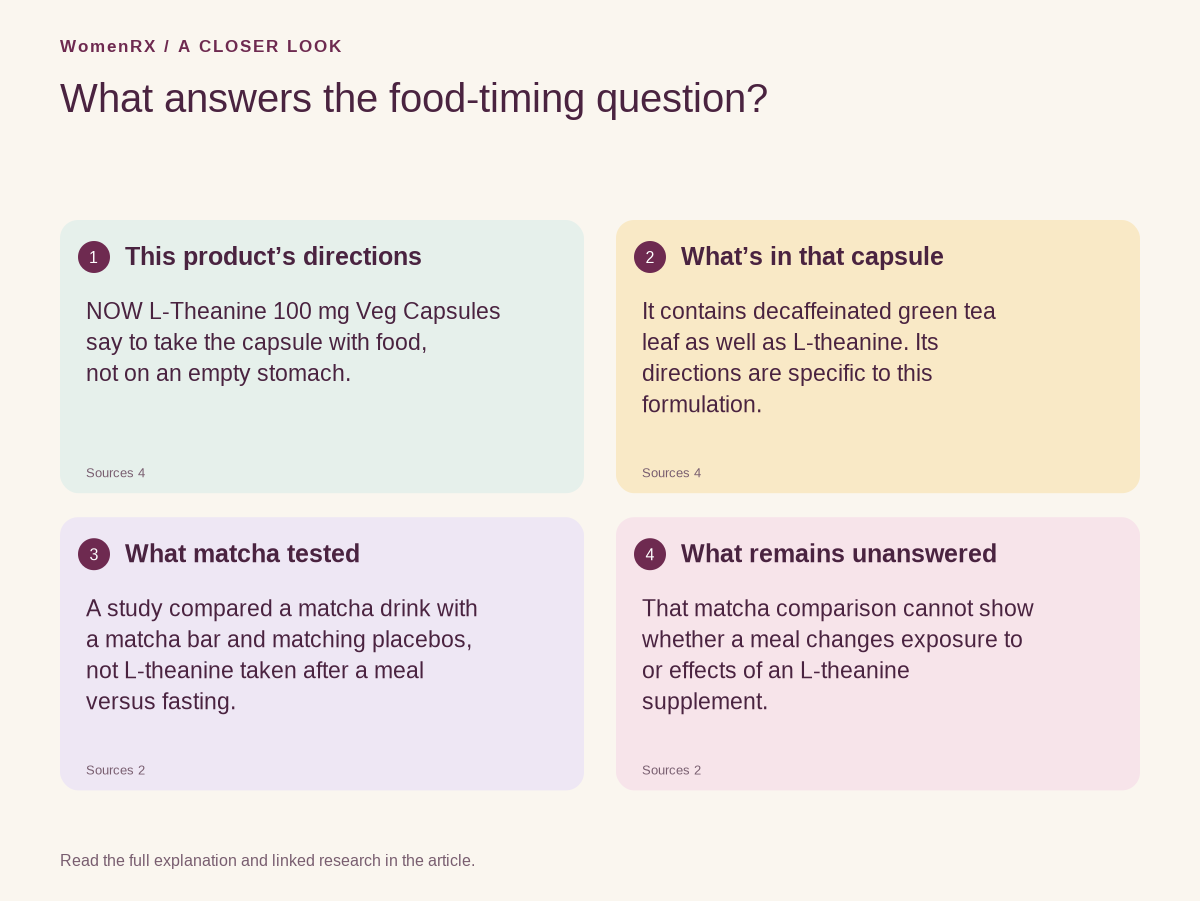
What answers the food-timing question?
This product’s directions: NOW L-Theanine 100 mg Veg Capsules say to take the capsule with food, not on an empty stomach.4
What’s in that capsule: It contains decaffeinated green tea leaf as well as L-theanine. Its directions are specific to this formulation.4
What matcha tested: A study compared a matcha drink with a matcha bar and matching placebos, not L-theanine taken after a meal versus fasting.2
What remains unanswered: That matcha comparison cannot show whether a meal changes exposure to or effects of an L-theanine supplement.2
Read the figure as text
These pieces of information answer different questions; none turns a matcha comparison into a fasting rule for L-theanine capsules.- This product’s directions: NOW L-Theanine 100 mg Veg Capsules say to take the capsule with food, not on an empty stomach.4
- What’s in that capsule: It contains decaffeinated green tea leaf as well as L-theanine. Its directions are specific to this formulation.4
- What matcha tested: A study compared a matcha drink with a matcha bar and matching placebos, not L-theanine taken after a meal versus fasting.2
- What remains unanswered: That matcha comparison cannot show whether a meal changes exposure to or effects of an L-theanine supplement.2
Sources you can check
- Pregnancy and Medicines | MedlinePlusAccessed 2026-09-25Return to first citation
- An intervention study on the effect of matcha tea, in drink and snack bar formats, on mood and cognitive performance.Dietz C, Dekker M, Piqueras-Fiszman B. · Food research international (Ottawa, Ont.) · 2017Return to first citation
- Theanine2006Return to first citation
- NOW L-Theanine 100 mg Veg Capsules: manufacturer directions and amountsAccessed 2026-09-25Return to first citation