VO₂ Max: What Your Number Can Tell You
A VO₂ max result can offer a useful fitness snapshot, but a wearable estimate isn’t the same as a laboratory measurement or a personal health verdict.
VO₂ max is a measure of cardiorespiratory fitness, often reported as oxygen uptake relative to body weight. A lab test measures oxygen uptake during exercise; a wearable provides an estimate. In one small Apple Watch study, Bland-Altman analysis showed good overall agreement with lab measurements, but the intraclass correlation indicated poor reliability, and mean absolute percentage error was 15.79%. The study did not test whether watch estimates track fitness changes over time. 1
What the number represents
VO₂ max is a measure of cardiorespiratory fitness. It’s commonly reported as milliliters of oxygen per kilogram per minute. That describes a particular measure taken during exercise, not every part of your health or how you feel day to day. 1
It isn’t a direct measure of weight, willpower, or whether you’re healthy. Fitness is one piece of health, and a single number can’t tell you by itself why exercise feels difficult or what’s happening with your heart or lungs.
Lab measurement versus wearable estimate
In one laboratory study, participants completed a graded exercise test on a stationary cycle ergometer until they reached subjective exhaustion. A metabolic gas analyzer measured their VO₂ max. The result reflects a person’s response to that particular exercise test. 1
The same study compared those measurements with estimates from the Apple Watch Series 7, taken after participants wore the watch for at least two consecutive days and completed an outdoor running test. It doesn’t establish how that watch calculates its estimate or how accurate other devices are, so an estimate from another brand or model shouldn’t be assumed to match either the lab measurement or the Apple Watch result. 1
One small 2024 validation study compared Apple Watch Series 7 estimates with lab testing in 19 adults, including seven women. In that study, the watch’s average estimate was lower than the lab’s average measurement, but individual estimates could be higher or lower. Bland-Altman analysis showed good overall agreement, while the intraclass correlation coefficient indicated poor reliability. The average absolute percentage error was 15.79%. These are different ways of assessing the comparison: the study’s overall agreement finding doesn’t mean an estimate will be precise for an individual. That’s a reason to be cautious about treating any one estimate as exact, not proof that every watch has the same accuracy. 1
That study compared watch estimates with lab measurements at one assessment; it did not test whether changes in a watch’s estimate reliably track changes in fitness over time. If the displayed number moves after a change in your routine, treat that movement as an unverified clue, not proof that your fitness changed by that amount. If precision matters for a health or training decision, a directly measured test gives a different, more direct kind of information than a wearable estimate. 1
What comparisons can tell you
Cardiorespiratory fitness changes with age, including in women. A review focused on midlife and older women describes age-related declines, while noting that women who have done endurance training over many years can have fitness comparable to or greater than that of younger sedentary women. Age can offer context for understanding a result, but it doesn’t dictate one person’s number. 2
One study of adults aged 50 and older reported fitness as an age- and sex-adjusted percentile. That shows how one research cohort accounted for age and sex; it doesn’t establish a general adult reference standard. The findings here don’t provide an adult reference chart or a universal cutoff for women. If a device labels your result “low” or “excellent,” its label alone doesn’t tell you whether the comparison is suitable for you. 3
What it can, and can’t, say about health
Cardiorespiratory fitness is associated with health outcomes. A review focused on midlife and older women describes VO₂ max and VO₂ peak as relevant to cardiovascular and all-cause mortality risk. That’s population-level context, not a prediction of what will happen to you based on one wearable result. The review doesn’t give an individual risk estimate for a particular score. 2
A fitness score also isn’t a diagnosis. It shouldn’t replace an evaluation of symptoms or other health information. If you’re deciding whether to change your training, the number may be one consideration alongside how exercise feels and whether you’re progressing toward a goal. If you’re trying to understand a health concern, a wearable score alone can’t explain its cause.
The most useful approach is to keep the question specific: Are you looking for a directly measured fitness value, a performance measurement, or help understanding a health concern? A wearable gives a convenient estimate, but the study discussed here didn’t establish its value for tracking changes over time. A lab test measures oxygen use more directly. Neither number, by itself, tells the whole story.
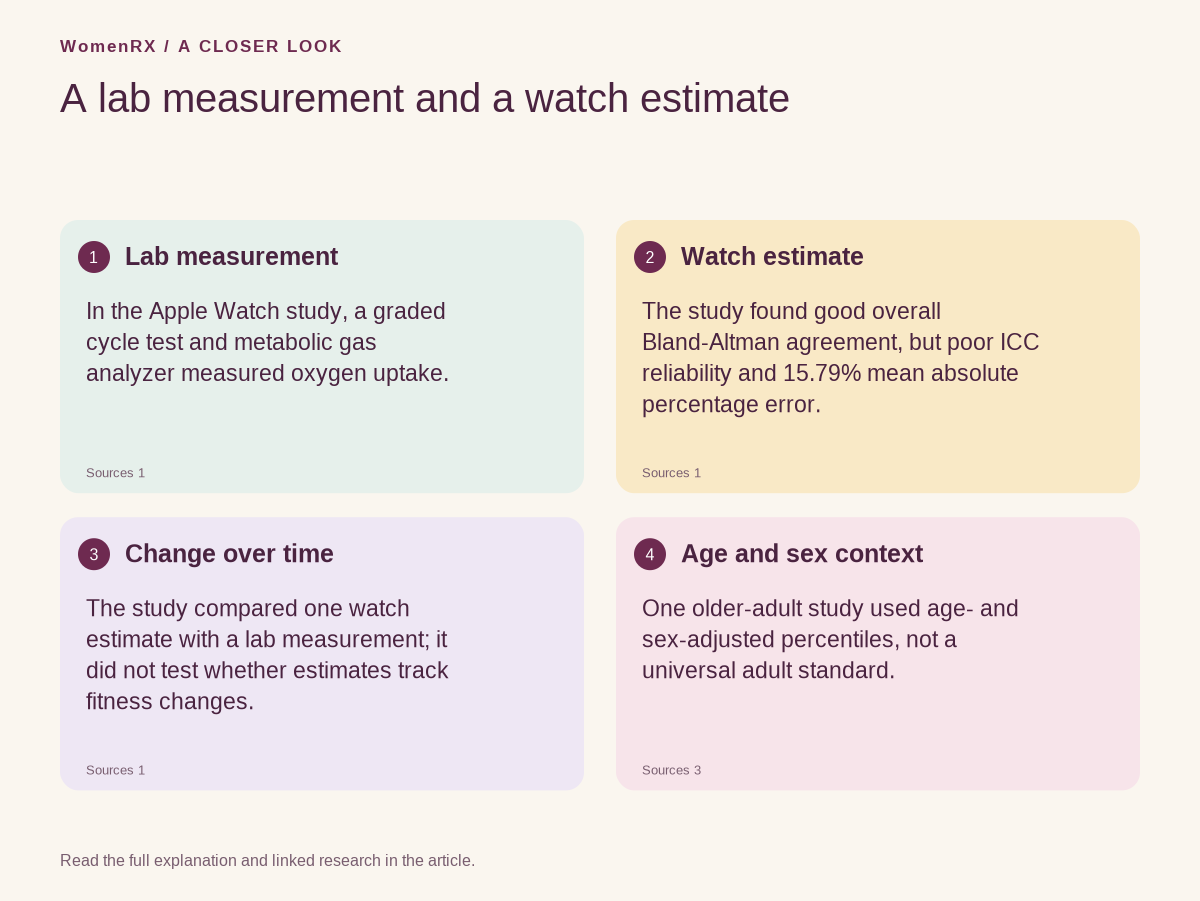
A lab measurement and a watch estimate
Lab measurement: In the Apple Watch study, a graded cycle test and metabolic gas analyzer measured oxygen uptake.1
Watch estimate: The study found good overall Bland-Altman agreement, but poor ICC reliability and 15.79% mean absolute percentage error.1
Change over time: The study compared one watch estimate with a lab measurement; it did not test whether estimates track fitness changes.1
Age and sex context: One older-adult study used age- and sex-adjusted percentiles, not a universal adult standard.3
Read the figure as text
How a VO₂ max result is obtained, and what a comparison can establish, affects how much to read into it.- Lab measurement: In the Apple Watch study, a graded cycle test and metabolic gas analyzer measured oxygen uptake.1
- Watch estimate: The study found good overall Bland-Altman agreement, but poor ICC reliability and 15.79% mean absolute percentage error.1
- Change over time: The study compared one watch estimate with a lab measurement; it did not test whether estimates track fitness changes.1
- Age and sex context: One older-adult study used age- and sex-adjusted percentiles, not a universal adult standard.3
More questions, answered
Should I compare my VO₂ max with a friend’s?
A raw number may not make a fair comparison. Fitness changes with age, and one study of adults 50 and older reported age- and sex-adjusted percentiles, but that doesn’t establish a universal adult reference standard. Individual estimates from a wearable can also differ from lab measurements. 1 2 3
Does a higher VO₂ max guarantee better health?
No. Cardiorespiratory fitness is associated with health outcomes in population research, but a VO₂ max result doesn’t predict an individual’s future or diagnose a condition. 2
Sources you can check
- Assessing the Accuracy of Smartwatch-Based Estimation of Maximum Oxygen Uptake Using the Apple Watch Series 7: Validation Study.Caserman P, Yum S, Göbel S, Reif A, Matura S. · JMIR biomedical engineering · 2024Return to first citation
- Effects of aging and endurance exercise training on cardiorespiratory fitness and cardiac structure and function in healthy midlife and older women.Carrick-Ranson G, Howden EJ, Brazile TL, Levine BD, Reading SA. · Journal of applied physiology (Bethesda, Md. : 1985) · 2023Return to first citation
- Healthy Vascular Aging Is Associated With Higher Cardiorespiratory Fitness.Fleenor BS, Carlini NA, Kaminsky LA, Whaley MH, Peterman JE, Harber MP. · Journal of cardiopulmonary rehabilitation and prevention · 2021Return to first citation