VO₂ Max Training: How Hard, How Often, How to Progress
Intervals can improve aerobic fitness, but research uses different intensities and routines, so you don’t need to start with all-out sprints.
VO₂ max training uses repeated harder efforts with easier recovery to challenge your aerobic system. Study protocols vary: one mixed-sex trial used work intervals above 90% of maximum heart rate, while a study in postmenopausal women used 30-second efforts. 1 3 As a practical example, try turning one usual cardio session into intervals, keep the rest of your routine steady, and change just one feature at a time if it remains manageable.
What an interval session is meant to do
VO₂ max describes the body’s capacity to take in and use oxygen during intense exercise. Interval training alternates harder efforts with recovery. The work periods challenge your aerobic system; the easier periods give you time to recover enough to repeat them. That basic pattern can look quite different from one program to another.
In one 10-week study of 48 healthy, physically sedentary women, average age about 21, the training group completed online sessions three times a week. The program combined body-weight intervals and running, and researchers reported improved VO₂ max after the program. It’s an example of improvement in young sedentary women, not a template proven best for every age, fitness level, or life stage. 2
“High intensity” doesn’t mean one exact effort
In that study of young women, the interval sessions progressed over time by adding sets and later shortening recovery. A separate eight-week study in 30 postmenopausal women used supervised sessions on non-consecutive days and progressed its target intensity from 75% toward 85% of estimated maximum heart rate. The study compared two dietary approaches alongside the exercise program, so it can’t isolate the effect of HIIT from diet or show that this schedule is right for everyone. 2 3
A trial involving young men and women used a more demanding endurance-running program: 4-6 intervals of 4-6 minutes, with work above 90% of maximum heart rate. That protocol shows what hard intervals can look like in a structured training study; it isn’t a starting requirement. 1
A practical way to fit intervals into your week
There isn’t a single weekly frequency established by these examples for women with different fitness levels and routines. As a cautious, practical example, if you already do cardio twice a week, you could make one of those sessions an interval session and keep the other comfortable. That’s a way to try intervals without adding another hard workout; it isn’t a research-tested minimum or a universal prescription.
Keep the first version simple and repeatable. If the session fits your routine and the efforts still feel controlled, you might later adjust one feature, such as the number or length of work periods, or the recovery between them. Change only one feature at a time. If the session starts to feel difficult to repeat or crowds out the rest of your routine, hold steady or make it easier rather than progressing. This is a practical framework, not a progression plan tested in the cited studies.
A useful session shape
Think of a workout as four parts: an easy warm-up, work intervals, easier recovery, and an easy cool-down. The study protocols vary, so use this as a flexible structure rather than copying a particular study’s minutes or heart-rate target. The work-and-recovery pattern matters more than matching one protocol.
Keep the rest of your routine in view, too. Intervals are one way to train aerobic fitness, not a test you have to pass or a replacement for every easier session. In one study of sedentary young women, the program included both interval training and continuous running, rather than intervals alone. 2
Heart-rate zones are guides, not guarantees
A percentage of maximum heart rate can help describe a study protocol, but the number depends on how maximum heart rate is determined. In a small study of 20 highly trained collegiate distance runners, including 10 women, heart rates recorded during training and competition were higher than the runners’ laboratory maximum heart rates. Those findings are specific to trained runners; they do show why a heart-rate target shouldn’t be treated as a perfectly precise effort gauge for everyone. 4
You can use a heart-rate display as one piece of information, alongside how hard the effort feels and whether you can repeat it with good control. Don’t assume that matching a percentage on a watch means you’ve matched a laboratory protocol.
What a VO₂ max number can, and can’t, tell you
A directly measured VO₂ max and a device’s estimate aren’t interchangeable. In the postmenopausal-women study, researchers estimated VO₂ max from treadmill performance using the manufacturer’s proprietary algorithm. The study reported an increase in that estimate, but it did not test consumer watches or establish how accurately they measure VO₂ max. 3
You might choose to view a watch estimate as an unvalidated trend, but the study doesn’t establish that consumer-device estimates track change accurately. Don’t treat the number as a diagnosis or a reason to force a harder session. The research supports intervals as one possible way to improve aerobic fitness; it doesn’t establish a single required intensity, schedule, or device target for women across ages and life stages.
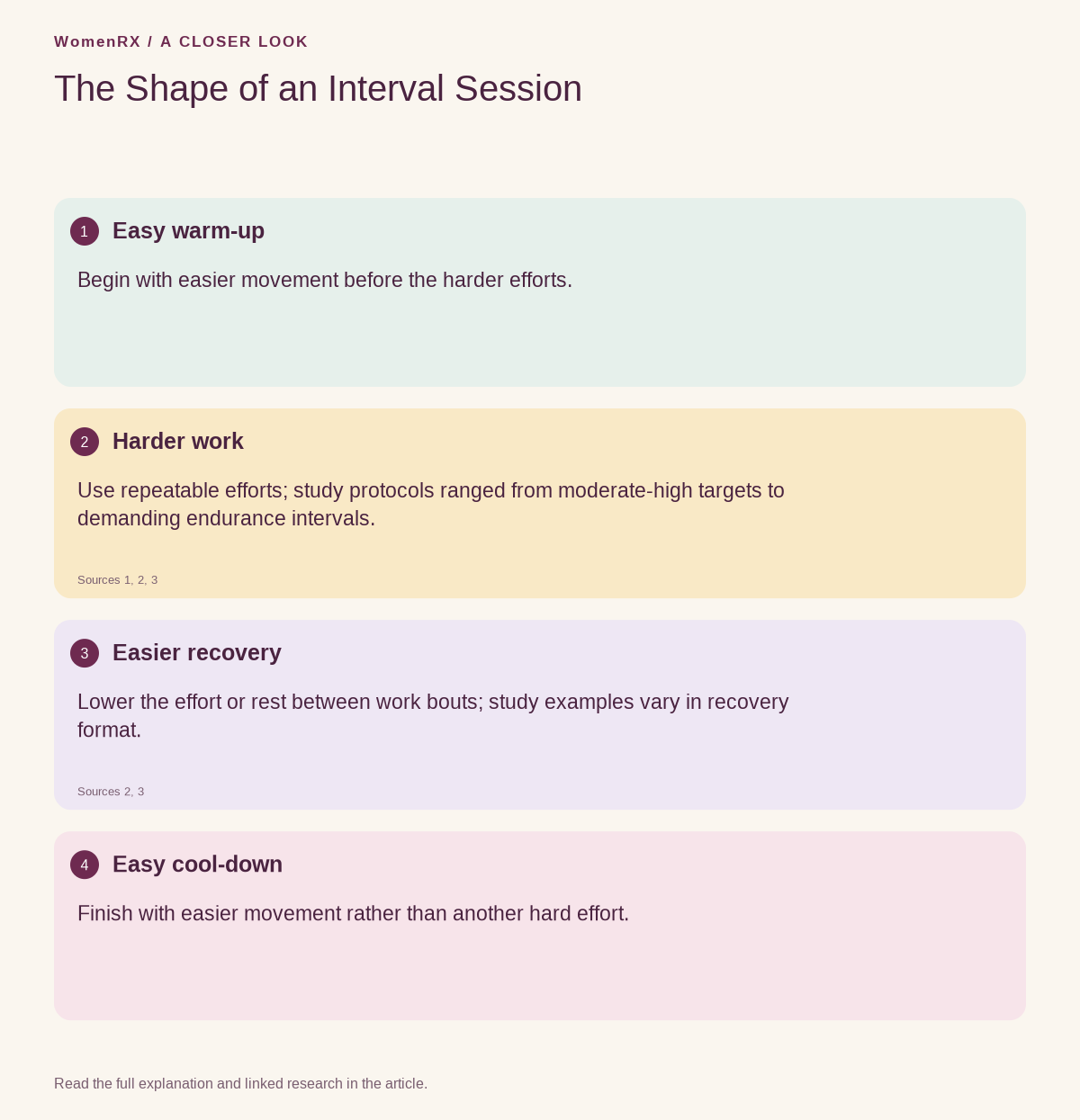
The Shape of an Interval Session
Easy warm-up: Begin with easier movement before the harder efforts.
Harder work: Use repeatable efforts; study protocols ranged from moderate-high targets to demanding endurance intervals.123
Easier recovery: Lower the effort or rest between work bouts; study examples vary in recovery format.23
Easy cool-down: Finish with easier movement rather than another hard effort.
Read the figure as text
A flexible session structure, with work and recovery at its center.- Easy warm-up: Begin with easier movement before the harder efforts.
- Harder work: Use repeatable efforts; study protocols ranged from moderate-high targets to demanding endurance intervals.123
- Easier recovery: Lower the effort or rest between work bouts; study examples vary in recovery format.23
- Easy cool-down: Finish with easier movement rather than another hard effort.
More questions, answered
Do I need to reach 90% of maximum heart rate?
No single target applies to every interval workout. One mixed-sex study used intervals above 90% of maximum heart rate in a structured endurance program, while studies in women used other intensities and formats. That higher target is an example, not a requirement for getting started. 1 2 3
Sources you can check
- Vitamin C and E supplementation hampers cellular adaptation to endurance training in humans: a double-blind, randomised, controlled trial.Paulsen G, Cumming KT, Holden G, Hallén J, Rønnestad BR, Sveen O, Skaug A, Paur I, Bastani NE, Østgaard HN, Buer C, Midttun M, Freuchen F, Wiig H, Ulseth ET, Garthe I, Blomhoff R, ... · The Journal of physiology · 2014Return to first citation
- Effects of 10-Week Online Moderate- to High-Intensity Interval Training on Body Composition, and Aerobic and Anaerobic Performance during the COVID-19 Lockdown.Rodríguez-García L, Ceylan HI, Silva RM, Silva AF, Guadalupe-Grau A, Liñán-González A. · Healthcare (Basel, Switzerland) · 2023Return to first citation
- Influence of Intermittent Fasting on Body Composition, Physical Performance, and the Orexinergic System in Postmenopausal Women: A Pilot Study.Valenzano AA, Vasco P, D'Orsi G, Marzovillo RRR, Torquato M, Messina G, Polito R, Cibelli G. · Nutrients · 2025Return to first citation
- Discrepancy between training, competition and laboratory measures of maximum heart rate in NCAA division 2 distance runners.Semin K, Stahlnecker Iv AC, Heelan K, Brown GA, Shaw BS, Shaw I. · Journal of sports science & medicine · 2008Return to first citation