HIIT or Steady Exercise: Which Fits You?
HIIT can improve cardiorespiratory fitness, but it isn’t clearly better than moderate continuous exercise for every outcome or every woman.
HIIT alternates vigorous efforts with recovery; moderate continuous exercise keeps a steadier, moderate pace. Both can improve fitness. In trials of women with breast cancer, HIIT improved cardiorespiratory fitness compared with usual care but did not significantly outperform moderate continuous training. A review of middle-aged and older women found fitness benefits from HIIT, but it didn’t establish that HIIT is best for women overall. 2 4
What makes a workout HIIT?
High-intensity interval training (HIIT) means repeating vigorous bouts of exercise with easier recovery periods between them. Moderate-intensity continuous training (MICT) means sustaining a moderate effort rather than alternating hard and easier bouts. The difference is the pattern and intensity, not whether the activity is running, cycling, walking, or something else. In research, the exact intensity and workout structure vary. 2
That variation matters: “HIIT” doesn’t describe one standard workout. One program may use brisk walking intervals, another hard cycling efforts. The label alone doesn’t tell you how demanding a session will feel or whether it suits your current routine.
What the comparison shows
For cardiorespiratory fitness, HIIT is a promising option, not a clear universal winner. A systematic review of 19 randomized trials involving 646 middle-aged and older women found that HIIT improved measured VO₂max compared with control interventions. But the review found no significant effect for VO₂peak, and it combined different kinds of comparison groups, including usual activity, moderate exercise, and other training. Its overall result shouldn’t be read as proof that HIIT beats MICT. 2
A separate review of 10 randomized trials involving 330 women with breast cancer found better VO₂peak with HIIT than with control interventions overall. In the comparison specifically against MICT, however, the difference wasn’t statistically significant. These results concern women with breast cancer, so they don’t settle which approach is better for every woman. 4
Other outcomes may point in different directions. In that breast cancer review, HIIT didn’t significantly change body mass index, fat mass, lean mass, or body-fat percentage compared with control interventions. In a small trial of 40 young, untrained women with obesity, several training approaches improved measures including fitness and body composition; the polarized-training group showed broader improvements than the HIIT group. That’s a particular study and training comparison, not evidence that one approach will produce the same result for you. 3 4
HIIT also shouldn’t be treated as a substitute for every kind of exercise. In the review of middle-aged and older women, it didn’t significantly improve muscle strength. Muscle-strengthening activities have their own role in maintaining or building strength. 1 2
What the evidence says about women
Women were directly studied in the review of middle-aged and older adults, and participants included some postmenopausal women. Across the included studies, average ages ranged from about 44 to 81. The review did not report results separately by menopause stage, so it can’t tell us whether HIIT works differently at different menopause stages. And because it studied women rather than comparing women with men, it can’t establish a women-specific advantage over men. 2
The most useful takeaway is practical: HIIT can improve fitness for some women, but there’s no evidence here that you need it to get fit or that your sex makes it the better choice. A steady workout that you can repeat consistently is a reasonable alternative. Regular activity also supports health in ways beyond fitness, including stronger muscles and bones and better sleep. 1
A readiness and recovery check
This isn’t a validated fitness test or a prescription for a workout. Use it as a way to decide whether HIIT sounds like a good fit for your current routine:
- Your baseline: Are you doing some activity regularly now, or are you returning after a long inactive stretch? MedlinePlus recommends starting slowly; you don’t have to begin with vigorous intervals. 1
- Your preference: Would short periods of vigorous effort feel motivating, or would you rather keep a more even pace? The best format is one you’re willing to return to.
- Your recovery: After a hard effort, do you feel ready to resume at an easier pace? HIIT includes recovery between intense bouts, and protocols differ in how those periods are structured. 2
- Your next-day response: Notice whether a session leaves you able to continue your usual activities and return to movement when planned. If the intensity repeatedly feels like too much, choose an easier pace or continuous exercise instead.
- Your broader mix: If strength is a goal, include muscle-strengthening activity separately; HIIT alone didn’t reliably improve strength in the review of middle-aged and older women. 1 2
You can also use weekly activity goals as a guide rather than a reason to force a particular style. The review describes general adult targets of at least 150 minutes of moderate-intensity activity or 75 minutes of vigorous-intensity activity per week. Those targets can be met through different activity choices; HIIT isn’t the only route. 2
The decision in plain terms
Choose HIIT if you like alternating vigorous efforts and recovery and want to work on cardiorespiratory fitness. Choose moderate continuous exercise if a steadier pace feels more comfortable or sustainable. If you’re unsure, begin with activity at an intensity that feels manageable and build gradually. You don’t have to choose one approach forever, and the evidence doesn’t support treating HIIT as necessary for weight loss or as automatically superior for women.
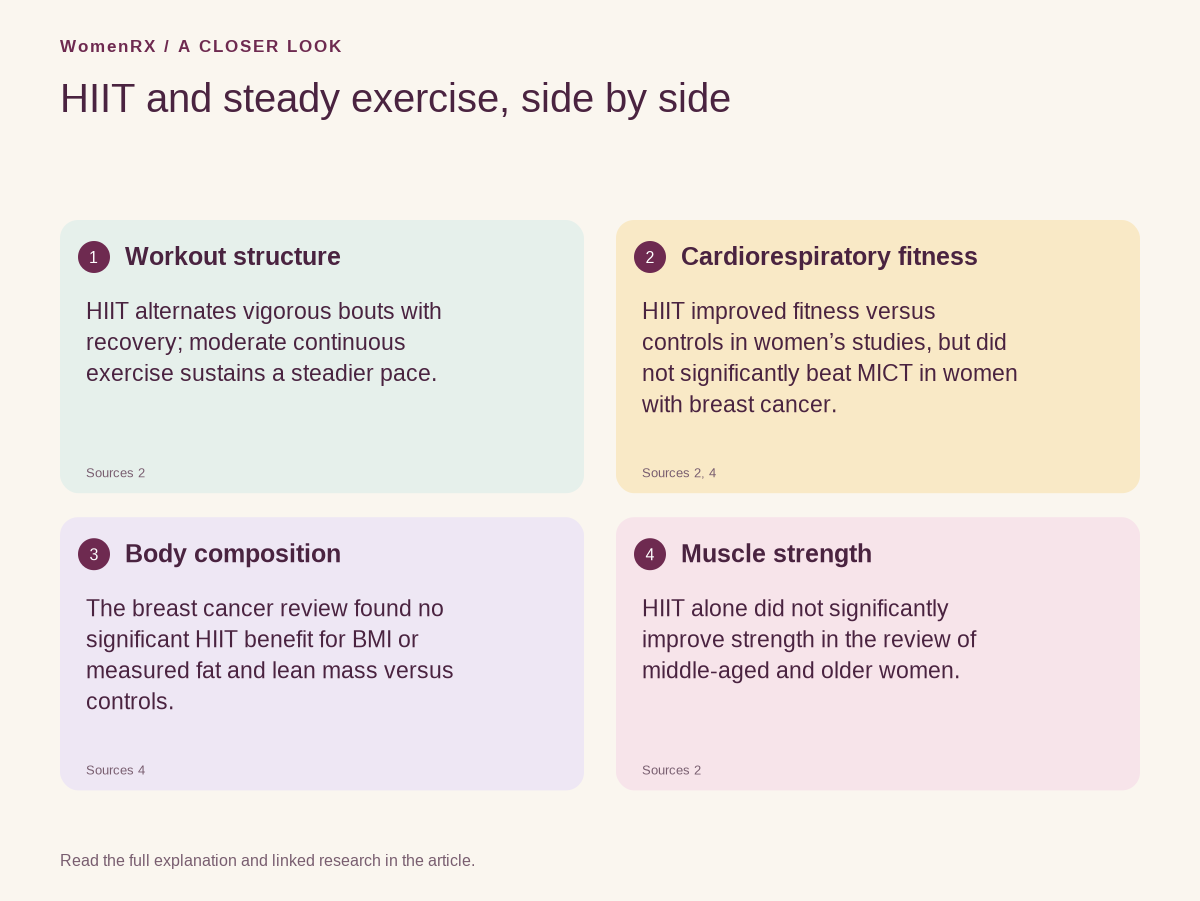
HIIT and steady exercise, side by side
Workout structure: HIIT alternates vigorous bouts with recovery; moderate continuous exercise sustains a steadier pace.2
Cardiorespiratory fitness: HIIT improved fitness versus controls in women’s studies, but did not significantly beat MICT in women with breast cancer.24
Body composition: The breast cancer review found no significant HIIT benefit for BMI or measured fat and lean mass versus controls.4
Muscle strength: HIIT alone did not significantly improve strength in the review of middle-aged and older women.2
Read the figure as text
The format differs, and the evidence varies by outcome. Neither approach is a universal winner.- Workout structure: HIIT alternates vigorous bouts with recovery; moderate continuous exercise sustains a steadier pace.2
- Cardiorespiratory fitness: HIIT improved fitness versus controls in women’s studies, but did not significantly beat MICT in women with breast cancer.24
- Body composition: The breast cancer review found no significant HIIT benefit for BMI or measured fat and lean mass versus controls.4
- Muscle strength: HIIT alone did not significantly improve strength in the review of middle-aged and older women.2
More questions, answered
Is HIIT necessary for weight loss?
No. These studies don’t show that HIIT is required for weight loss. In trials of women with breast cancer, HIIT didn’t significantly change body-composition measures compared with control interventions, and a small study of young women with obesity found improvements across more than one training approach. 3 4
Does HIIT work differently after menopause?
The review of middle-aged and older women included some postmenopausal participants, but it didn’t report results by menopause stage. It therefore can’t establish whether HIIT works differently before, during, or after menopause. 2
Sources you can check
- Benefits of Exercise: MedlinePlusAccessed 2026-09-25Return to first citation
- Effects of high intensity interval training (HIIT) on cardiopulmonary fitness and physical function in middle-aged and elderly women: a systematic review and meta-analysis.Cai L, Guo J, Zhang R, Gu J, Zhao L, Wu J, Yu Y, Chen S. · Frontiers in physiology · 2026Return to first citation
- Adaptive Responses of Cardiorespiratory Fitness and Cardiometabolic Risk Factors to Polarized Versus Other Types of Training Intensity Distribution in Obese Untrained Females.Zhou C, Teng Y, Xu Y. · Journal of sports science & medicine · 2026Return to first citation
- Effects of high‑intensity interval training on physical function and quality of life in breast cancer patients: a systematic review and meta-analysis.Zheng J, Yan R, Zhou S, Lin J. · BMC sports science, medicine & rehabilitation · 2026Return to first citation