Walking Workouts: Steady Pace or Intervals?
A steady walk is simple to repeat; varied-pace walking gives you another way to make a routine your own.
Choose steady walking if you want one pace you can comfortably sustain. Try varied pace if alternating easier and quicker stretches makes a walk more engaging. You can use either format to build a repeatable routine, but neither guarantees weight loss. The interval-walking study measured short-term responses, not weight change, while a women-only walking trial studied weight maintenance after dieting. 3 5
Start with the format you’ll repeat
A steady walk keeps roughly the same comfortable or purposeful pace throughout. A varied-pace walk alternates easier stretches with stretches that feel noticeably quicker for you. The choice is about how you want to structure your walk: the interval study did not measure weight loss, and the women-only walking trial did not compare pace formats. 3 5
Try steady walking if you prefer a straightforward routine, want to ease back into activity, or find pace changes unpleasant. Consider intervals if changing gears makes a walk more engaging. You can also keep most walks steady and experiment with a few quicker stretches in one session.
What the research can, and can’t, tell you
In a randomized, single-session study, 10 adults with type 2 diabetes, including three women, completed both a steady walk and interval walking. The interval session alternated three minutes of fast walking with three minutes of slow walking. Researchers matched the sessions for total oxygen use and found some differences in short-term measurements after exercise, but no difference between formats in the measured fat-oxidation response after the meal. The study did not test weight loss over time, and its small, mixed-sex sample can’t show that intervals lead to greater weight loss for women. 3
A separate randomized trial offers a women-specific, but different, piece of evidence. Premenopausal women who had lost weight on a very-low-energy diet were assigned to a weight-maintenance program that included counseling and either no added walking or walking at one of two activity levels. At the two-year follow-up, the lower walking-activity group had regained less weight and waist circumference than the control group. This supports a possible role for walking in maintaining weight loss after dieting; it does not compare steady walking with intervals or show that walking alone causes weight loss. 5
Exercise can support weight management, but body-weight change also depends on food and drink intake. Walking can still have health benefits even when the scale doesn’t change. 2 4
Build a week around the time you have
Here’s an example structure, not a tested weight-loss plan. Pick three days that fit your week, such as Monday, Wednesday, and Saturday. Leave room between walks to rest or move at an easy pace. For each day, choose the shorter or longer version based on your time and how walking feels right now.
- Walk 1: Steady. For a shorter walk, try about 10 to 15 minutes: begin easily, settle into a purposeful pace you could sustain, then ease off near the end. If you have more time, use the same pattern over roughly 25 to 30 minutes. Your purposeful pace should feel different from a stroll, not like a race.
- Walk 2: Steady or varied pace. You can repeat Walk 1. Or, after a few easy minutes, alternate about one minute of noticeably quicker walking with two minutes at your usual easy pace. Try a few rounds on a shorter walk, or keep alternating for longer if it feels manageable. Finish easily. The quicker stretch is a change of pace for you, not a sprint. These timings are planning examples; the research session used a different, three-minute fast and slow pattern and did not test long-term weight loss. 3
- Walk 3: Easy or steady. Repeat the shorter steady walk, or take a longer comfortable walk if you feel ready. If you’re tired or pressed for time, walk easily for a few minutes or take a rest day instead.
If you’re starting from very little activity, choose the shorter, steady versions first. Once those fit comfortably into your week, you could lengthen a walk or try a few quicker stretches in Walk 2. Change one thing at a time so you can tell whether the routine still feels workable. Starting slowly and finding ways to fit activity into daily life are consistent with MedlinePlus guidance. 2
Adjust for how your body feels
If quicker stretches don’t feel good, slow down or return to steady walking. Pelvic pain can sometimes occur during activities such as exercise; if it keeps coming back or doesn’t go away, seek medical advice rather than trying to push through it. 1
Keep the version of the week you can return to. An easier pace, a shorter walk, or rest is part of making the routine workable, not a failed workout.
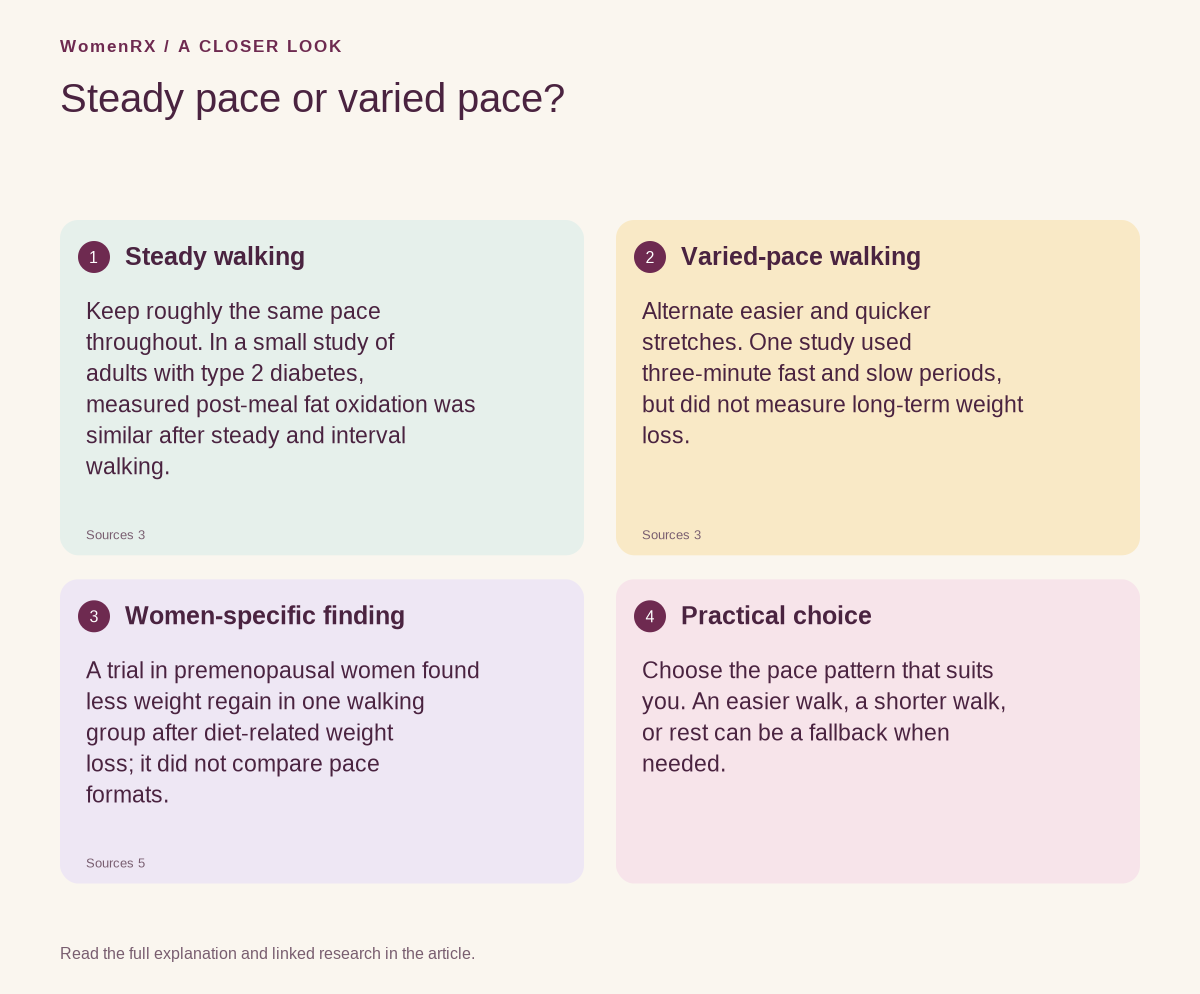
Steady pace or varied pace?
Steady walking: Keep roughly the same pace throughout. In a small study of adults with type 2 diabetes, measured post-meal fat oxidation was similar after steady and interval walking.3
Varied-pace walking: Alternate easier and quicker stretches. One study used three-minute fast and slow periods, but did not measure long-term weight loss.3
Women-specific finding: A trial in premenopausal women found less weight regain in one walking group after diet-related weight loss; it did not compare pace formats.5
Practical choice: Choose the pace pattern that suits you. An easier walk, a shorter walk, or rest can be a fallback when needed.
Read the figure as text
Compare the two walking formats by how a session is structured and what the weight-related studies actually measured.- Steady walking: Keep roughly the same pace throughout. In a small study of adults with type 2 diabetes, measured post-meal fat oxidation was similar after steady and interval walking.3
- Varied-pace walking: Alternate easier and quicker stretches. One study used three-minute fast and slow periods, but did not measure long-term weight loss.3
- Women-specific finding: A trial in premenopausal women found less weight regain in one walking group after diet-related weight loss; it did not compare pace formats.5
- Practical choice: Choose the pace pattern that suits you. An easier walk, a shorter walk, or rest can be a fallback when needed.
Sources you can check
- Pelvic pain - NHSAccessed 2026-09-25Return to first citation
- Benefits of Exercise: MedlinePlusAccessed 2026-09-25Return to first citation
- The effects of interval- vs. continuous exercise on excess post-exercise oxygen consumption and substrate oxidation rates in subjects with type 2 diabetes.Karstoft K, Wallis GA, Pedersen BK, Solomon TP. · Metabolism: clinical and experimental · 2016Return to first citation
- Exercise Training Is Associated With Treatment Response in Liver Fat Content by Magnetic Resonance Imaging Independent of Clinically Significant Body Weight Loss in Patients With Nonalcoholic Fatty Liver Disease: A Systematic Review and Meta-Analysis.Stine JG, DiJoseph K, Pattison Z, Harrington A, Chinchilli VM, Schmitz KH, Loomba R. · The American journal of gastroenterology · 2023Return to first citation
- Effects of walking training on weight maintenance after a very-low-energy diet in premenopausal obese women: a randomized controlled trial.Fogelholm M, Kukkonen-Harjula K, Nenonen A, Pasanen M. · Archives of internal medicine · 2000Return to first citation