What Is a Realistic Pace for Weight Loss?
A useful weight-loss timeline leaves room for your health needs, ordinary scale changes, and a plan you can sustain.
For adults trying to lose weight, the CDC describes about 1 to 2 pounds a week as a gradual pace associated with a better chance of keeping weight off. It isn’t a personal safety target or a promise of steady weekly loss. Your health history, life stage, and how the plan affects you matter more than a deadline.117
Use the weekly range as a reference, not a deadline
The CDC’s general guidance favors gradual weight loss, about 1 to 2 pounds a week, over faster loss for people who want to keep weight off. That range can help you question a demanding deadline, but it cannot tell you whether a particular pace is appropriate for you. Medicines, medical conditions, stress, sleep, age, and your surroundings can all affect weight management. If you’re considering a weight-loss plan, your health history and goals belong in the decision too.1187
A practical way to set a timeline is to start with changes you can repeat, then revisit the goal rather than treating every week as a test. For example, replacing a usual sugary drink with water or taking a walk that fits your schedule is more specific than promising to reach a certain weight by a certain date. The CDC recommends realistic short-term goals and regular reassessment of what is and isn’t working.11
A scale reading is not the whole result
Your weight includes water, muscle, bone, and fat. That means a change on the scale does not, by itself, show how much body fat you’ve lost. An isolated reading deserves less weight in your decision than the broader pattern and how you’re doing. Weight also doesn’t capture the whole health picture: energy, health history, and, particularly for older adults, muscle and strength matter.7
This distinction works both ways. A week without a lower number isn’t proof that your efforts have failed, and a faster drop isn’t automatically better. Rather than pushing harder to meet a date, ask whether the habits behind your plan are workable and whether the goal still fits your circumstances. The CDC advises reviewing progress regularly and revising goals when needed.117
Know when the timeline needs a different conversation
Pregnancy is not the time to apply an ordinary weight-loss deadline. Weight gain serves the pregnancy, and guidance warns against dieting to lose weight while pregnant. If your weight concerns you during pregnancy, raise them with your prenatal care team rather than using a general adult rate.9
After birth, recovery brings physical and emotional demands. If you’re breastfeeding, your nutritional needs are different too; the calories you need depend partly on your activity and whether you’re exclusively breastfeeding. A pre-pregnancy timeline may not fit this period. Ask about a goal that accounts for recovery and feeding, rather than assuming the general weekly range applies.210
Your relationship with eating also matters. Some adults seeking weight management have eating disorders or disordered eating behaviors. Research on structured behavioral programs often finds no average worsening in eating-disorder symptoms, but individual experiences can differ. If a deadline is driving distress or disordered eating, say so when discussing your goal; a lower number on the scale is not the only outcome that matters.65
For older adults, preserving muscle and strength is an additional consideration. Studies of intentional weight-loss programs in selected older adults report group results, not a weekly pace that suits every older person.734
When weight loss calls for care rather than a revised goal
There’s a difference between an uneven result while you’re deliberately making changes and weight that keeps falling when you haven’t changed your eating or activity. Unintentional loss can have causes ranging from stress and medicine effects to medical conditions. If you keep losing weight without trying, arrange a medical assessment; seek advice sooner if other symptoms appear alongside the loss.17
If you are trying to lose weight, a useful goal-setting conversation is specific: What health outcome are we aiming for? Do my health conditions, medicines, age, pregnancy or postpartum circumstances change the plan? How will we tell whether it’s working without relying on one scale reading? And what would make us pause or revise it? Those questions leave room for a plan built around your health, not just the calendar.711210
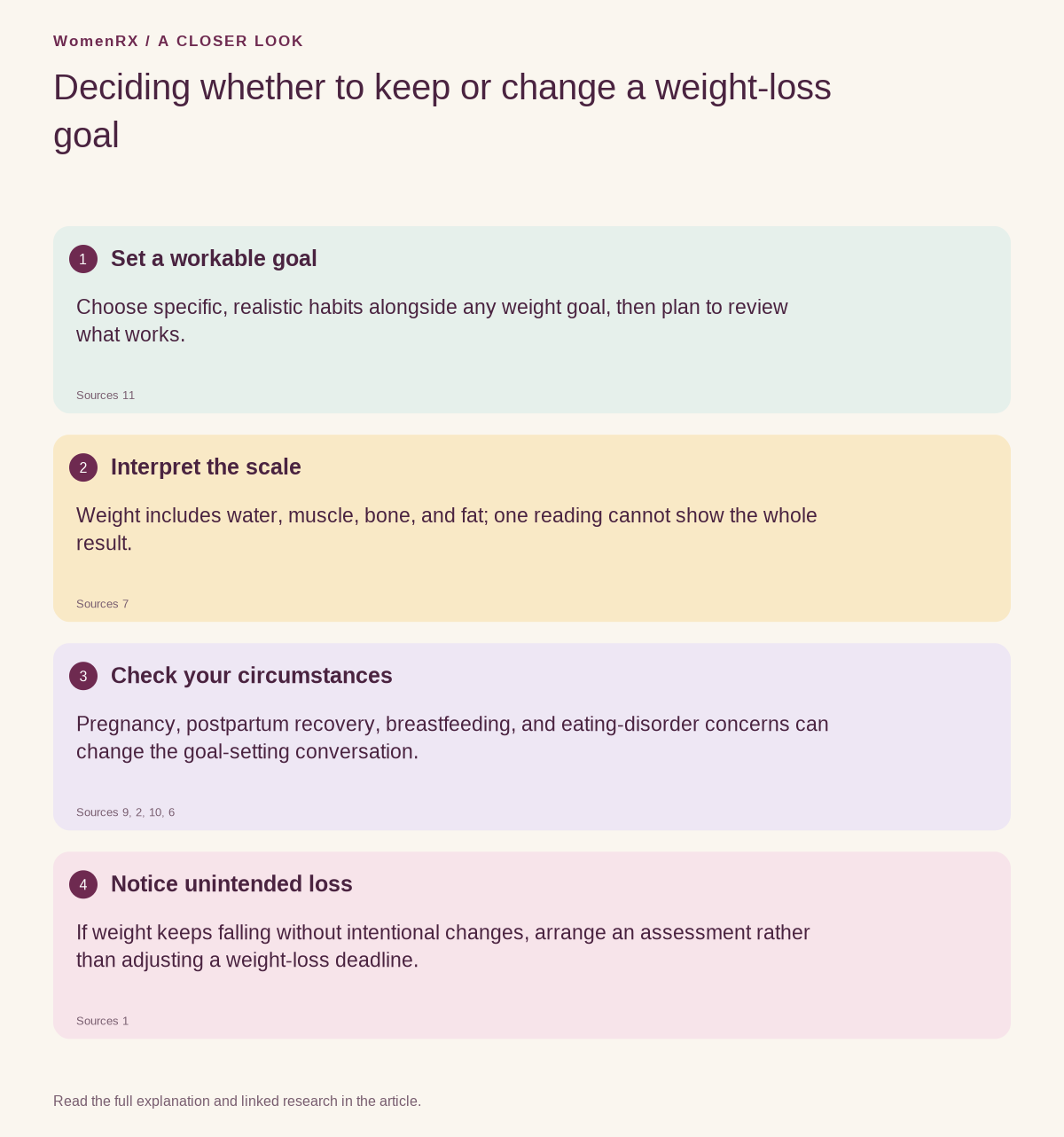
Deciding whether to keep or change a weight-loss goal
Set a workable goal: Choose specific, realistic habits alongside any weight goal, then plan to review what works.11
Interpret the scale: Weight includes water, muscle, bone, and fat; one reading cannot show the whole result.7
Check your circumstances: Pregnancy, postpartum recovery, breastfeeding, and eating-disorder concerns can change the goal-setting conversation.92106
Notice unintended loss: If weight keeps falling without intentional changes, arrange an assessment rather than adjusting a weight-loss deadline.1
Read the figure as text
Four different questions help put a deadline and a scale reading in context.- Set a workable goal: Choose specific, realistic habits alongside any weight goal, then plan to review what works.11
- Interpret the scale: Weight includes water, muscle, bone, and fat; one reading cannot show the whole result.7
- Check your circumstances: Pregnancy, postpartum recovery, breastfeeding, and eating-disorder concerns can change the goal-setting conversation.92106
- Notice unintended loss: If weight keeps falling without intentional changes, arrange an assessment rather than adjusting a weight-loss deadline.1
Sources you can check
- Unintentional weight loss - NHSAccessed 2026-09-25Return to first citation
- Postpartum Care: MedlinePlusAccessed 2026-09-25Return to first citation
- The effect of intentional weight loss on all-cause mortality in older adults: results of a randomized controlled weight-loss trial.Shea MK, Nicklas BJ, Houston DK, Miller ME, Davis CC, Kitzman DW, Espeland MA, Appel LJ, Kritchevsky SB. · The American journal of clinical nutrition · 2011Return to first citation
- The effect of randomization to weight loss on total mortality in older overweight and obese adults: the ADAPT Study.Shea MK, Houston DK, Nicklas BJ, Messier SP, Davis CC, Miller ME, Harris TB, Kitzman DW, Kennedy K, Kritchevsky SB. · The journals of gerontology. Series A, Biological sciences and medical sciences · 2010Return to first citation
- Effect of Behavioral Weight Management Interventions on Symptoms of Binge-Eating Disorder and Bulimia Nervosa: A Systematic Review and Meta-Analysis.Berry MP, Gunderson CG, Alshaeba SE, Funaro MC, Holleck JL, Marhoffer EA, Masheb RM. · Obesity reviews : an official journal of the International Association for the Study of Obesity · 2026Return to first citation
- Unpacking weight management interventions measuring eating disorder risk in adults: coding of components of interventions in a systematic review.Lister NB, Khalid R, Jardine IR, Pryde S, Melville H, Seidler AL, Hunter KE, Ahern AL, Baur LA, Braet C, Garnett SP, Hill AJ, Maguire S, Nicholls D, Paxton SJ, Piya MK, Sainsbury A... · Journal of eating disorders · 2026Return to first citation
- Body Weight: MedlinePlusAccessed 2026-09-25Return to first citation
- Weight Control: MedlinePlusAccessed 2026-09-25Return to first citation
- Weight gain in pregnancy - NHSAccessed 2026-09-25Return to first citation
- Maternal Diet and Breastfeeding | Breastfeeding special circumstances | CDCAccessed 2026-09-25Return to first citation
- Steps for Losing Weight | Healthy Weight and Growth | CDCAccessed 2026-09-25Return to first citation