Retatrutide for Weight Loss: What Trials Show
Retatrutide has produced substantial weight loss in a phase 2 obesity trial, but trial results alone don’t establish approved routine use or answer every safety question.
If you’ve heard retatrutide called “Reta,” it’s being studied in clinical trials. In a 48-week phase 2 trial of adults with obesity or overweight plus a weight-related condition, the 12 mg group had a mean weight reduction of up to 24.2%. That’s a study average, not a personal forecast, and it doesn’t settle long-term safety. 2
What “Reta” means in the research
Retatrutide is a medicine designed to activate three hormone receptors: GIP, GLP-1, and glucagon. You may have heard retatrutide called “Reta.” The nickname itself isn’t a clinical result: evaluate a weight-loss claim by looking at the study population, comparison, and follow-up behind it.
Clinical publications describe retatrutide as under development. A phase 3 program is evaluating it for weight management and related conditions, but trial results alone don’t establish approved, routine-care use or verify its current US approval status. 34
What the weight-loss result can tell you
In a 48-week, randomized, placebo-controlled phase 2 trial, adults had obesity or overweight with at least one weight-related complication. They did not have diabetes. The reported mean weight reduction in the 12 mg group reached up to 24.2% at week 48. It’s a group average from a particular trial, not a promised result, and it doesn’t establish how results compare with other treatments in everyday care. 2
A systematic review of three clinical-trial reports also found that retatrutide reduced weight in the studies it assessed. That’s a small evidence base. The obesity trial described above ran for 48 weeks, while the separate diabetes trial below ran for 40 weeks; neither duration answers how well treatment works over years or for people unlike those enrolled. 123
A separate phase 3 trial studied adults with type 2 diabetes whose blood sugar was not adequately controlled by diet and exercise alone. At week 40, average body weight changed by −15.3% in the 12 mg group and −2.6% with placebo. Those figures apply to that diabetes trial population; they shouldn’t be treated as the expected result for an obesity trial in people without diabetes. 3
What side effects and safety results mean
Gastrointestinal effects were the most commonly reported side effects in the reviewed retatrutide trials. That tells you what came up often in the studies; it doesn’t establish that these are the only possible risks or settle safety with longer use. 15
In the phase 3 diabetes trial, the most frequent side effects were generally mild to moderate gastrointestinal events and tended to subside over time. Study treatment was discontinued because of side effects by 2-5% of participants receiving retatrutide, compared with 0% receiving placebo. These results are specific to that 40-week diabetes study, not a complete long-term safety picture for weight treatment. 3
What the reported results say about women
Women were represented in the published trial evidence: the abstract of a 2025 review of three clinical reports counted 356 women and 335 men among 691 participants assigned to trial groups. The abstract does not report weight-loss results or side effects separately by sex. Enrollment alone can’t answer whether outcomes differed for women and men. 1
The trial findings reported here don’t include pregnancy or reproductive-safety results. That means these results don’t answer whether retatrutide is safe during pregnancy or what the evidence means for someone planning a pregnancy. If that applies to you, ask a clinician how the available evidence and your circumstances affect treatment decisions rather than assuming general adult results answer the question.
Questions that get beyond online claims
If you’re discussing retatrutide with a clinician, useful questions include:
- Is this a clinical trial, or is someone offering a product outside a trial?
- Which study population and timeframe does a quoted weight-loss number come from?
- What side effects were reported, and how long did that study follow participants?
- Do published results address people like me, including my health conditions and pregnancy plans?
- What established treatment options fit my needs while evidence on retatrutide develops?
These questions help separate a trial result from an online promise. A large average change in a study can be scientifically meaningful without establishing an individual outcome, long-term safety, or approved routine-care use.
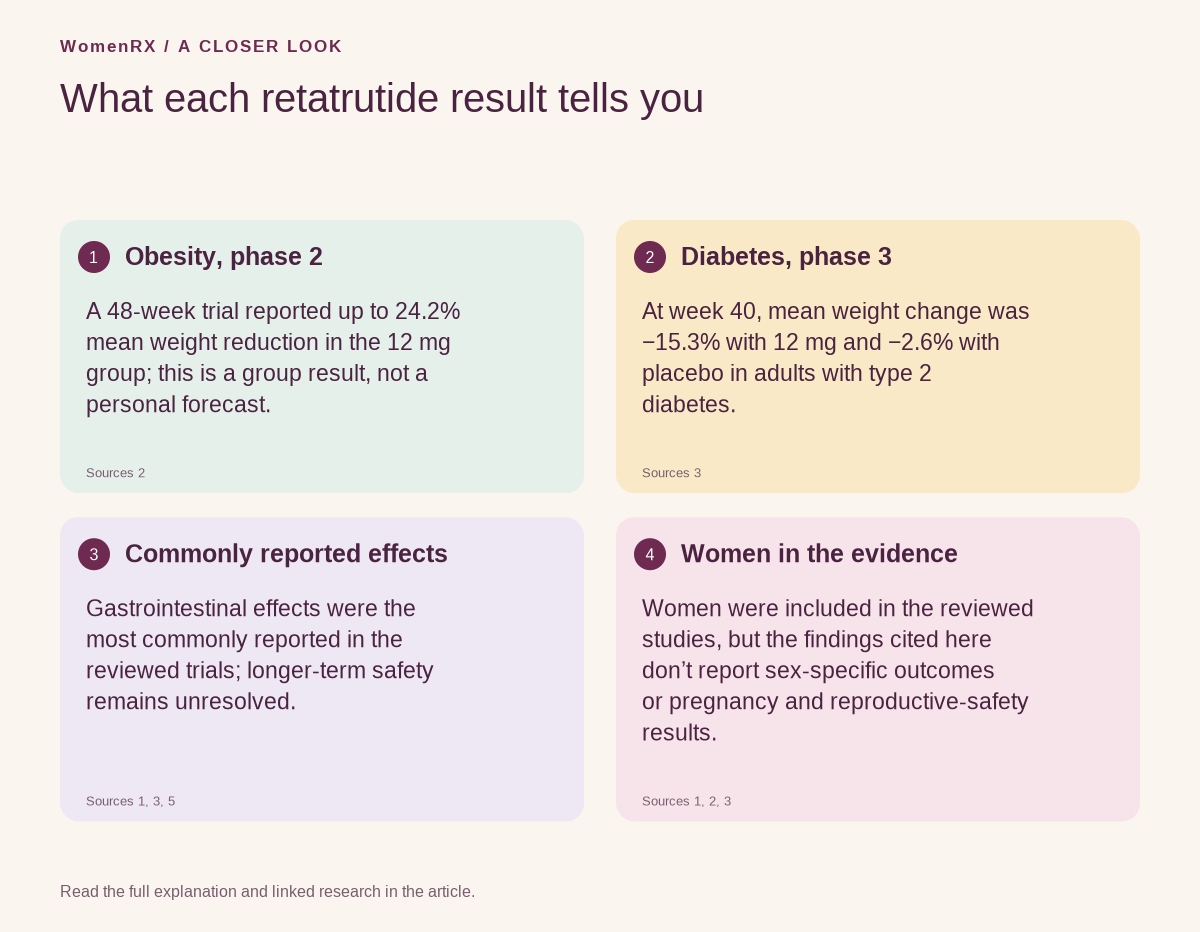
What each retatrutide result tells you
Obesity, phase 2: A 48-week trial reported up to 24.2% mean weight reduction in the 12 mg group; this is a group result, not a personal forecast.2
Diabetes, phase 3: At week 40, mean weight change was −15.3% with 12 mg and −2.6% with placebo in adults with type 2 diabetes.3
Commonly reported effects: Gastrointestinal effects were the most commonly reported in the reviewed trials; longer-term safety remains unresolved.135
Women in the evidence: Women were included in the reviewed studies, but the findings cited here don’t report sex-specific outcomes or pregnancy and reproductive-safety results.123
Read the figure as text
The study population and evidence stage change what a reported outcome can reasonably mean.- Obesity, phase 2: A 48-week trial reported up to 24.2% mean weight reduction in the 12 mg group; this is a group result, not a personal forecast.2
- Diabetes, phase 3: At week 40, mean weight change was −15.3% with 12 mg and −2.6% with placebo in adults with type 2 diabetes.3
- Commonly reported effects: Gastrointestinal effects were the most commonly reported in the reviewed trials; longer-term safety remains unresolved.135
- Women in the evidence: Women were included in the reviewed studies, but the findings cited here don’t report sex-specific outcomes or pregnancy and reproductive-safety results.123
More questions, answered
Does “Reta” mean an approved weight-loss medicine?
No approval claim can be inferred from the nickname “Reta” or from weight-loss trial results. Clinical publications describe retatrutide as under development, but they cannot verify its current US approval status. Check current US approval information before treating an offer as an approved prescription medicine. 34
Were women included in retatrutide studies?
Yes. The abstract of a review of three clinical reports counted 356 women among 691 participants assigned to study groups. It does not report sex-specific weight-loss or side-effect results, so those reported findings can’t show whether outcomes were the same for women and men. 1
Sources you can check
- Efficacy and safety of retatrutide for the treatment of obesity: a systematic review of clinical trials.Misra S, Narayan RK, Kaur M. · Journal of basic and clinical physiology and pharmacology · 2025Return to first citation
- Perceived benefits of treatment for obesity with retatrutide: A qualitative study of patients in a phase 2 clinical trial.Goetz IA, Kanu C, Hoover A, Jimenez-Moreno C, Karn H, Kimel M, Neff LM, Boye KS. · Obesity pillars · 2025Return to first citation
- Efficacy and safety of retatrutide, a GIP, GLP-1, and glucagon receptor agonist, in people with type 2 diabetes and inadequate glycaemic control with diet and exercise (TRANSCEND-T2D-1): a double-blind, randomised, phase 3 trial.Bajaj HS, Welch M, Shah P, Luna E, Jaouimaa FZ, Liu B, Liu R, Chen Y, Patel H, Bartee A. · Lancet (London, England) · 2026Return to first citation
- Retatrutide for the treatment of obesity, obstructive sleep apnea and knee osteoarthritis: Rationale and design of the TRIUMPH registrational clinical trials.Giblin K, Kaplan LM, Somers VK, Le Roux CW, Hunter DJ, Wu Q, Lalonde A, Ahmad N, Bethel MA. · Diabetes, obesity & metabolism · 2026Return to first citation
- Triple Agonism Based Therapies for Obesity.Goldney J, Hamza M, Surti F, Davies MJ, Papamargaritis D. · Current cardiovascular risk reports · 2025Return to first citation