Chromium for Weight Loss: What the Trials Show
Trials show a very small average weight difference from placebo, not a result you can count on.
Across 21 trials involving 1,316 adults with overweight or obesity, people taking chromium lost 0.75 kg more than those taking placebo, on average, over 9 to 24 weeks. Researchers considered the effect too small to have much clinical significance. A separate trial in women found no independent effect on weight or body fat. 1 4
Chromium is promoted for weight loss partly because it might affect hunger, cravings, or how the body uses glucose. But the question that matters if you’re considering a supplement is simpler: did people lose meaningfully more weight when they took it? Across trials, the answer is generally no. 1
The pooled weight difference was less than a kilogram
A 2019 meta-analysis combined 21 trials involving 1,316 adults with overweight or obesity. The trials lasted 9 to 24 weeks and tested several forms of chromium, most often chromium picolinate. Compared with placebo, chromium groups lost an average of 0.75 kg more weight. They also had a 0.40 kg/m² greater reduction in BMI and a 0.68 percentage-point greater reduction in body-fat percentage. Waist circumference and waist-to-hip ratio did not change significantly compared with placebo. 1
That 0.75 kg is the difference between groups, not the total weight anyone lost. It also isn’t a prediction of what you would lose. The NIH Office of Dietary Supplements describes the pooled weight and body-fat effects as very small and of little clinical significance. A Cochrane review discussed in its fact sheet rated the overall evidence quality as low. 1
An individual trial helps put the pooled result in perspective. In a randomized pilot trial of 80 otherwise healthy adults with overweight, chromium picolinate did not produce a significant BMI difference from placebo at either 12 or 24 weeks. That finding doesn’t cancel out the pooled average. It does show why a small average difference shouldn’t be mistaken for a dependable result. 3
What can women take from these studies?
One randomized trial studied 83 women eating nutritionally balanced diets with controlled energy intake for 12 weeks. All groups lost some weight and fat, but chromium picolinate did not independently change weight or body fat compared with the control groups. Those results do not establish whether outcomes differ by menstrual or menopause status, or whether they apply during pregnancy. 4
The pooled estimate describes adults with overweight or obesity. It does not provide a women-specific estimate or show whether effects differ during cycling years, perimenopause, or postmenopause. There’s no basis here for claiming a special weight-loss effect at any of those stages. 1
A study in overweight women with polycystic ovary syndrome (PCOS) did find greater weight loss in a group taking chromium with carnitine than in a placebo group over 12 weeks. Because the two supplements were given together, the trial cannot tell us whether chromium caused the difference. It also cannot establish the same result for women without PCOS. 2
Appetite and glucose aren’t substitutes for weight results
Chromium’s proposed effects on insulin action, hunger, food intake, and cravings offer reasons to study it. Appetite-related findings remain preliminary, though, and a possible mechanism isn’t evidence that a supplement produces meaningful weight loss. 1
The same distinction applies to blood glucose. Studies in people with diabetes have produced mixed findings, and a change in a glucose measure does not demonstrate a change in body weight. If a product points to glucose research to support a weight-loss claim, look for weight outcomes in trials of that product or its ingredients instead. 1
Is it worth buying for weight loss?
For weight, the pooled result is small and the evidence is low quality. For body composition, the average body-fat difference is also small, with no significant pooled change in waist measures. A combination-product result cannot tell you what chromium alone will do. 1 2
Safety matters to that decision, too. No tolerable upper intake level has been set for chromium, but that does not mean high-dose supplements are proven safe. Safety data are limited, and people with kidney or liver disease may be more susceptible to harm from high intakes. 1
If your goal is a noticeable change in weight or body composition, these trials give you little reason to expect chromium to deliver it.
Which chromium outcomes changed?
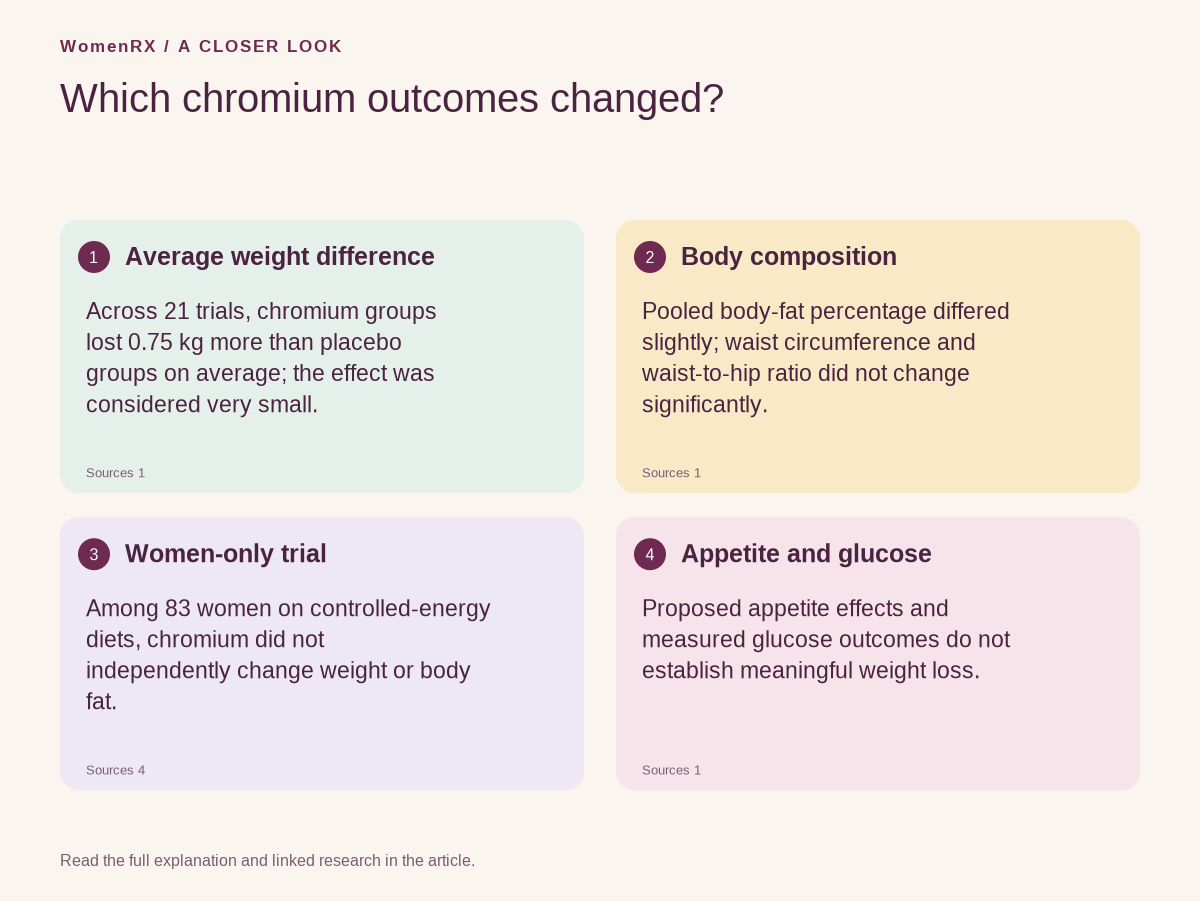
Average weight difference: Across 21 trials, chromium groups lost 0.75 kg more than placebo groups on average; the effect was considered very small.1
Body composition: Pooled body-fat percentage differed slightly; waist circumference and waist-to-hip ratio did not change significantly.1
Women-only trial: Among 83 women on controlled-energy diets, chromium did not independently change weight or body fat.4
Appetite and glucose: Proposed appetite effects and measured glucose outcomes do not establish meaningful weight loss.1
Read the figure as text
A side-by-side view of direct weight findings, body-composition findings, and measures that cannot stand in for weight loss.- Average weight difference: Across 21 trials, chromium groups lost 0.75 kg more than placebo groups on average; the effect was considered very small.1
- Body composition: Pooled body-fat percentage differed slightly; waist circumference and waist-to-hip ratio did not change significantly.1
- Women-only trial: Among 83 women on controlled-energy diets, chromium did not independently change weight or body fat.4
- Appetite and glucose: Proposed appetite effects and measured glucose outcomes do not establish meaningful weight loss.1
More questions, answered
Does chromium picolinate work better than other forms?
Most trials in the pooled analysis used chromium picolinate, while others used chromium-enriched yeast or chromium nicotinate. The pooled results do not establish that one form leads to better weight outcomes than another. 1
Sources you can check
- Chromium - Health Professional Fact SheetAccessed 2026-09-25Return to first citation
- Effects of Chromium and Carnitine Co-supplementation on Body Weight and Metabolic Profiles in Overweight and Obese Women with Polycystic Ovary Syndrome: a Randomized, Double-Blind, Placebo-Controlled Trial.Jamilian M, Foroozanfard F, Kavossian E, Kia M, Aghadavod E, Amirani E, Asemi Z. · Biological trace element research · 2020Return to first citation
- A pilot study of chromium picolinate for weight loss.Yazaki Y, Faridi Z, Ma Y, Ali A, Northrup V, Njike VY, Liberti L, Katz DL. · Journal of alternative and complementary medicine (New York, N.Y.) · 2010Return to first citation
- Chromium picolinate supplementation in women: effects on body weight, composition, and iron status.Lukaski HC, Siders WA, Penland JG. · Nutrition (Burbank, Los Angeles County, Calif.) · 2007Return to first citation