“Reta” and Retatrutide: What the Trials Actually Show
Retatrutide has produced weight-loss results in clinical trials, but those results can’t tell you what’s in a product offered as “reta.”
“Reta” may be shorthand for retatrutide, a compound being studied for obesity and type 2 diabetes. In trials, participants received a specified study treatment; a product using the same name hasn’t necessarily been tested or verified. Check the product’s identity and any approval claim separately from the research. 2 3
Start with the name, then separate the claims
Retatrutide acts on three hormone receptors: GIP, GLP-1, and glucagon. Researchers have studied it in adults with obesity and in adults with type 2 diabetes. 2 3 A seller might use “reta” to mean retatrutide, but that nickname alone tells you nothing certain about an offered item’s ingredient, strength, or source.
This is the central distinction: a trial result belongs to the specified treatment used in that trial. It doesn’t authenticate a separate product, even if the listing quotes the result accurately. 2 3
What has been measured in people
In a 48-week phase 2 trial, researchers studied adults with obesity, or with overweight and at least one weight-related complication, who did not have diabetes. The 12 mg study group had an average weight reduction of 24.2% at week 48. That’s a group average for a particular trial treatment, not a prediction of what will happen to one person and not evidence about a seller’s product. 2
A completed, 40-week phase 3 trial asked a different question. It studied adults whose type 2 diabetes was not adequately controlled with diet and exercise alone. Change in blood sugar was its primary outcome; change in body weight was a key secondary outcome. Average weight change was −15.3% in the 12 mg retatrutide group, compared with −2.6% in the placebo group. Those figures describe people with type 2 diabetes, so they shouldn’t be substituted for results from the obesity trial. Gastrointestinal events were the most frequent adverse events with retatrutide in this trial. 3
You may also see references to the TRIUMPH phase 3 obesity studies. A report describing their design explains which outcomes those studies are set up to measure, including weight change. A study plan isn’t a completed result. 4
What the reported findings show about women
Women took part in the research. The abstract of a systematic review of three clinical-trial articles reports 356 women among 691 participants assigned to trial groups, or 52%. That’s the share of randomized participants, not the share of everyone screened. The review abstract identifies gastrointestinal effects as the most commonly reported adverse effects; it doesn’t show separate weight-loss or adverse-event estimates for women. 1
The phase 3 diabetes trial abstract reports 296 women among its 537 randomized participants. It presents overall weight and blood-sugar findings, not sex-stratified estimates. 3 Those overall results also don’t establish retatrutide’s effects or safety during pregnancy. The adult trial results described here aren’t pregnancy-specific and can’t answer that question. 1 2 3
How to assess an offer without confusing it with a trial
If you’re looking at something labeled “reta,” these questions keep the product claim separate from the evidence:
- What exactly is it called? Does the seller state “retatrutide” as the ingredient, or rely on a nickname?
- What item is being offered? Look for a stated strength, manufacturer or source, and lot information. Those are details to verify, not proof that the contents match the label.
- Is approval being claimed? Check that claim against current public records from the medicines regulator where you live. A clinical-trial publication does not establish a product’s current approval status.
- Is a trial being cited? Check which population and outcome the quoted number comes from. A trial reference does not connect an offered item to the treatment used in that trial. 2 3
If those questions remain unanswered, a striking trial figure doesn’t fill the gaps. It tells you what researchers measured in a defined group, not what an unverified item contains.
Match the claim to the evidence
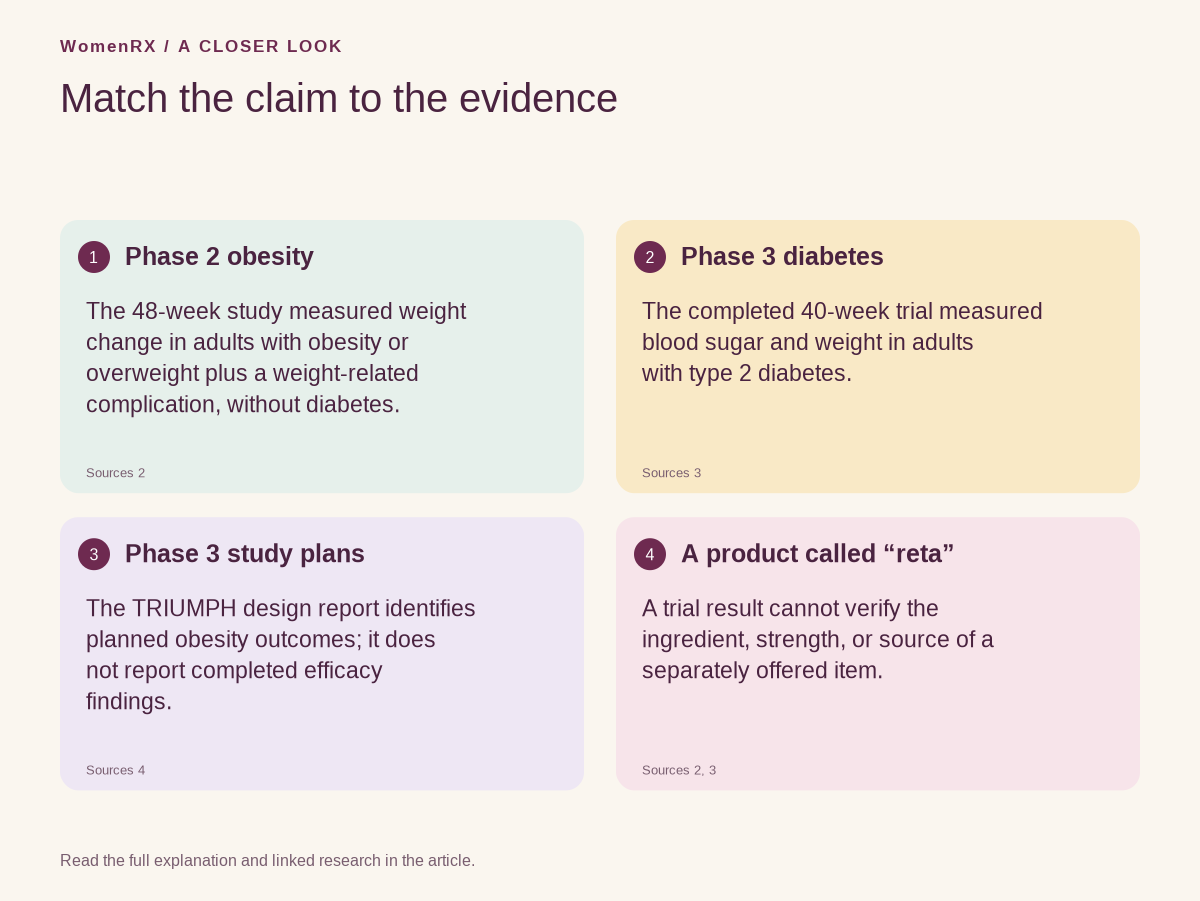
Phase 2 obesity: The 48-week study measured weight change in adults with obesity or overweight plus a weight-related complication, without diabetes.2
Phase 3 diabetes: The completed 40-week trial measured blood sugar and weight in adults with type 2 diabetes.3
Phase 3 study plans: The TRIUMPH design report identifies planned obesity outcomes; it does not report completed efficacy findings.4
A product called “reta”: A trial result cannot verify the ingredient, strength, or source of a separately offered item.23
Read the figure as text
A result is useful only when you know what was studied and what question it answers.- Phase 2 obesity: The 48-week study measured weight change in adults with obesity or overweight plus a weight-related complication, without diabetes.2
- Phase 3 diabetes: The completed 40-week trial measured blood sugar and weight in adults with type 2 diabetes.3
- Phase 3 study plans: The TRIUMPH design report identifies planned obesity outcomes; it does not report completed efficacy findings.4
- A product called “reta”: A trial result cannot verify the ingredient, strength, or source of a separately offered item.23
Sources you can check
- Efficacy and safety of retatrutide for the treatment of obesity: a systematic review of clinical trials.Misra S, Narayan RK, Kaur M. · Journal of basic and clinical physiology and pharmacology · 2025Return to first citation
- Perceived benefits of treatment for obesity with retatrutide: A qualitative study of patients in a phase 2 clinical trial.Goetz IA, Kanu C, Hoover A, Jimenez-Moreno C, Karn H, Kimel M, Neff LM, Boye KS. · Obesity pillars · 2025Return to first citation
- Efficacy and safety of retatrutide, a GIP, GLP-1, and glucagon receptor agonist, in people with type 2 diabetes and inadequate glycaemic control with diet and exercise (TRANSCEND-T2D-1): a double-blind, randomised, phase 3 trial.Bajaj HS, Welch M, Shah P, Luna E, Jaouimaa FZ, Liu B, Liu R, Chen Y, Patel H, Bartee A. · Lancet (London, England) · 2026Return to first citation
- Retatrutide for the treatment of obesity, obstructive sleep apnea and knee osteoarthritis: Rationale and design of the TRIUMPH registrational clinical trials.Giblin K, Kaplan LM, Somers VK, Le Roux CW, Hunter DJ, Wu Q, Lalonde A, Ahmad N, Bethel MA. · Diabetes, obesity & metabolism · 2026Return to first citation