Does Broccoli Help With Weight Loss?
Broccoli can be a useful, fiber-containing part of meals, but research hasn’t established a special weight-loss effect from broccoli itself.
Broccoli can fit into meals that support weight management, partly because vegetables provide fiber, which can help you feel full. But that general benefit isn’t proof that broccoli specifically causes weight loss. A review of broccoli-derived compounds found limited and inconsistent human evidence for changes in body weight, and it did not establish a distinct effect for women. 2 4
The short answer: useful food, not a weight-loss treatment
Broccoli can help make a meal more satisfying, but there’s no established special effect that makes it a fat-burning food. Its value is more ordinary and more useful: it’s a vegetable you can include in a varied eating pattern, and vegetables are sources of dietary fiber. Fiber adds bulk and can help you feel full sooner, which may support weight control. That general fiber benefit doesn’t show that broccoli itself produces weight loss. 2 3
The distinction matters. Adding broccoli to a meal can be a helpful food choice; expecting it to cause weight loss on its own is a different claim. A weight-management approach is built around the overall eating pattern and other habits, not one ingredient. 1 3
What broccoli-specific research can tell us
Broccoli contains compounds that researchers have studied, including sulforaphane. A 2026 narrative review looked at laboratory, animal, and human research on sulforaphane and broccoli-derived preparations. It described promising mechanisms and preclinical findings, but said human studies were limited and varied. Evidence for meaningful reductions in body weight, body fat, or body composition remained limited and inconsistent. 4
That means findings about a compound’s activity in cells or animals shouldn’t be treated as proof that eating broccoli will make a person lose weight. Nor does research on a broccoli-derived preparation automatically tell us what happens when someone eats broccoli as part of a meal. The review does not establish a separate weight-loss effect for women; its summary doesn’t report a women-specific result. 4
Make broccoli part of the meal, not the whole plan
A practical way to use broccoli is to include it in meals you already enjoy. For example, you could add it to a bean-and-grain bowl, stir it into pasta, serve it alongside eggs, or put it in a stir-fry. These are meal ideas, not weight-loss prescriptions. The useful question is whether the whole meal works for your appetite, preferences, and routine.
If you’re trying to change your weight, consider the tradeoff between adding and swapping. Adding broccoli to an already filling meal may not change the meal in the way you hoped. Using it in place of some of a less nourishing side, or building a meal around a mix of vegetables, protein foods, and grains, may be a more practical fit. A healthy eating pattern can include different foods and personal preferences; it doesn’t need to revolve around one vegetable or strict rules. 3
Broccoli is worth eating if you like it. Just let it be one useful option among many, rather than a test of whether your weight-loss plan is working.
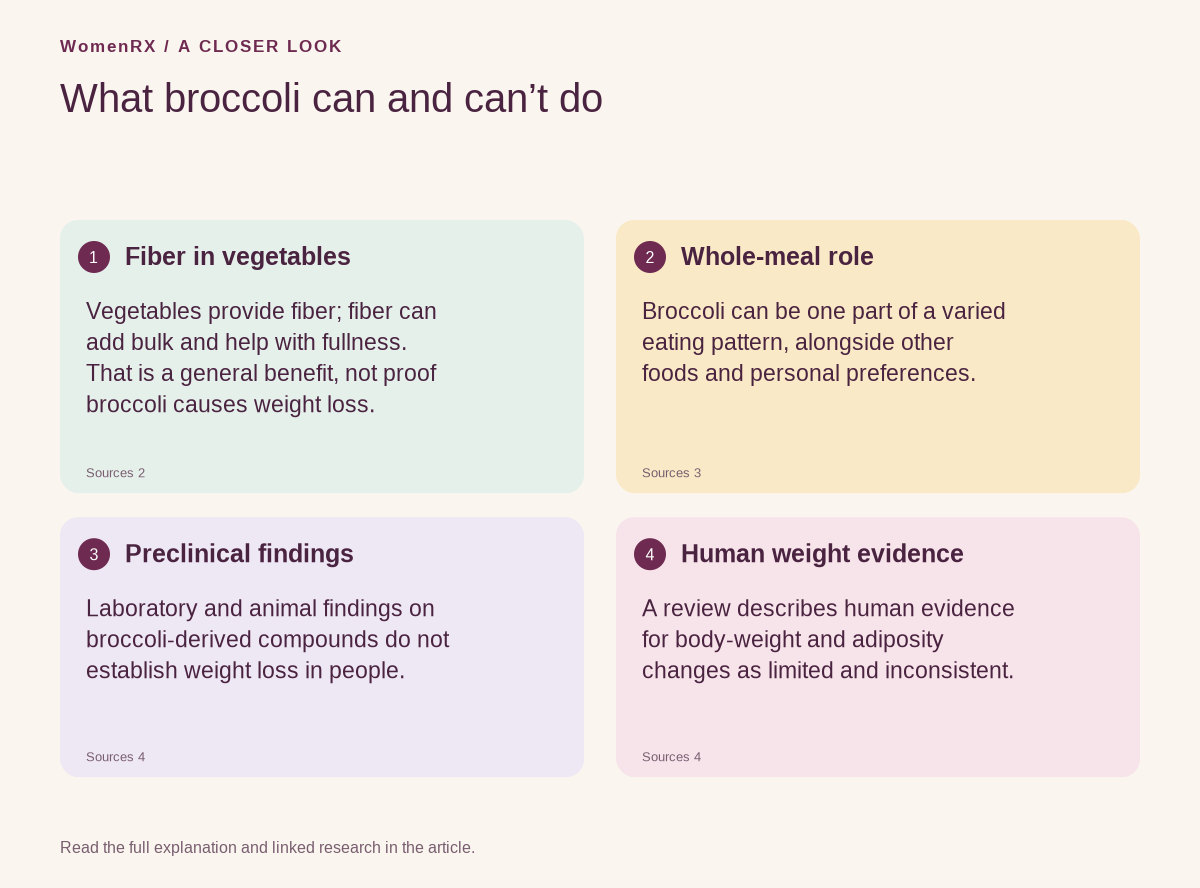
What broccoli can and can’t do
Fiber in vegetables: Vegetables provide fiber; fiber can add bulk and help with fullness. That is a general benefit, not proof broccoli causes weight loss.2
Whole-meal role: Broccoli can be one part of a varied eating pattern, alongside other foods and personal preferences.3
Preclinical findings: Laboratory and animal findings on broccoli-derived compounds do not establish weight loss in people.4
Human weight evidence: A review describes human evidence for body-weight and adiposity changes as limited and inconsistent.4
Read the figure as text
Separate the practical role of broccoli in meals from claims about direct weight loss.- Fiber in vegetables: Vegetables provide fiber; fiber can add bulk and help with fullness. That is a general benefit, not proof broccoli causes weight loss.2
- Whole-meal role: Broccoli can be one part of a varied eating pattern, alongside other foods and personal preferences.3
- Preclinical findings: Laboratory and animal findings on broccoli-derived compounds do not establish weight loss in people.4
- Human weight evidence: A review describes human evidence for body-weight and adiposity changes as limited and inconsistent.4
More questions, answered
Does broccoli have a proven women-specific weight-loss benefit?
A review of research on broccoli-derived compounds does not establish a distinct weight-loss effect for women. Its summary describes limited and inconsistent human weight evidence, without reporting a women-specific result. 4
Should I eat broccoli before meals to lose weight?
Fiber from vegetables may help with fullness, but that general effect doesn’t demonstrate that eating broccoli before meals is a weight-loss strategy. 2
Sources you can check
- Dietary Supplements for Weight Loss - Health Professional Fact SheetAccessed 2026-09-25Return to first citation
- Dietary Fiber: MedlinePlusAccessed 2026-09-25Return to first citation
- Nutrition: MedlinePlusAccessed 2026-09-25Return to first citation
- Sulforaphane and Broccoli-Derived Preparations in Obesity and Obesity-Related Metabolic Dysfunction: Mechanistic Insights, Preclinical Evidence, and Clinical Perspectives.Poulios E, Papadopoulou SK, Psara E, Tasoulas D, Giaginis C. · Pharmaceuticals (Basel, Switzerland) · 2026Return to first citation