What Broccoli Adds to a Meal Besides Protein
Broccoli brings fiber and a little protein to the plate; beans or chicken can add a more substantial protein contribution.
A half cup of raw chopped broccoli has about 1.1 grams of fiber and 1.2 grams of protein. Its fiber can help make a meal satisfying and support digestion, while foods such as beans or chicken do more of the work of supplying protein. Cooked broccoli is useful too, but raw serving numbers shouldn’t be treated as cooked serving numbers. 412
Think of broccoli as the vegetable, not the protein
If broccoli takes up a generous part of your plate, it may look like a substantial protein serving. The numbers tell a different story. A half cup of raw chopped broccoli, about 44 grams, provides approximately 1.1 grams of fiber and 1.2 grams of protein. Measure out two of those half cups and you’d have about 2.2 grams of fiber and 2.4 grams of protein before cooking. That’s a contribution, not the protein centerpiece of a meal. 4
Protein helps your body build and maintain muscle, skin, and other tissues. Beans, meat, dairy foods, and nuts are among the foods people use to get it. For example, broccoli alongside beans and rice gives you a vegetable and a separate protein source. Chicken with broccoli works on the same principle. You don’t need to find a way for the broccoli to do both jobs. 2
What the fiber does
Broccoli’s fiber is one reason it can make a meal feel more substantial than its protein number suggests. Fiber is a part of plant foods that adds bulk to what you eat. It can help you feel full sooner and supports digestion and regular bowel movements. That doesn’t mean a serving of broccoli will cause weight loss, or that it supplies all the fiber you need for the day. It means the vegetable adds something useful alongside the meal’s protein source. 14
If you’re adding more vegetables and other fiber-rich foods to your meals, build up gradually if your stomach is sensitive. A sudden increase in fiber can cause gas, bloating, or cramps. 1
Raw and cooked portions aren’t interchangeable
A cup measure describes how much space broccoli takes up, not a fixed amount of broccoli. The figures above are for raw, chopped broccoli measured before cooking. If you scoop a half cup of broccoli after cooking, don’t assign it the raw half-cup numbers: it’s a differently prepared portion, and these figures don’t establish its fiber or protein content. Cooking and storage can also change some of broccoli’s measured compounds. 43
For an everyday meal, you don’t have to settle the raw-versus-cooked math to use broccoli well. Choose the version you like and will eat, then consider the rest of the plate. A bowl of cooked broccoli with beans, for example, has a clear protein source; broccoli by itself is still mostly doing the vegetable’s job. The same distinction holds if you prefer it raw with a meal. 24
What about pregnancy, breastfeeding, or menopause?
During pregnancy, breastfeeding, or menopause, the raw half-cup figures are food-composition estimates, not guidance on how much broccoli or protein you personally need. Broccoli adds some fiber and a little protein; pairing it with beans or chicken provides another protein source. Protein needs vary with age, health, and activity. 412
Broccoli also contains vitamin C and other plant compounds, although their measured amounts and availability can change with preparation. Laboratory measurements of those compounds don’t show that broccoli has a special effect on hormones or prevents disease. The practical reason to put it on your plate is simpler: it adds a vegetable and some fiber, with a small amount of protein alongside. 34
What the broccoli portion tells you
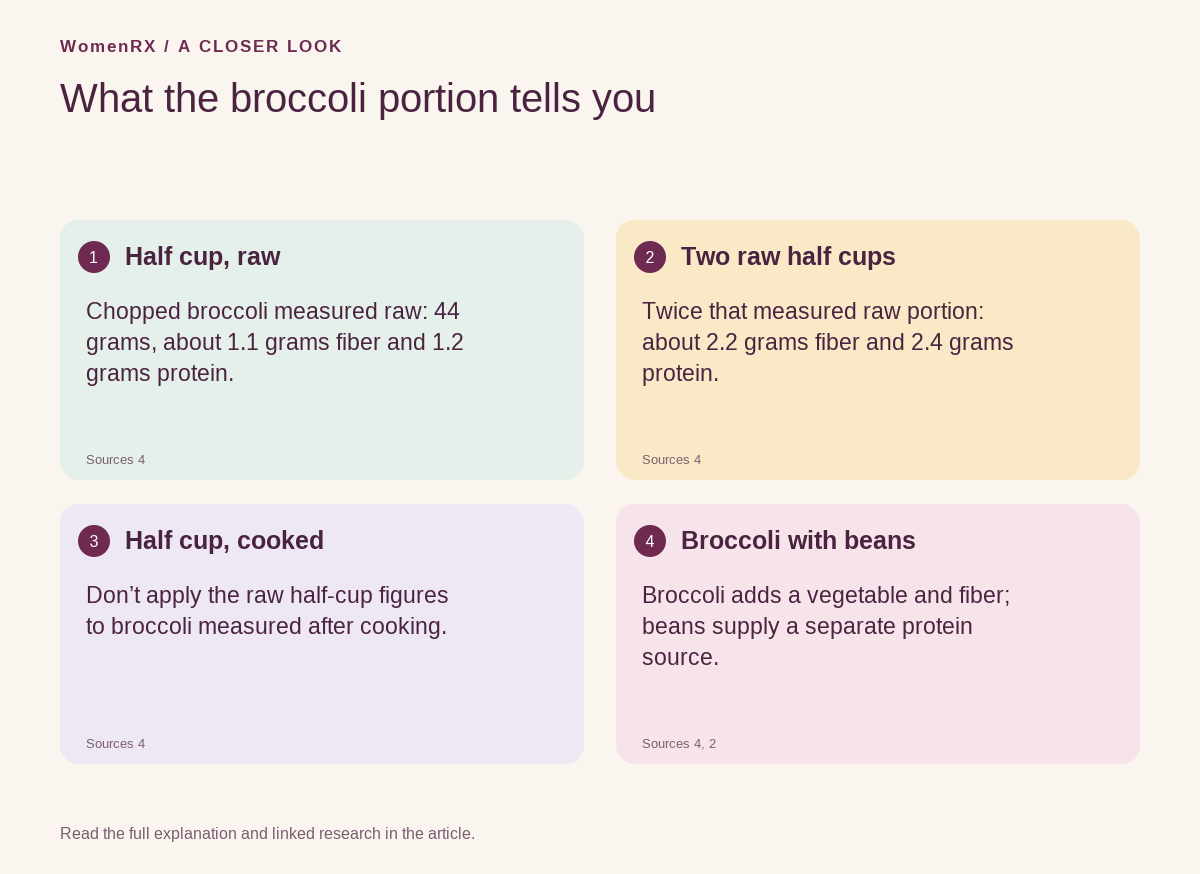
Half cup, raw: Chopped broccoli measured raw: 44 grams, about 1.1 grams fiber and 1.2 grams protein.4
Two raw half cups: Twice that measured raw portion: about 2.2 grams fiber and 2.4 grams protein.4
Half cup, cooked: Don’t apply the raw half-cup figures to broccoli measured after cooking.4
Broccoli with beans: Broccoli adds a vegetable and fiber; beans supply a separate protein source.42
Read the figure as text
Raw portion figures are useful for perspective; a cooked portion needs its own food-composition figures.- Half cup, raw: Chopped broccoli measured raw: 44 grams, about 1.1 grams fiber and 1.2 grams protein.4
- Two raw half cups: Twice that measured raw portion: about 2.2 grams fiber and 2.4 grams protein.4
- Half cup, cooked: Don’t apply the raw half-cup figures to broccoli measured after cooking.4
- Broccoli with beans: Broccoli adds a vegetable and fiber; beans supply a separate protein source.42
Sources you can check
- Dietary Fiber: MedlinePlusAccessed 2026-09-25Return to first citation
- Dietary Proteins: MedlinePlusAccessed 2026-09-25Return to first citation
- Evaluation of bioaccessibility of bioactive compounds in ready-to-eat refrigerated and frozen broccoli using in vitro digestion models.Abd Allah MA, Khiralla G, Elhariry H. · Scientific reports · 2025Return to first citation
- USDA SR Legacy: Broccoli, raw (FDC 170379)Accessed 2026-09-25Return to first citation