What Kale Adds to a Meal, and What It Doesn’t
A cup of raw kale brings vitamin K to the table, but it isn’t a substantial protein source.
Kale is a useful leafy green, especially for vitamin K. A cup of raw kale has about 0.6 grams of protein and 0.9 grams of fiber in USDA reference data, so it works better alongside a protein food than in place of one. Cooking changes some measured nutrients, but kale’s nutrient content doesn’t prove it prevents disease or improves bone or reproductive health in women. 7145
Put a cup of kale in perspective
Kale can do a lot for a meal: add leafy greens to a bowl, give a soup more substance, or make a side dish feel less like an afterthought. Its strongest case here is specific, not magical. The NIH Office of Dietary Supplements lists one cup of raw kale at 113 micrograms of vitamin K, about 94% of the Daily Value. Vitamin K helps your body make proteins involved in blood clotting and healthy bones and tissues. 12
Protein is a different story. USDA reference data estimate that one cup of raw kale, weighing 21 grams, contains 0.6 grams of protein and 0.9 grams of fiber. Those are contributions, but the protein amount is too small to make kale the protein anchor of a meal. The figures are estimates for raw kale, not promises about every bunch or a cup of cooked leaves. 7
If you’re making a kale salad and want it to serve as lunch, think of the kale as the vegetable and add a protein food. Tofu, tempeh, beans, lentils, eggs, fish, and dairy foods are all examples of protein sources. The amount in a particular serving depends on the food and, for packaged products, its label. 8 Kale’s fiber adds to what you get across the day, but 0.9 grams in that raw cup is also a reason not to treat one serving as your whole fiber plan. 7
Raw or cooked? Choose for the meal first
Raw kale holds up in a salad; cooked kale fits into a soup or a warm grain bowl. Preparation also changes what’s in the leaves. In a laboratory study of one kale variety, cooking substantially reduced measured vitamin C and polyphenols, while beta-carotene was more stable. Another laboratory study, which included specially iodine-enriched kale, found that steaming, blanching, and boiling generally reduced several measured compounds. Neither study tested whether people who ate raw rather than cooked kale had better health outcomes. 46
So there’s no need to force yourself to eat it raw for a theoretical advantage. If cooked kale is the version you enjoy and use, it still belongs on the plate. Just don’t apply the raw-cup nutrition figures to an equal-looking cup after cooking: the reference serving is measured as raw leaves. 7
What the health claims can actually tell you
The bone-health claim has a plausible starting point: vitamin K helps make proteins involved in healthy bones, and kale supplies vitamin K. But those facts alone don’t show that eating kale prevents fractures. That distinction matters especially after menopause, when osteoporosis is more common in women. Bone health also involves factors beyond one vegetable, including adequate calcium, vitamin D, and protein. 213
Cancer and reproductive-health claims need similar care. A systematic review found associations between cruciferous vegetables as a group and risks of several cancers, including ovarian and endometrial cancer. Its evidence came from observational case-control and cohort studies, not trials showing that kale prevents those cancers. Results for a vegetable group can’t tell you what one kale salad will do, or establish a reproductive-health benefit from kale itself. 5
One practical exception to the relaxed approach is vitamin K and blood-thinning medication. If you take a blood thinner whose effect is influenced by vitamin K, check with your care team before making a large change to how often you eat kale or other leafy greens. The point is to get advice about your usual eating pattern, not to assume kale must disappear from it. 2
Kale earns its place as a versatile green with a notable vitamin K contribution. Pair it with a real protein source when you need a satisfying meal, and prepare it in a way you’ll actually enjoy. 178
What a Cup of Kale Shows
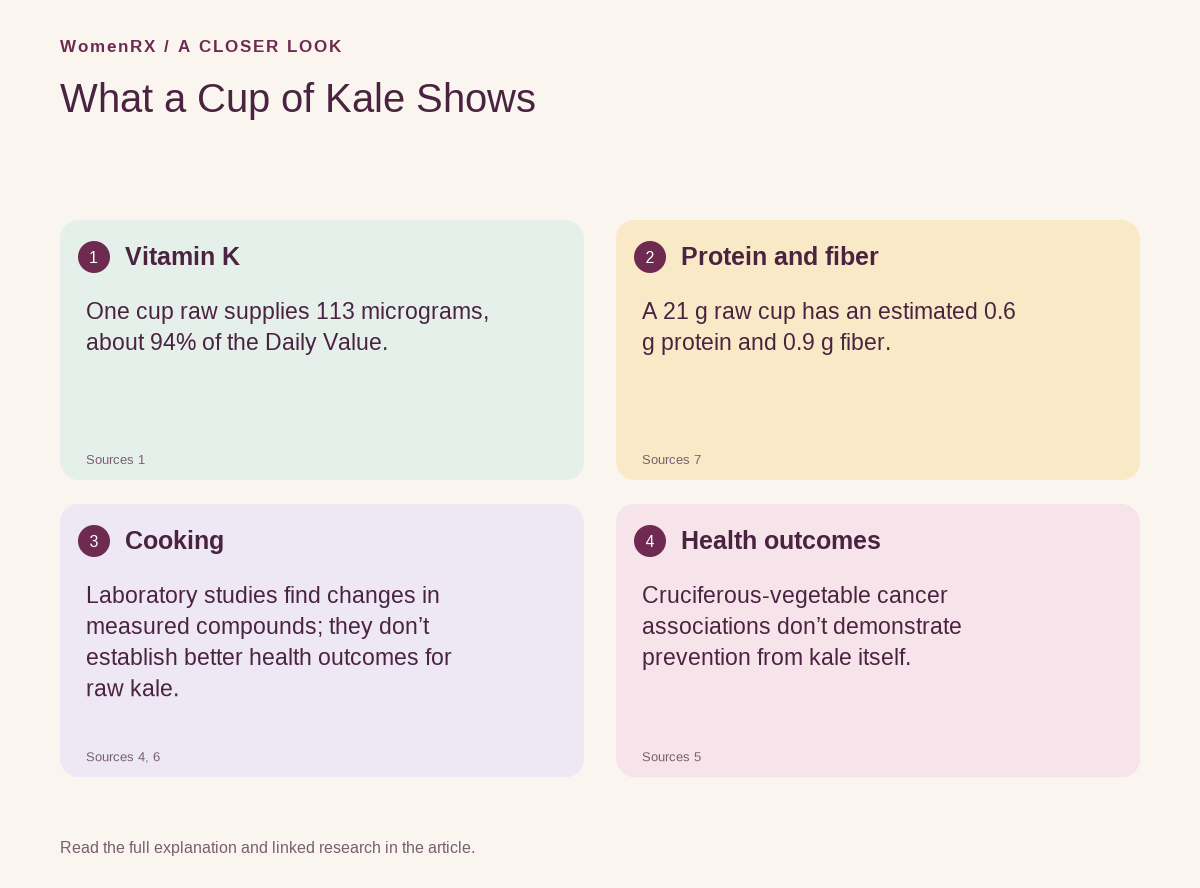
Vitamin K: One cup raw supplies 113 micrograms, about 94% of the Daily Value.1
Protein and fiber: A 21 g raw cup has an estimated 0.6 g protein and 0.9 g fiber.7
Cooking: Laboratory studies find changes in measured compounds; they don’t establish better health outcomes for raw kale.46
Health outcomes: Cruciferous-vegetable cancer associations don’t demonstrate prevention from kale itself.5
Read the figure as text
A quick separation of serving-level facts, preparation findings, and claims that require human outcome evidence.- Vitamin K: One cup raw supplies 113 micrograms, about 94% of the Daily Value.1
- Protein and fiber: A 21 g raw cup has an estimated 0.6 g protein and 0.9 g fiber.7
- Cooking: Laboratory studies find changes in measured compounds; they don’t establish better health outcomes for raw kale.46
- Health outcomes: Cruciferous-vegetable cancer associations don’t demonstrate prevention from kale itself.5
Sources you can check
- Vitamin K - Health Professional Fact SheetAccessed 2026-09-25Return to first citation
- Vitamin K: MedlinePlusAccessed 2026-09-25Return to first citation
- Osteoporosis | MedlinePlusAccessed 2026-09-25Return to first citation
- Composition and antioxidant activity of kale (Brassica oleracea L. var. acephala) raw and cooked.Sikora E, Bodziarczyk I. · Acta scientiarum polonorum. Technologia alimentaria · 2012Return to first citation
- Unveiling the Effects of Cruciferous Vegetable Intake on Different Cancers: A Systematic Review and Dose-Response Meta-analysis.Zheng S, Yan J, Wang J, Wang X, Kang YE, Koo BS, Shan Y, Liu L. · Nutrition reviews · 2025Return to first citation
- Iodine enriched kale (Brassica oleracea var. sabellica L.)-The influence of heat treatments on its iodine content, basic composition and antioxidative properties.Krzemińska J, Kapusta-Duch J, Smoleń S, Kowalska I, Słupski J, Skoczeń-Słupska R, Krawczyk K, Waśniowska J, Koronowicz A. · PloS one · 2024Return to first citation
- USDA SR Legacy: Kale, raw (FDC 168421)Accessed 2026-09-25Return to first citation
- MedlinePlus: Protein in diet, including tofu and other plant sourcesAccessed 2026-09-25Return to first citation