Does Asparagus Have a Special Role in Weight Loss?
Asparagus can add fiber to a meal, but its composition alone doesn’t show that it has a special effect on body weight.
Asparagus can be part of a weight-management eating pattern, and fiber from plant foods can help you feel full faster. But research describing asparagus’s composition doesn’t establish that eating it changes weight or gives it an advantage over other vegetables. There’s no basis here for a women-specific weight-loss claim, either. 2 3
Asparagus can be a useful vegetable in meals, but research on its composition doesn’t show that eating it changes people’s weight. Its fiber is one reason it can fit into a satisfying meal. Weight management involves the broader eating pattern, rather than one vegetable acting on its own. 1 2 3
What asparagus research can tell us
A 2024 study examined the composition and functional properties of edible asparagus, including its dietary fiber. Those findings describe the vegetable; they don’t establish a weight-loss effect from eating it. Because the study analyzed asparagus rather than people, it also can’t show whether any weight effect differs for women. 3
The researchers also tested properties such as how asparagus samples held water and oil and how they affected bacterial growth under laboratory conditions. Those tests help describe the plant material, but they didn’t measure whether someone who ate asparagus felt fuller, ate differently later, or lost weight. That distinction matters when a food’s fiber or other components are presented as proof of a result in people. 3
Fiber belongs to the whole meal
Fiber from plant foods adds bulk and can help you feel full faster, which may help with weight control. Vegetables are one source, alongside fruits, whole grains, nuts, and seeds. This is general guidance about fiber, not evidence that asparagus has a unique effect or will make every person feel full in the same way. 2
The reported asparagus composition findings also don’t establish that it has an energy-density advantage over other vegetables. So there’s no evidence here for ranking asparagus as a special weight-loss food. 3
Energy density is about how much energy a food provides relative to its amount. Even if you’re thinking about that when choosing a vegetable, the question for a meal is bigger: what else is on the plate, how is it prepared, and is it replacing something or simply being added? The asparagus composition study didn’t compare meals or test whether choosing asparagus instead of another vegetable changes weight. 3
At the meal level, consider what asparagus is doing in the dish. For example, you might serve it as a vegetable side or use it in place of a richer side. That’s a practical way to include it, not a tested asparagus-specific weight-loss treatment. A healthy dietary pattern and reduced calorie intake are part of the broader approach to long-term weight loss described by NIH. 1
Those two uses aren’t identical. If asparagus replaces a side you’d otherwise have, it changes the meal you chose. If you add it while keeping everything else, you’ve added a vegetable, but you haven’t made the same swap. Neither choice makes asparagus uniquely effective; the distinction helps you think about the whole meal rather than expecting a result from one ingredient.
A simple way to use it
If you enjoy asparagus, include it because it works for you as a vegetable, not because you’re counting on a special slimming effect. Pair it with foods that make the meal satisfying, and consider what it replaces as well as what you add. The same principle applies to other vegetables: one food can support an eating pattern without being a stand-alone solution.
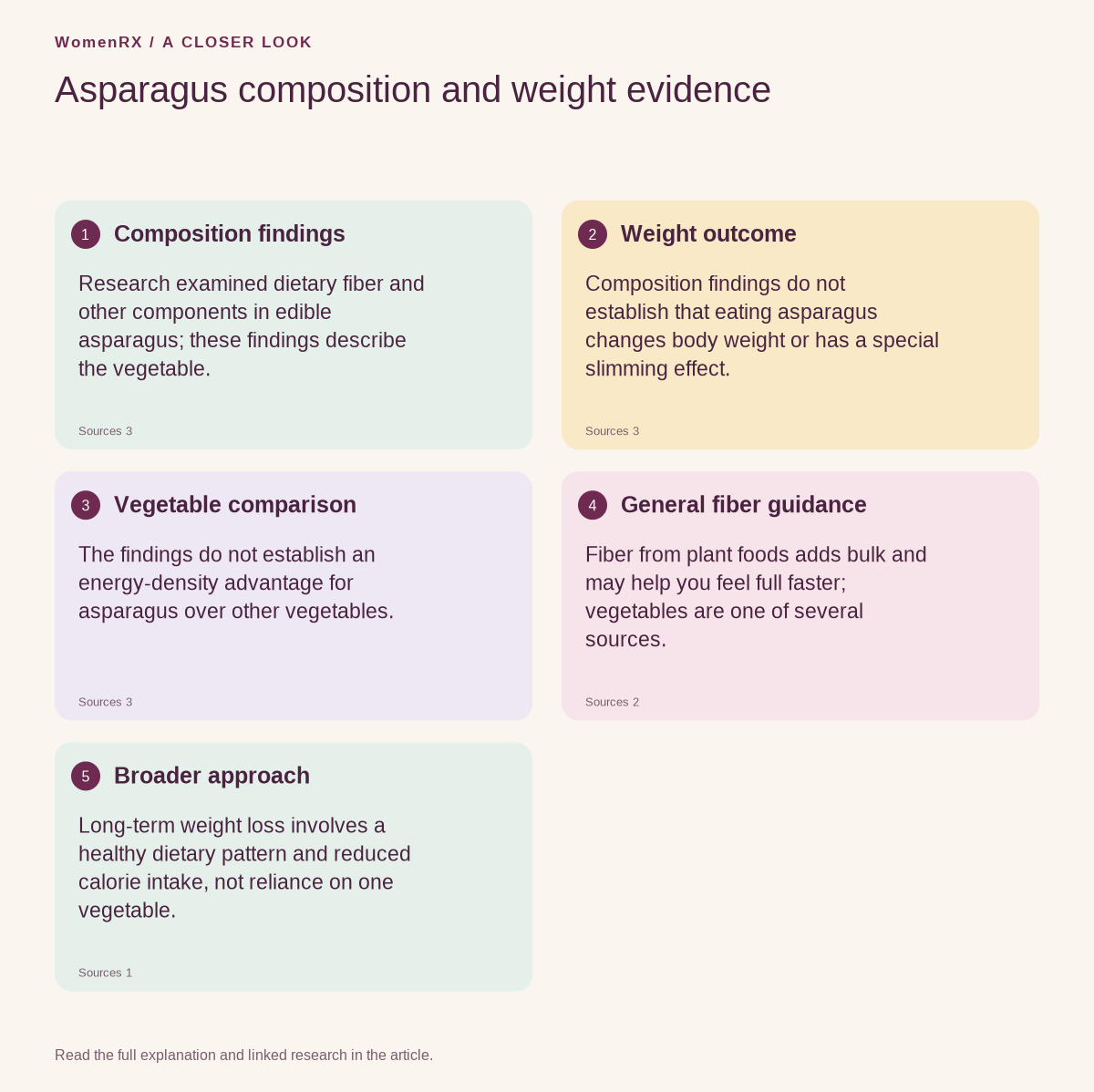
Asparagus composition and weight evidence
Composition findings: Research examined dietary fiber and other components in edible asparagus; these findings describe the vegetable.3
Weight outcome: Composition findings do not establish that eating asparagus changes body weight or has a special slimming effect.3
Vegetable comparison: The findings do not establish an energy-density advantage for asparagus over other vegetables.3
General fiber guidance: Fiber from plant foods adds bulk and may help you feel full faster; vegetables are one of several sources.2
Broader approach: Long-term weight loss involves a healthy dietary pattern and reduced calorie intake, not reliance on one vegetable.1
Read the figure as text
Separate what asparagus composition findings can tell you from general fiber guidance and evidence about body weight.- Composition findings: Research examined dietary fiber and other components in edible asparagus; these findings describe the vegetable.3
- Weight outcome: Composition findings do not establish that eating asparagus changes body weight or has a special slimming effect.3
- Vegetable comparison: The findings do not establish an energy-density advantage for asparagus over other vegetables.3
- General fiber guidance: Fiber from plant foods adds bulk and may help you feel full faster; vegetables are one of several sources.2
- Broader approach: Long-term weight loss involves a healthy dietary pattern and reduced calorie intake, not reliance on one vegetable.1
More questions, answered
Does asparagus fiber guarantee that I’ll feel full?
No. Fiber can add bulk and help you feel full faster, but that general effect doesn’t mean asparagus will have the same effect for everyone or cause weight loss by itself. 2
Sources you can check
- Dietary Supplements for Weight Loss - Health Professional Fact SheetAccessed 2026-09-25Return to first citation
- Dietary Fiber: MedlinePlusAccessed 2026-09-25Return to first citation
- Composition and Functional Properties of the Edible Spear and By-Products from Asparagus officinalis L. and Their Potential Prebiotic Effect.Goñi I, García-Alonso A, Alba C, Rodríguez JM, Sánchez-Mata MC, Guillén-Bejarano R, Redondo-Cuenca A. · Foods (Basel, Switzerland) · 2024Return to first citation