Can Berries Help Make Meals More Filling?
Berries add fruit and fiber to a meal; the evidence doesn’t show that eating berries on their own causes weight loss.
Berries can add fiber-containing fruit to a snack or meal, and dietary fiber can help you feel full faster. Choose fresh or plain frozen berries for oatmeal, yogurt, or a smoothie; if you’re considering a sweetened berry product, check its ingredient list for sugar or syrup. One diet trial found similar weight loss between two groups, but it didn’t test berries as the cause. 1 4
What berries may contribute to a meal
Fruit is a source of dietary fiber. Fiber adds bulk to food and can help you feel full faster, so berries can be one way to include a fiber-containing fruit in a snack or meal. That’s a reasonable role for them, not a special weight-loss effect. 1
For example, add fresh berries to oatmeal or yogurt, or use plain frozen berries in a smoothie or thawed over breakfast. A bowl of berries can also be a snack on its own. These are ways to work berries into meals you already enjoy; whether a meal feels satisfying is personal.
Fullness isn’t the same as weight loss
A food can contribute to fullness without having been shown to cause weight loss. Body weight reflects more than one food, and a study of an overall eating pattern can’t isolate what berries alone did. 2 3
One weight-loss diet trial helps show the difference. Men and women with obesity were assigned to intermittent or continuous energy restriction. Among the 98 participants who completed food records, the continuous-restriction group increased fruit and berry intake by an average of 45 grams per day over three months, compared with 2 grams per day in the intermittent-restriction group. Weight loss was similar between the groups. Because the trial compared broader diet approaches, it doesn’t show that berries caused weight loss; it also didn’t report a berry-specific weight outcome separately for women. 4
Choose the berry form that suits the meal
Fresh and plain frozen berries are easy to add to foods you already eat. For example, try fresh berries with yogurt or oatmeal, or blend plain frozen berries into a smoothie. Pick the form that works for your routine and preference; the trial didn’t compare berry forms or test which one is more filling. 4
Sweetened berry products can be another option. If you want to avoid added sweeteners, check the ingredient list for examples such as sugar or syrup. You could use that product in a meal where you enjoy its sweetness, or choose plain berries instead. There’s no result from the trial showing that sweetened and plain forms have different effects on fullness or body weight. 4
The practical takeaway: berries can be a fiber-containing fruit in a snack or meal, but they aren’t a proven weight-loss food. Choose fresh, plain frozen, or sweetened forms according to the meal and your preferences, rather than expecting one form to cause weight loss. 1 4
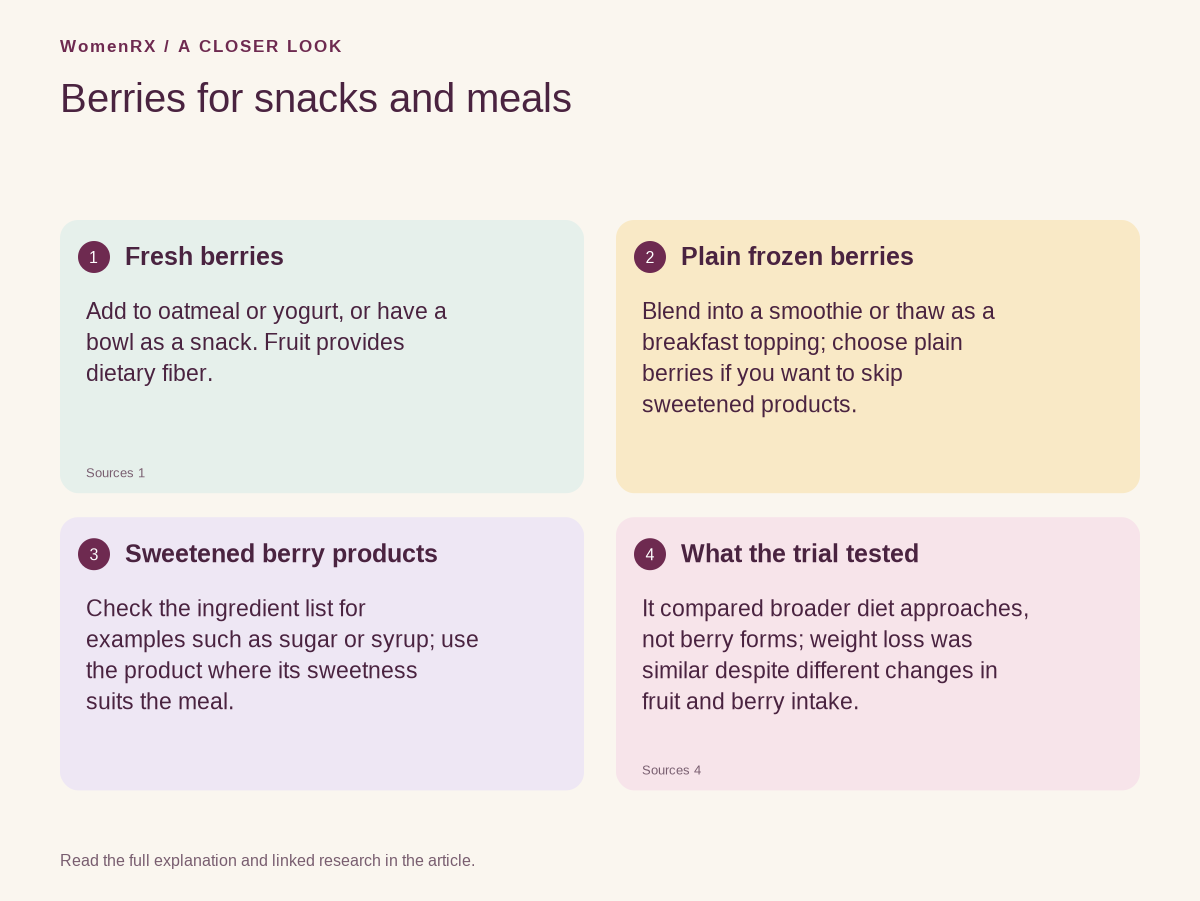
Berries for snacks and meals
Fresh berries: Add to oatmeal or yogurt, or have a bowl as a snack. Fruit provides dietary fiber.1
Plain frozen berries: Blend into a smoothie or thaw as a breakfast topping; choose plain berries if you want to skip sweetened products.
Sweetened berry products: Check the ingredient list for examples such as sugar or syrup; use the product where its sweetness suits the meal.
What the trial tested: It compared broader diet approaches, not berry forms; weight loss was similar despite different changes in fruit and berry intake.4
Read the figure as text
Compare practical ways to use fresh, plain frozen, or sweetened berries without implying that one form has a proven fullness or weight-loss advantage.- Fresh berries: Add to oatmeal or yogurt, or have a bowl as a snack. Fruit provides dietary fiber.1
- Plain frozen berries: Blend into a smoothie or thaw as a breakfast topping; choose plain berries if you want to skip sweetened products.
- Sweetened berry products: Check the ingredient list for examples such as sugar or syrup; use the product where its sweetness suits the meal.
- What the trial tested: It compared broader diet approaches, not berry forms; weight loss was similar despite different changes in fruit and berry intake.4
Sources you can check
- Dietary Fiber: MedlinePlusAccessed 2026-09-25Return to first citation
- Body Weight: MedlinePlusAccessed 2026-09-25Return to first citation
- Obesity: MedlinePlusAccessed 2026-09-25Return to first citation
- Effects of intermittent versus continuous energy restriction for weight loss on diet quality and eating behavior. A randomized trial.Sundfør TM, Tonstad S, Svendsen M. · European journal of clinical nutrition · 2019Return to first citation