How to Make Chia Pudding More Filling and Balanced
Start with a measured recipe, then adjust the liquid and toppings to suit your taste and the meal you want.
For a measured starting point, Cleveland Clinic’s chocolate chia pudding makes six ½-cup servings. Its published estimate is 4 grams protein, 16 grams total carbohydrate, and 7 grams fat per serving. 4 For a more substantial meal, try adding a protein-containing food such as dairy yogurt, and count that addition separately. 2 Changing ingredients or portions changes the nutrition.
Chia pudding is easy to customize, but there isn’t one fixed nutrition profile hiding in the name. The seeds, liquid, add-ins, toppings, and portion size all matter. Start with a measured recipe if you want a nutrition reference point, then change one ingredient at a time to find the bowl you like.
Chia is a food, not a fertility or hormone treatment. It contains fiber 3, but that doesn’t mean a particular pudding recipe causes weight loss or changes hormones.
Make a measured chocolate version
Cleveland Clinic publishes a chocolate chia pudding with these ingredients: ½ cup chia seeds, 1 cup unsweetened vanilla almond milk, 1 cup 2% milk, 1½ tablespoons honey, 1 tablespoon unsweetened cocoa powder, 1 teaspoon cinnamon, and 1 teaspoon vanilla extract. Set aside 2 tablespoons unsweetened coconut flakes and 2 tablespoons dried tart cherries for topping. 4
Combine the seeds, liquids, honey, cocoa, cinnamon, and vanilla in a covered container and shake until mixed. Refrigerate for at least five hours or overnight, then divide into six ½-cup servings and add the coconut and cherries. For a smoother pudding, Cleveland Clinic suggests blending it before chilling. 4
The publisher’s estimate per ½-cup serving, including the listed recipe ingredients, is 140 calories, 4 grams protein, 16 grams total carbohydrate, 7 grams fat, and 6 grams fiber. That’s a reference for this recipe, not for every chia pudding. Milk brands, a different dried fruit, larger servings, or an extra scoop of yogurt will change your bowl’s numbers. 4
Adjust the texture without guessing at the nutrition
The chocolate recipe uses ½ cup chia seeds for 2 cups liquid. For a softer starting point, try 3 tablespoons chia seeds per 1 cup liquid. These are different kitchen ratios, not tested promises about how filling either version will be. Chia’s gelling ability gives the mixture its spoonable texture. 34
Stir well, wait a few minutes, then stir again to break up clumps. Cover and chill until the mixture thickens. If it’s firmer than you like, loosen it with a little more liquid. If it’s too soft, add a little more chia and give it time to thicken.
Keep the seed amount the same while you compare textures. For example, with 3 tablespoons chia, try about ¾ cup liquid for a thicker starting point or about 1¼ cups for a softer one. These are kitchen adjustments, not nutrition equivalents: changing the amount or kind of liquid changes the finished recipe.
Build the meal around what you want
For more protein: Use a protein-containing liquid or stir in dairy yogurt. Dairy and nuts provide protein, though the amount depends on the food and serving. Check the package rather than assuming a plant-based or “high-protein” product supplies a particular amount. Protein needs also vary among people. 2
For fruit and crunch: Add fresh or thawed fruit, or some chopped nuts or seeds. These can contribute fiber as well as flavor; count them as ingredients when you estimate nutrition. Add crunchy toppings just before eating if you want them to stay crisp. 1
For a less sweet version: Choose an unsweetened liquid and use fruit for sweetness. If you add honey, syrup, sweetened yogurt, or flavored milk, include it in your estimate too.
Fiber adds bulk and can help people feel full sooner. That general effect doesn’t tell you how long a particular pudding will satisfy you. If you’re not used to much fiber, increase it gradually; adding a lot at once can cause gas, bloating, or cramps. 1
Estimate the bowl you actually eat
Cleveland Clinic’s numbers are useful for its measured chocolate recipe. To estimate a variation, use the labels on your ingredients:
- Record every ingredient and amount, including the liquid, sweetener, yogurt, fruit, and toppings.
- Match each amount to its Nutrition Facts serving size. If you used half a labeled serving, count half the listed values.
- Add calories, protein, total carbohydrate, fat, and fiber for the whole batch.
- Divide by the number of portions you serve. Unequal portions won’t have equal estimates.
Keep fiber visible rather than quietly subtracting it from total carbohydrate. Labels may round their values, and products differ, so treat your total as an estimate. The most useful comparison is between versions you measure and calculate the same way.
Make the recipe once, then change one element in the next batch: liquid for texture, a protein-containing addition for a more substantial meal, or a topping for flavor and crunch. You’ll learn what you enjoy and get a nutrition estimate that reflects your bowl.
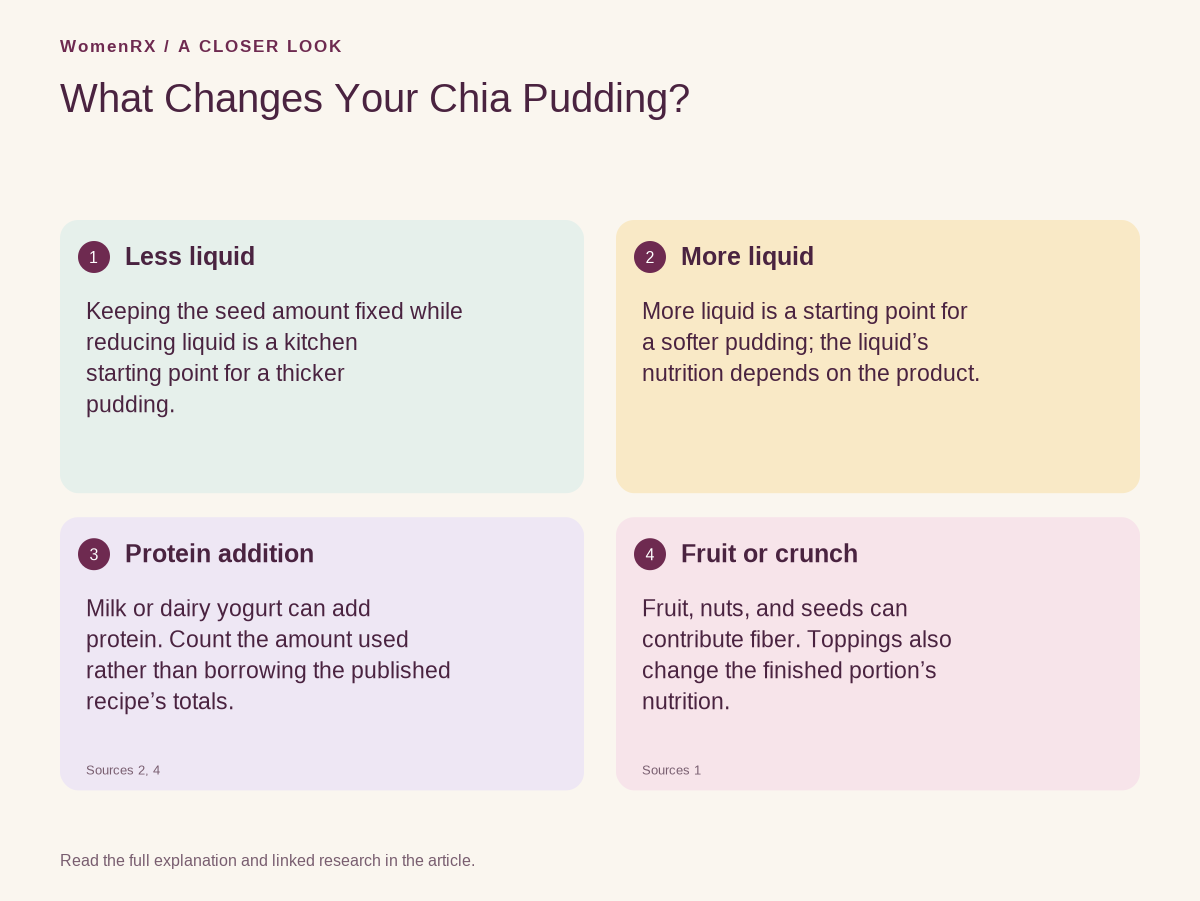
What Changes Your Chia Pudding?
Less liquid: Keeping the seed amount fixed while reducing liquid is a kitchen starting point for a thicker pudding.
More liquid: More liquid is a starting point for a softer pudding; the liquid’s nutrition depends on the product.
Protein addition: Milk or dairy yogurt can add protein. Count the amount used rather than borrowing the published recipe’s totals.24
Fruit or crunch: Fruit, nuts, and seeds can contribute fiber. Toppings also change the finished portion’s nutrition.1
Read the figure as text
Compare texture choices with additions that change the ingredients you need to count.- Less liquid: Keeping the seed amount fixed while reducing liquid is a kitchen starting point for a thicker pudding.
- More liquid: More liquid is a starting point for a softer pudding; the liquid’s nutrition depends on the product.
- Protein addition: Milk or dairy yogurt can add protein. Count the amount used rather than borrowing the published recipe’s totals.24
- Fruit or crunch: Fruit, nuts, and seeds can contribute fiber. Toppings also change the finished portion’s nutrition.1
More questions, answered
Does chia pudding keep you full longer?
Chia contributes fiber. 3 Dietary fiber can help people feel full sooner, but that doesn’t establish how long one particular pudding will satisfy you; ingredients and portion size differ. 1
Why does my chia pudding turn out lumpy?
Chia forms a gel as it mixes with liquid. Stirring again shortly after the first mix is a practical way to break up clumps before the pudding sets. 3
Sources you can check
- Dietary Fiber: MedlinePlusAccessed 2026-09-25Return to first citation
- Dietary Proteins: MedlinePlusAccessed 2026-09-25Return to first citation
- An overview of chia seed (Salvia hispanica L.) bioactive peptides' derivation and utilization as an emerging nutraceutical food.Rabail R, Khan MR, Mehwish HM, Rajoka MSR, Lorenzo JM, Kieliszek M, Khalid AR, Shabbir MA, Aadil RM. · Frontiers in bioscience (Landmark edition) · 2021Return to first citation
- Recipe: Perfect Chocolate Chia PuddingAccessed 2026-09-25Return to first citation