Chia Seeds and Estrogen: The Human Evidence Is Limited
The human chia studies described in a 2009 review focused on cardiovascular risk factors, not reported estrogen changes or menopause-symptom relief.
The human chia studies described in a 2009 review focused on cardiovascular risk factors, not reported estrogen changes or menopause-symptom relief. A rat experiment measured estradiol, but it can’t tell us what eating chia does during perimenopause or after menopause. Chia can be a food you enjoy, but it isn’t established as an estrogen booster or hot-flash treatment. 21
The distinction that matters
Chia’s ingredients, hormone measurements and symptom relief are three different kinds of evidence. Finding a plant compound in a seed doesn’t tell you whether eating it changes your estradiol. Measuring estradiol in an animal experiment doesn’t tell you whether chia helps with hot flashes in people. 51
A 2009 systematic review described two human chia studies focused on cardiovascular risk factors, including body weight, rather than reported estrogen changes or menopause-symptom relief. That tells you what the review can contribute to this question, not what every later study may have found. 2
Why plant compounds aren’t proof of a hormone effect
Chia contains plant compounds, including polyphenols and some compounds classified as isoflavones. Finding a compound in a seed doesn’t show that eating the seed changes a person’s estradiol, or that it improves hot flashes, night sweats, or other menopause symptoms. Those are separate outcomes that need to be measured in people. 5
Evidence about another seed doesn’t automatically transfer to chia, either. Seeds differ in their compounds and in how they’re prepared and studied. A finding about soy or flax, for example, would be a finding about that seed and study, not proof of chia’s effects.
What the chia hormone study can tell us
A 2023 study tested chia in obese rats with ovarian dysfunction and measured estradiol along with other hormones. It was an animal experiment, not a study of women in perimenopause or menopause. It cannot establish whether eating chia changes estrogen or relieves symptoms in people. 1
That distinction matters: measuring a hormone isn’t the same as demonstrating a useful effect on menopause symptoms.
If you’re considering chia for hot flashes
The North American Menopause Society’s 2023 statement does not recommend supplements and herbal remedies as a group for vasomotor symptoms such as hot flashes. That guidance isn’t a chia-specific clinical trial, but it doesn’t support relying on chia as a proven symptom treatment. 4
If symptoms are bothering you, there are options with evidence behind them. The Society identifies hormone therapy as the most effective treatment for vasomotor symptoms. Among its recommended nonhormonal options are cognitive-behavioral therapy and certain prescription medicines, including SSRIs and SNRIs. Which option makes sense depends on your situation and preferences. 34
Chia can still be a food you enjoy. The useful distinction is simple: its nutritional or plant-compound content is not, on its own, evidence that it changes estrogen or treats menopause symptoms.
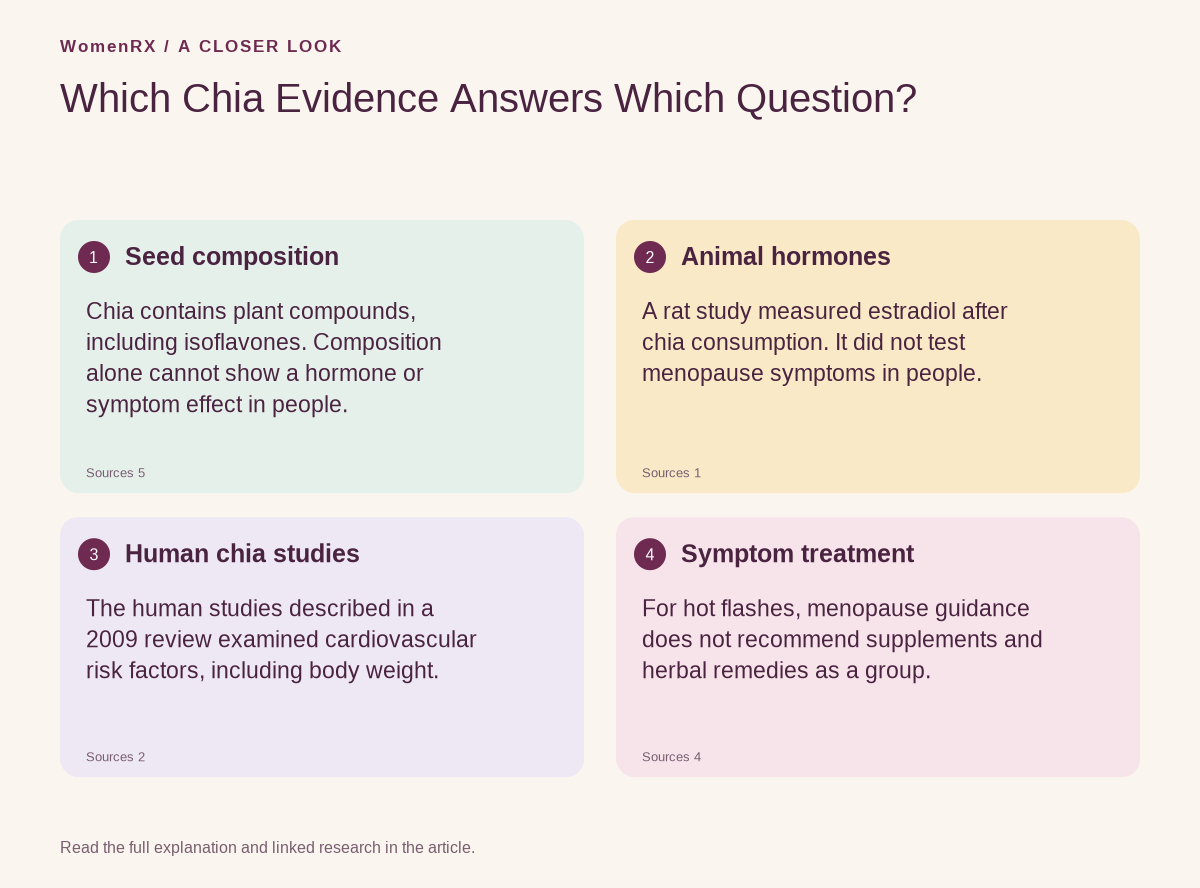
Which Chia Evidence Answers Which Question?
Seed composition: Chia contains plant compounds, including isoflavones. Composition alone cannot show a hormone or symptom effect in people.5
Animal hormones: A rat study measured estradiol after chia consumption. It did not test menopause symptoms in people.1
Human chia studies: The human studies described in a 2009 review examined cardiovascular risk factors, including body weight.2
Symptom treatment: For hot flashes, menopause guidance does not recommend supplements and herbal remedies as a group.4
Read the figure as text
Each step asks a different question: what is in chia, what happens in an animal experiment, and what has been shown in people.- Seed composition: Chia contains plant compounds, including isoflavones. Composition alone cannot show a hormone or symptom effect in people.5
- Animal hormones: A rat study measured estradiol after chia consumption. It did not test menopause symptoms in people.1
- Human chia studies: The human studies described in a 2009 review examined cardiovascular risk factors, including body weight.2
- Symptom treatment: For hot flashes, menopause guidance does not recommend supplements and herbal remedies as a group.4
More questions, answered
Does evidence about soy or flax apply to chia?
Not automatically. A result for one seed doesn’t establish the effect of another. Research that measures estrogen or menopause symptoms after people eat chia is needed to answer those questions about chia.
Sources you can check
- Protective effect of Salvia hispanica (chia seeds) against obesity induced ovarian disorders in rat model.FaragAllah EM, Algharib SA, Goda NIA, El-Malkey NF, Mahboub HH, El-Fayoumi SH, Al-Hoshani N, Wahid RM, Aref M. · Tissue & cell · 2023Return to first citation
- Chia (Salvia hispanica): a systematic review by the natural standard research collaboration.Ulbricht C, Chao W, Nummy K, Rusie E, Tanguay-Colucci S, Iannuzzi CM, Plammoottil JB, Varghese M, Weissner W. · Reviews on recent clinical trials · 2009Return to first citation
- The 2022 hormone therapy position statement of The North American Menopause Society.“The 2022 Hormone Therapy Position Statement of The North American Menopause Society” Advisory Panel. · Menopause (New York, N.Y.) · 2022Return to first citation
- The 2023 nonhormone therapy position statement of The North American Menopause Society.Menopause (New York, N.Y.) · 2023Return to first citation
- Evaluation of Salvia hispanica as a Therapeutic Agent against Sodium Arsenic-Induced Testicular Toxicity in a Male Rats Model.Omar SM, Zahran NN, Alhotan RA, Hussein EO, Galik B, Saleh AA. · Life (Basel, Switzerland) · 2024Return to first citation