Do Estrogen Supplements Help With Menopause Symptoms?
Soy, red clover, and black cohosh aren’t estrogen medicines, and their evidence for hot flashes differs.
Some supplements marketed for “estrogen support” may offer modest hot-flash relief, but results are inconsistent. Soy isoflavones and red clover contain plant compounds similar in structure to estrogen; they aren’t the same as taking estrogen. Black cohosh is another herb entirely. For bothersome hot flashes, menopause guidance does not recommend supplements as a reliably effective treatment.2346
First, find out what the product contains
“Estrogen supplement” can mean several different things on a package. Soy and red clover contain isoflavones, plant compounds similar in structure to estrogen. That similarity doesn’t mean a capsule replaces the estrogen your body makes or works like a prescription estradiol patch. Black cohosh is a different botanical; its active ingredients and how it might work aren’t established.346
That distinction matters if you’re comparing treatments. Menopausal hormone therapy remains the most effective treatment for hot flashes and night sweats. Its benefits and risks depend on factors including the type of therapy, how it’s taken, and when it’s started. Supplements shouldn’t be treated as interchangeable with it.1
What have studies found for hot flashes?
Soy isoflavones: Soy isoflavone supplements or soy protein may reduce how often or how severely hot flashes occur. The effect may be small, and findings haven’t been consistent across studies or soy products. The Menopause Society’s 2023 review does not recommend soy foods, soy extracts, or the soy metabolite equol as treatments for vasomotor symptoms, the clinical term for hot flashes and night sweats. That’s a judgment about dependable symptom relief, not a reason to avoid soy as food.32
Red clover isoflavones: Studies of red clover for menopausal hot flashes have produced inconsistent results, and some had a high risk of bias. There isn’t conclusive evidence that it helps. Don’t assume a promising result for soy applies to red clover simply because both contain isoflavones.43
Black cohosh: Here the findings pull in different directions. A review described by the National Center for Complementary and Integrative Health found potential improvements in hot flashes with products containing black cohosh, sometimes alongside other herbs. But a placebo-controlled trial described by the NIH Office of Dietary Supplements found no significant advantage for the black cohosh preparations studied over placebo on the number of vasomotor symptoms at its follow-up assessments. Formulations vary considerably, and the Menopause Society does not recommend herbal supplements for hot flashes. A positive review, in other words, isn’t a promise that the bottle in your hand will help.562
Most of this evidence addresses hot flashes or broader menopause symptom scores, not every symptom someone might hope to treat. For example, the black cohosh review described improvements in hot flashes but not anxiety or depressive symptoms. If vaginal dryness is your main concern, hot-flash studies don’t answer that question; menopause guidance discusses different treatments for bothersome vaginal symptoms.51
How to judge the bottle without trusting the front label
Start with the Supplement Facts panel. Look for the named ingredient, the amount, whether it’s an extract or another preparation, and any additional herbs. Then ask whether the research you’re relying on studied that ingredient or formulation and measured the symptom you want to improve. This is especially useful for black cohosh: its preparations differ substantially in chemical composition, making results from one formulation hard to apply confidently to another.6
A blend labeled “menopause support” makes that comparison harder if it doesn’t clearly identify what’s in it. And “natural” doesn’t establish either effectiveness or safety. In the US, dietary supplements aren’t approved before sale in the way drugs are; manufacturers and distributors are responsible for evaluating their products’ safety and labeling before marketing them.36
What about medication interactions?
The most concrete named interaction here concerns certain soy foods, not a demonstrated interaction for soy isoflavone capsules. Soy products high in tyramine, such as some tofu and soy sauce, have been reported to interact with monoamine oxidase inhibitors (MAOIs), a group of antidepressants, causing dangerously high blood pressure. If you take an MAOI, ask your pharmacist about the particular soy foods or product you’re considering rather than assuming all forms of soy carry the same finding.3
For black cohosh, the NIH Office of Dietary Supplements says no clinically relevant medication interactions are known, but they haven’t been systematically studied. That isn’t proof a supplement can’t interact with your medicine. The red clover information likewise advises checking before combining herbal products with medicines, without establishing a particular named drug interaction. If you take medication, showing a pharmacist the actual ingredient list is more useful than asking whether “estrogen supplements” interact in general.64
If hot flashes are disrupting your sleep or daily life, you don’t have to choose between an uncertain supplement and doing nothing. Evidence-supported nonhormonal options include cognitive behavioral therapy, clinical hypnosis, and certain prescription medicines. Which option fits depends on the symptom you want to treat and your own circumstances.2
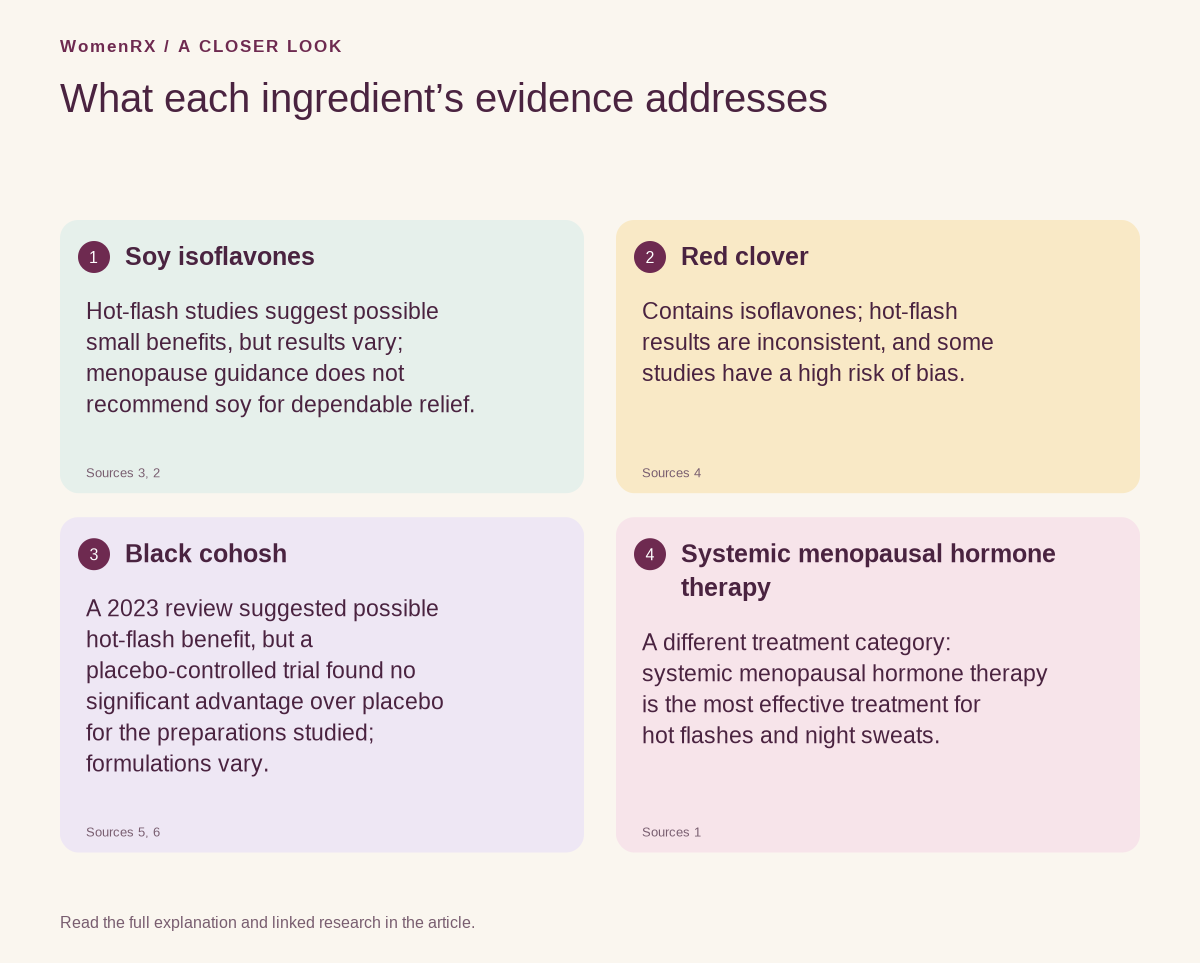
What each ingredient’s evidence addresses
Soy isoflavones: Hot-flash studies suggest possible small benefits, but results vary; menopause guidance does not recommend soy for dependable relief.32
Red clover: Contains isoflavones; hot-flash results are inconsistent, and some studies have a high risk of bias.4
Black cohosh: A 2023 review suggested possible hot-flash benefit, but a placebo-controlled trial found no significant advantage over placebo for the preparations studied; formulations vary.56
Systemic menopausal hormone therapy: A different treatment category: systemic menopausal hormone therapy is the most effective treatment for hot flashes and night sweats.1
Read the figure as text
Use the ingredient and the studied outcome, not the words “estrogen support,” to compare products.- Soy isoflavones: Hot-flash studies suggest possible small benefits, but results vary; menopause guidance does not recommend soy for dependable relief.32
- Red clover: Contains isoflavones; hot-flash results are inconsistent, and some studies have a high risk of bias.4
- Black cohosh: A 2023 review suggested possible hot-flash benefit, but a placebo-controlled trial found no significant advantage over placebo for the preparations studied; formulations vary.56
- Systemic menopausal hormone therapy: A different treatment category: systemic menopausal hormone therapy is the most effective treatment for hot flashes and night sweats.1
More questions, answered
Does black cohosh raise estrogen levels?
That hasn’t been established. Studies have found varying results on whether black cohosh changes estrogen levels, and its active ingredients and mechanism remain unclear. It shouldn’t be treated as an estrogen replacement.6
Can a hot-flash supplement also treat vaginal dryness?
Don’t assume so. Evidence about hot flashes doesn’t establish relief for vaginal symptoms. For bothersome vaginal symptoms that aren’t relieved by over-the-counter options, menopause guidance discusses treatments such as low-dose vaginal estrogen for women who don’t need systemic hormone therapy.1
Sources you can check
- The 2022 hormone therapy position statement of The North American Menopause Society.“The 2022 Hormone Therapy Position Statement of The North American Menopause Society” Advisory Panel. · Menopause (New York, N.Y.) · 2022Return to first citation
- The 2023 nonhormone therapy position statement of The North American Menopause Society.Menopause (New York, N.Y.) · 2023Return to first citation
- Soy: Usefulness and Safety | NCCIHAccessed 2026-09-25Return to first citation
- Red Clover: Usefulness and Safety | NCCIHAccessed 2026-09-25Return to first citation
- Black Cohosh: Usefulness and Safety | NCCIHAccessed 2026-09-25Return to first citation
- Black Cohosh - Health Professional Fact SheetAccessed 2026-09-25Return to first citation