Menopause Night Sweats: What Supplements Can Do
One small omega-3 analysis found fewer night sweats, but the evidence is too limited to count on supplements for relief.
Supplements aren’t a dependable, evidence-backed way to treat menopause-related night sweats. A review of three omega-3 trials found fewer and less severe night sweats compared with placebo, but the researchers still judged the evidence insufficient, and sleep quality didn’t improve. Black cohosh results are inconsistent, and current menopause guidance doesn’t recommend supplements or herbal remedies for vasomotor symptoms. Better-supported treatments are available. 245
What supplement studies actually measured
Night sweats are nighttime vasomotor symptoms: episodes of sweating that can wake you or leave you needing to change clothes or bedding. But studies don’t always report nighttime episodes separately. A result about hot flashes or overall vasomotor symptoms doesn’t automatically show that a supplement will reduce night sweats or help you sleep.
Omega-3 supplements offer a mixed, limited signal. A systematic review pooled three randomized trials involving 483 menopausal women. Compared with placebo, participants taking omega-3 had fewer and less severe night sweats in the analysis. However, the same review found no improvement in sleep quality, insomnia severity, or hot flashes, and its authors concluded that there wasn’t enough evidence to establish a benefit. That makes omega-3 an interesting research question, not a reliable fix for nights disrupted by sweating. 5
Black cohosh has been studied more, but not with a clear result. In one randomized trial of 351 women ages 45 to 55, the number and intensity of hot flashes and night sweats generally didn’t differ between the herbal groups and placebo at 3, 6, or 12 months. A Cochrane review of 16 trials, including 2,027 women, found substantial differences among the studies and concluded that the evidence was insufficient to support or oppose black cohosh for menopausal symptoms. 2
For soy isoflavones and red clover, don’t assume that a plant-based or “natural” label means a proven nighttime benefit. Soy research has produced inconsistent findings for vasomotor symptoms, and evidence hasn’t established that supplements and soy foods have comparable effects. The 2023 North American Menopause Society position statement does not recommend soy foods, soy extracts, or supplements and herbal remedies for these symptoms. 46
A more useful comparison
| Option | What the evidence says about night sweats |
|---|---|
| Omega-3 supplements | A three-trial review found fewer and less severe night sweats versus placebo, but judged the overall evidence insufficient. Sleep quality didn’t improve. 5 |
| Black cohosh | A large trial found no general difference from placebo; a review of trials found the results too varied for a firm conclusion. 2 |
| Soy or red clover | Soy findings for vasomotor symptoms are inconsistent; menopause guidance doesn’t recommend soy foods, soy extracts, or supplements and herbal remedies as treatment. The cited evidence doesn’t establish a specific night-sweat benefit for red clover. 46 |
| Established treatments | Hormone therapy is the most effective treatment for vasomotor symptoms. Several nonhormone treatments also have evidence, including cognitive behavioral therapy, clinical hypnosis, and certain prescription medicines. 34 |
The treatment studies and recommendations generally address vasomotor symptoms as a group, rather than proving that every option specifically stops nighttime episodes. Still, if sweating is repeatedly waking you, you don’t have to rely on an uncertain supplement trial. Menopause guidance identifies hormone therapy as the most effective option for bothersome vasomotor symptoms. Whether it’s appropriate depends on your health history and circumstances. For people who don’t want or can’t use hormone therapy, guidance supports options including cognitive behavioral therapy, clinical hypnosis, and certain prescription treatments. 34
When sweating may need another explanation
A warm room or heavy bedding can make you sweat at night without it being a menopausal symptom. Menopause is a common cause of night sweats, but it isn’t the only one; anxiety, alcohol or drug use, a tendency to sweat excessively, and some medicines can also play a role. If a medicine may be contributing, a clinician can help weigh whether it should be changed rather than having you stop it on your own. 1
Regular drenching sweats that wake you deserve attention, especially if you also have a fever or chills, a cough, diarrhea, or unexplained weight loss. Those symptoms don’t identify a cause by themselves, but they’re a reason not to assume menopause is the whole story. 1
If you’re considering a supplement, focus on the actual outcome you want help with: fewer nighttime episodes, less intense sweating, or better sleep. The evidence doesn’t show that these outcomes reliably travel together. And with black cohosh, products can vary substantially in composition, which makes results from one preparation hard to apply to another. 25
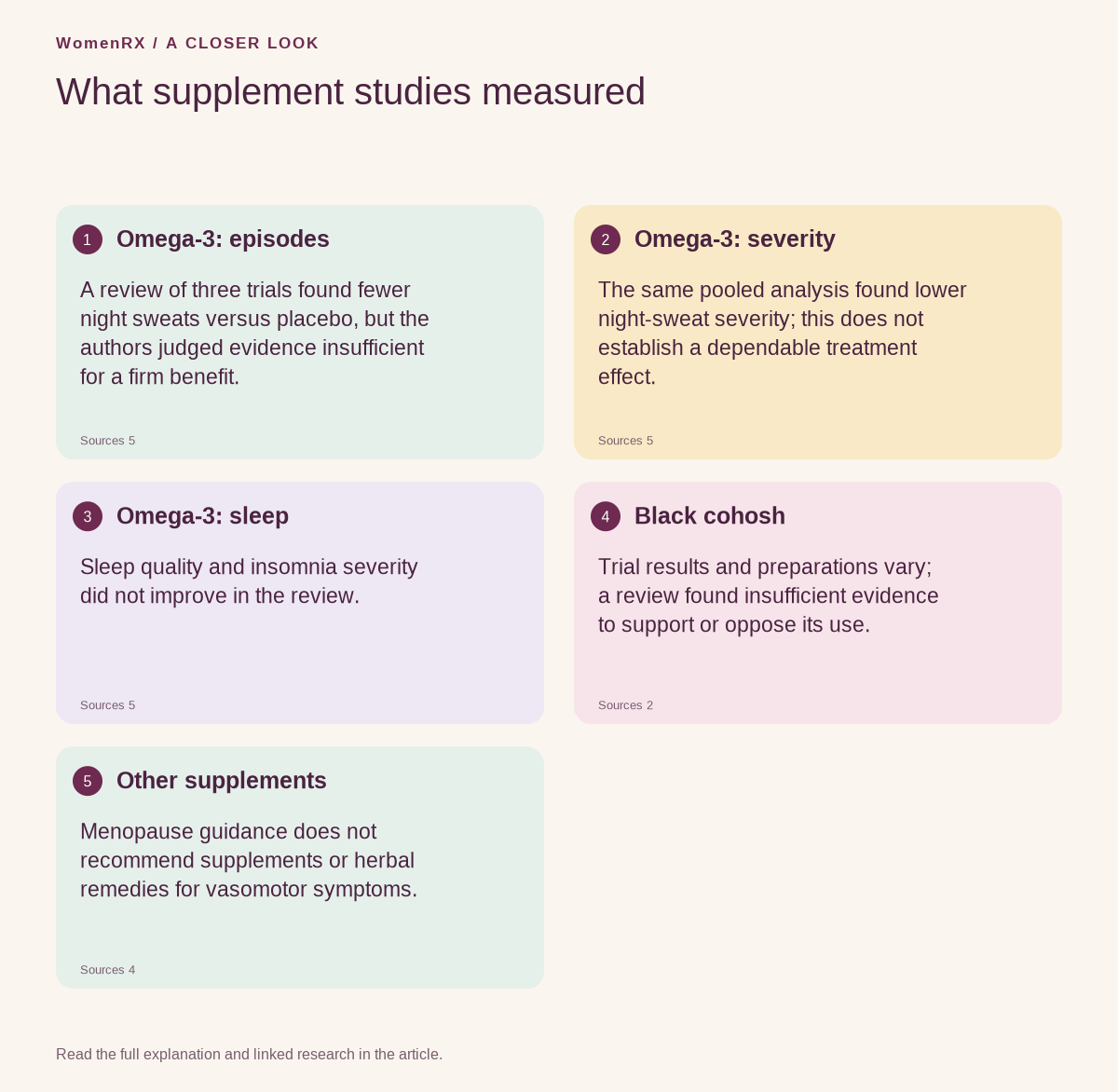
What supplement studies measured
Omega-3: episodes: A review of three trials found fewer night sweats versus placebo, but the authors judged evidence insufficient for a firm benefit.5
Omega-3: severity: The same pooled analysis found lower night-sweat severity; this does not establish a dependable treatment effect.5
Omega-3: sleep: Sleep quality and insomnia severity did not improve in the review.5
Black cohosh: Trial results and preparations vary; a review found insufficient evidence to support or oppose its use.2
Other supplements: Menopause guidance does not recommend supplements or herbal remedies for vasomotor symptoms.4
Read the figure as text
Night-sweat frequency, severity, and sleep are different outcomes. The evidence does not show that improvement in one guarantees improvement in the others.- Omega-3: episodes: A review of three trials found fewer night sweats versus placebo, but the authors judged evidence insufficient for a firm benefit.5
- Omega-3: severity: The same pooled analysis found lower night-sweat severity; this does not establish a dependable treatment effect.5
- Omega-3: sleep: Sleep quality and insomnia severity did not improve in the review.5
- Black cohosh: Trial results and preparations vary; a review found insufficient evidence to support or oppose its use.2
- Other supplements: Menopause guidance does not recommend supplements or herbal remedies for vasomotor symptoms.4
More questions, answered
Does black cohosh help with menopause night sweats?
It hasn’t shown a dependable benefit. In one trial of 351 women, night-sweat and hot-flash number and intensity generally didn’t differ from placebo; a review of 16 trials found the overall evidence insufficient. 2
Can a supplement improve sleep if night sweats wake me?
Not reliably based on the omega-3 review: it found no improvement in sleep quality or insomnia severity, even though its analysis found fewer and less severe night sweats. 5
Sources you can check
- Night sweats - NHSAccessed 2026-09-25Return to first citation
- Black Cohosh - Health Professional Fact SheetAccessed 2026-09-25Return to first citation
- The 2022 hormone therapy position statement of The North American Menopause Society.“The 2022 Hormone Therapy Position Statement of The North American Menopause Society” Advisory Panel. · Menopause (New York, N.Y.) · 2022Return to first citation
- The 2023 nonhormone therapy position statement of The North American Menopause Society.Menopause (New York, N.Y.) · 2023Return to first citation
- Effect of omega-3 supplements on vasomotor symptoms in menopausal women: A systematic review and meta-analysis.Mohammady M, Janani L, Jahanfar S, Mousavi MS. · European journal of obstetrics, gynecology, and reproductive biology · 2018Return to first citation
- The role of diet in managing menopausal symptoms: A narrative review.Yelland S, Steenson S, Creedon A, Stanner S. · Nutrition bulletin · 2023Return to first citation