Hot Flashes and Supplements: What the Evidence Shows
Black cohosh, soy, and other supplements haven’t shown dependable hot-flash relief, while several treatments have stronger evidence.
Black cohosh has been studied for hot flashes, but reviews haven’t established reliable relief, and one preparation’s results may not apply to another. Menopause guidance recommends against supplements and herbal remedies for hot flashes. If symptoms are disrupting sleep, work, or daily life, hormone therapy is the most effective treatment for many women, and evidence-based nonhormonal options are available. 1 2 3
Compare the symptom, not the promise on the label
If a hot flash interrupts a meeting or wakes you at night, “menopause support” on a bottle doesn’t answer the question you care about. Did the product reduce how often flashes happened, how severe they felt, or how long they lasted? Those are different outcomes, and a change in one doesn’t guarantee a change in the others.
Black cohosh has more ingredient-specific research here than the other herbs, but its results aren’t dependable. A review of 16 randomized trials involving 2,027 women found the studies too varied to support or oppose its use for menopausal symptoms. A later review of four trials involving 511 women found no significant association with fewer hot flashes and night sweats or better self-reported symptom scores. 1
The preparation matters, too. Black cohosh formulations vary in chemical composition, while their active ingredients and possible mechanisms remain uncertain. Even a promising result for one extract wouldn’t show that every bottle labeled “black cohosh” works the same way. 1
What each supplement finding actually tells you
| Ingredient or product | Hot-flash finding | What to keep in mind |
|---|---|---|
| Black cohosh | Reviews haven’t established reliable relief. 1 | Preparations vary. Trials summarized by NIH most commonly reported mild, temporary stomach upset and rash. 1 |
| Soy foods, soy extracts, and equol | The 2023 North American Menopause Society statement does not recommend these for vasomotor symptoms. 3 | These are distinct forms; don’t treat a finding about one as proof about another. |
| Red clover | The 2023 statement recommends against supplements and herbal remedies as a category. 3 | That category-level recommendation is not a measured effect or a product ranking for red clover. |
| Evening primrose oil | A systematic review found no significant difference from placebo in hot-flash frequency or duration and judged the evidence insufficient for a firm conclusion. 5 | The review found a possible severity benefit in shorter studies; participants also reported mild nausea and headache. 5 |
| Mixed herbal formulas | In one randomized trial of a five-ingredient capsule in postmenopausal women, hot-flash frequency, duration, and intensity did not significantly decrease. 6 | A blend’s result can’t establish what any one ingredient did or predict the result for a different blend. |
One small trial illustrates why comparisons need care. It assigned 80 postmenopausal women to black cohosh or evening primrose oil for eight weeks, without a placebo group. A later review found no significant difference between the herbs in hot-flash severity at four weeks. At eight weeks, severity was higher with evening primrose oil, but frequency did not differ significantly between groups. That comparison doesn’t establish that either herb works better than taking no active supplement. 4 5
Study populations also differ. The black cohosh trials summarized by NIH included women in the menopausal transition and after menopause, while the mixed-formula trial enrolled postmenopausal women. Their results shouldn’t be treated as a precise prediction for every stage or every level of symptom severity. 1 6
If flashes are affecting your day, there are stronger options
Hormone therapy remains the most effective treatment for menopausal hot flashes. For women younger than 60 or within 10 years of menopause onset who have no contraindications, the 2022 North American Menopause Society statement describes a favorable benefit-risk balance for bothersome symptoms. That balance changes with health history and with the treatment’s type, route, timing, and duration. 2
If hormone therapy isn’t a fit or isn’t your preference, evidence-based nonhormonal options include cognitive behavioral therapy, clinical hypnosis, certain antidepressants (SSRIs or SNRIs), gabapentin, and fezolinetant. The 2023 statement also recommends oxybutynin, with less consistent evidence. These choices have different considerations; they aren’t interchangeable substitutes for one another. 3
Bring the exact bottle into the conversation
If you’re considering a supplement, look beyond the ingredient named on the front. Check whether it’s a single extract or a blend, and bring the full label to a pharmacist or clinician if you take medication or are weighing it against another treatment. The cited findings don’t establish specific supplement-medication interactions or a complete safety profile, so it would be misleading to declare a product safe based on its herb name alone. 1 6
A focused question is: “What’s most likely to reduce the flashes that are interrupting my sleep or work, and what should we consider about my health history and this exact product?” That puts your day-to-day problem, rather than a marketing claim, at the center of the decision.
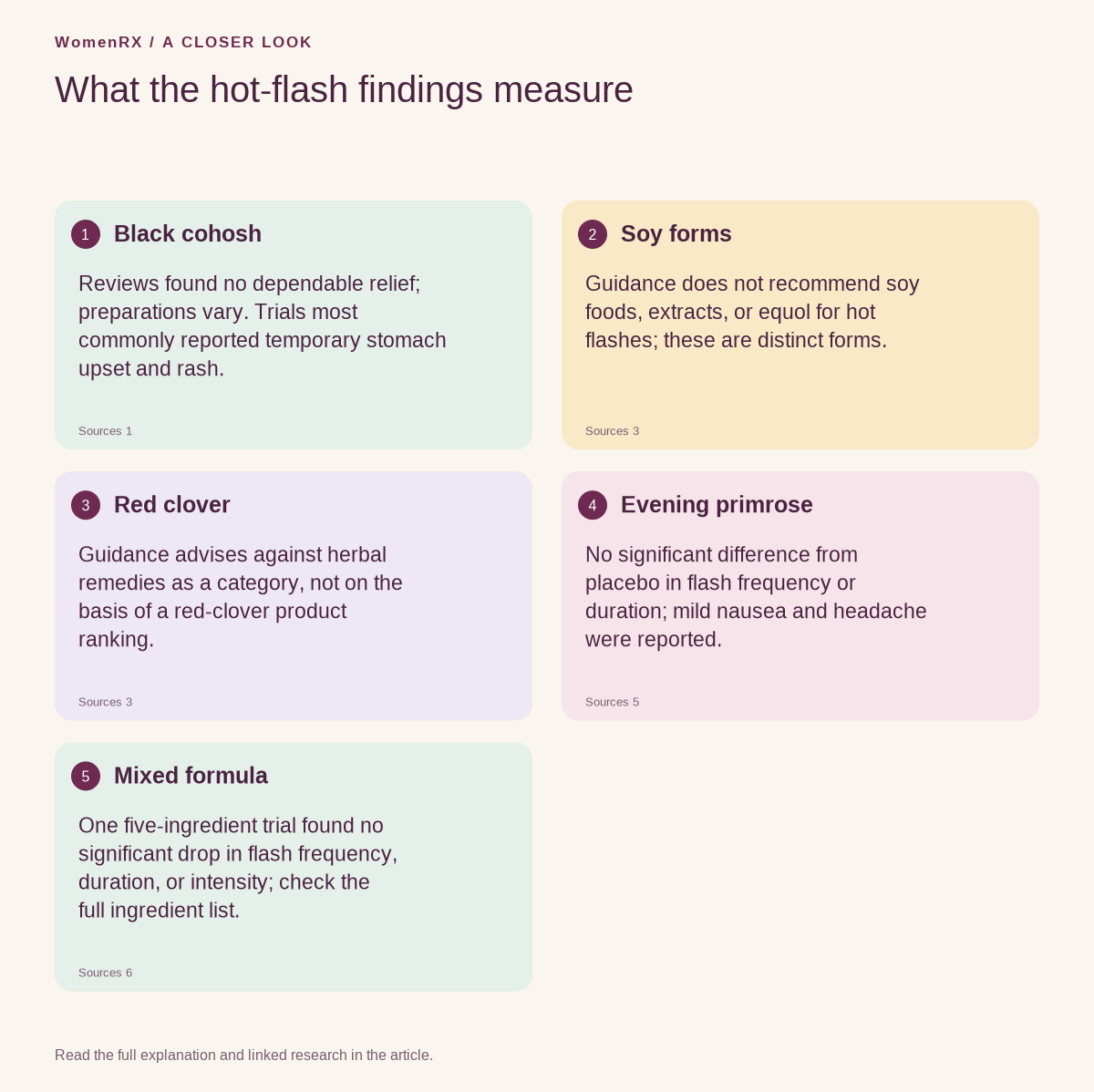
What the hot-flash findings measure
Black cohosh: Reviews found no dependable relief; preparations vary. Trials most commonly reported temporary stomach upset and rash.1
Soy forms: Guidance does not recommend soy foods, extracts, or equol for hot flashes; these are distinct forms.3
Red clover: Guidance advises against herbal remedies as a category, not on the basis of a red-clover product ranking.3
Evening primrose: No significant difference from placebo in flash frequency or duration; mild nausea and headache were reported.5
Mixed formula: One five-ingredient trial found no significant drop in flash frequency, duration, or intensity; check the full ingredient list.6
Read the figure as text
Compare measured outcomes and reported safety information without treating every preparation as equivalent.- Black cohosh: Reviews found no dependable relief; preparations vary. Trials most commonly reported temporary stomach upset and rash.1
- Soy forms: Guidance does not recommend soy foods, extracts, or equol for hot flashes; these are distinct forms.3
- Red clover: Guidance advises against herbal remedies as a category, not on the basis of a red-clover product ranking.3
- Evening primrose: No significant difference from placebo in flash frequency or duration; mild nausea and headache were reported.5
- Mixed formula: One five-ingredient trial found no significant drop in flash frequency, duration, or intensity; check the full ingredient list.6
More questions, answered
Is black cohosh proven to reduce hot flashes?
No. A review of 16 trials found the evidence insufficient to support or oppose its use, and a later review found no significant association with fewer hot flashes and night sweats. Preparations also differ, making results harder to apply to a particular bottle. 1
Does the guidance treat soy foods and soy supplements as the same product?
No. The 2023 North American Menopause Society statement lists soy foods, soy extracts, and the soy metabolite equol separately, though it does not recommend any of them for treating vasomotor symptoms. 3
Sources you can check
- Black Cohosh - Health Professional Fact SheetAccessed 2026-09-25Return to first citation
- The 2022 hormone therapy position statement of The North American Menopause Society.“The 2022 Hormone Therapy Position Statement of The North American Menopause Society” Advisory Panel. · Menopause (New York, N.Y.) · 2022Return to first citation
- The 2023 nonhormone therapy position statement of The North American Menopause Society.Menopause (New York, N.Y.) · 2023Return to first citation
- A comparative study on the effect of "black cohosh" and "evening primrose oil" on menopausal hot flashes.Mehrpooya M, Rabiee S, Larki-Harchegani A, Fallahian AM, Moradi A, Ataei S, Javad MT. · Journal of education and health promotion · 2018Return to first citation
- Evening Primrose Oil for Menopause Hot Flashes: Systematic Review and Meta-Analysis.Thevi T, De S, Soe HHK. · Journal of menopausal medicine · 2024Return to first citation
- Effect of Combined Herbal Capsule Menohelp on Hot Flashes and Night Sweats in Postmenopausal Women: A Single-Blind Randomized Controlled Trial.Shayan A, Masoumi SZ, Kazemi F, Oshvandi K. · Journal of menopausal medicine · 2020Return to first citation