Hot-Flash Supplements: What the Evidence Actually Shows
Black cohosh, soy isoflavones, and red clover have been studied, but their results don’t establish a reliable hot-flash benefit.
For hot flashes, black cohosh and red clover have not consistently outperformed placebo in clinical trials. Soy isoflavone findings are mixed, and results for soy foods shouldn’t be treated as proof that a concentrated supplement works. Products can differ in their ingredients, and long-term safety is not well established for these options. Black cohosh also has specific safety uncertainties worth weighing before you try it. 1 3
The short version: don’t judge by the label
A supplement marketed for menopause isn’t necessarily proven to reduce hot-flash frequency or intensity. For black cohosh, red clover, and soy isoflavones, the trial results are inconsistent or show no clear advantage over placebo. That doesn’t prove no one could benefit; it does mean a promised effect is more certain than the evidence supports. 1 3
It also helps to separate soy foods from soy isoflavone supplements, and a single-ingredient product from a blend. Those aren’t interchangeable tests of the same thing.
Black cohosh: studied, but not reliably effective
In a randomized trial of 351 women ages 45-55 who had daytime hot flashes and night sweats, black cohosh alone did not differ from placebo in the number or intensity of symptoms over 3, 6, or 12 months. A multibotanical blend containing black cohosh also showed no advantage. One separate group took that blend plus soy foods; at 12 months, its symptom intensity was significantly worse than the placebo group’s. That finding applies to the combination, not to black cohosh alone or soy foods alone. 1
A second randomized trial included 88 perimenopausal and postmenopausal women with at least 35 hot flashes and night sweats a week. Symptoms fell in every group, including placebo, but black cohosh did not produce a statistically significant improvement over placebo. At 6 and 9 months, the black-cohosh group reported worse symptom intensity. 1
The products tested weren’t all the same. Black cohosh preparations vary in composition, and researchers don’t know which compounds, if any, account for symptom relief. A review of 16 trials involving 2,027 women found the studies too different in product, design, and duration to support or rule out an effect. 1
For safety, short-term trials most often reported mild, temporary stomach upset or rash. Long-term safety hasn’t been assessed well. Reports of liver injury have been associated with black cohosh use, but a cause-and-effect link hasn’t been established. The NIH Office of Dietary Supplements says no clinically relevant medication interactions are known, while also noting that interactions haven’t been studied systematically. If you’re considering it, have a pharmacist check the exact product and your medications; stop taking it and contact a clinician if you develop symptoms such as dark urine, yellowing of the skin or eyes, or abdominal pain. 1
Soy isoflavones: foods and extracts aren’t the same
Reviews of soy isoflavones reach mixed conclusions. Some trials have suggested benefit, but most in one review did not find a difference from placebo. An earlier review described soy foods as possibly having a modest effect and said isoflavone preparations seemed less effective than soy foods, while emphasizing that the studies weren’t conclusive. 2 6
That distinction matters when you’re comparing a supplement label with everyday soy foods. The trial in which the group taking a black-cohosh-containing blend plus soy foods had worse symptom intensity tested the combination, so it can’t tell us whether soy foods by themselves helped, hurt, or made no difference. 1
A 2012 review of well-designed trials found statistically significant benefit over placebo in 21% of the soy-isoflavone trials it identified. That describes how often those selected trials found a difference; it isn’t the chance that a particular person will benefit. 5
Red clover: no clear advantage in a direct trial
Red clover isoflavones were tested alongside black cohosh in the 88-woman randomized trial. Symptoms decreased in all groups, but red clover did not significantly outperform placebo. This trial included both perimenopausal and postmenopausal participants, but it doesn’t establish whether one stage responds differently from the other. 1
What to check before buying
- Match the ingredient to the evidence. Evidence about soy foods doesn’t automatically apply to a soy extract, and evidence about one herbal preparation may not apply to another.
- Look for blends. If a product contains several ingredients, a result from a trial of one ingredient won’t tell you whether that specific blend works.
- Ask about your exact product and medicines. For black cohosh, medication interactions haven’t been studied systematically. Interaction information for one ingredient shouldn’t be assumed to apply to another. A pharmacist can check the ingredient list against your medications.
- Set a realistic expectation. These options haven’t shown a dependable reduction in hot-flash frequency or intensity. If symptoms are disrupting sleep or daily life, prescription and other treatment choices are a separate conversation; supplements shouldn’t be treated as equivalent to them. 1 3 4
The most useful comparison isn’t “natural versus medical.” It’s whether the specific product has shown a benefit for the symptom you want to change, how uncertain that result is, and what is known about its risks.
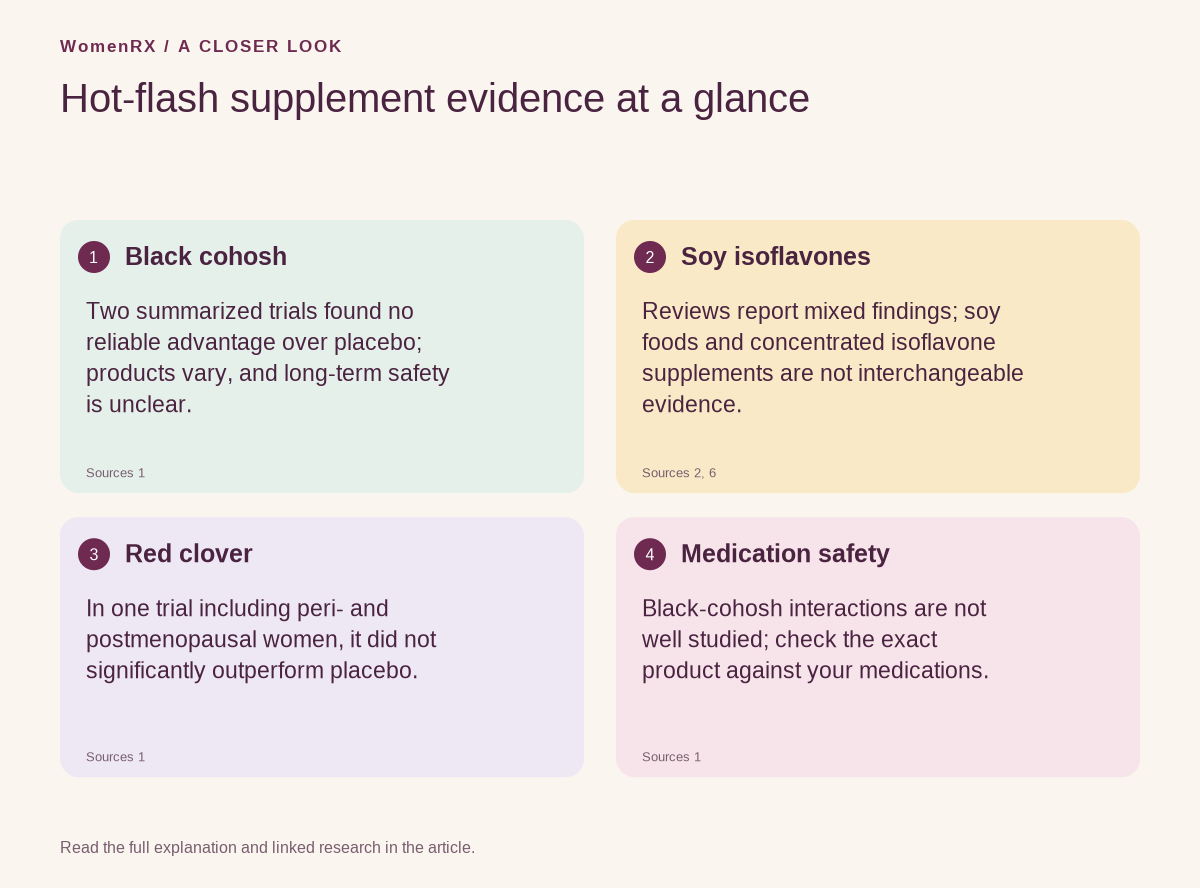
Hot-flash supplement evidence at a glance
Black cohosh: Two summarized trials found no reliable advantage over placebo; products vary, and long-term safety is unclear.1
Soy isoflavones: Reviews report mixed findings; soy foods and concentrated isoflavone supplements are not interchangeable evidence.26
Red clover: In one trial including peri- and postmenopausal women, it did not significantly outperform placebo.1
Medication safety: Black-cohosh interactions are not well studied; check the exact product against your medications.1
Read the figure as text
Compare what trials found with what remains uncertain. A result for one formulation or combination doesn’t automatically apply to another product.- Black cohosh: Two summarized trials found no reliable advantage over placebo; products vary, and long-term safety is unclear.1
- Soy isoflavones: Reviews report mixed findings; soy foods and concentrated isoflavone supplements are not interchangeable evidence.26
- Red clover: In one trial including peri- and postmenopausal women, it did not significantly outperform placebo.1
- Medication safety: Black-cohosh interactions are not well studied; check the exact product against your medications.1
More questions, answered
Why did symptoms improve in the placebo groups?
In the 88-woman trial, vasomotor symptoms decreased in every group, including placebo, but black cohosh and red clover did not significantly outperform placebo. A decline during a trial therefore isn’t, by itself, evidence that the supplement caused the improvement. 1
Does a lack of known black cohosh interactions mean it’s safe with my medicines?
No. The NIH Office of Dietary Supplements reports no known clinically relevant interactions, but says interactions haven’t been studied systematically. That leaves uncertainty, so a pharmacist should check the exact product and your medications. 1
Sources you can check
- Black Cohosh - Health Professional Fact SheetAccessed 2026-09-25Return to first citation
- Nonhormonal therapies for hot flashes in menopause.Carroll DG. · American family physician · 2006Return to first citation
- Evaluating the evidence for over-the-counter alternatives for relief of hot flashes in menopausal women.Kelley KW, Carroll DG. · Journal of the American Pharmacists Association : JAPhA · 2010Return to first citation
- Treatment of menopause-associated vasomotor symptoms: position statement of The North American Menopause Society.North American Menopause Society. · Menopause (New York, N.Y.) · 2004Return to first citation
- Effective and clinically meaningful non-hormonal hot flash therapies.Guttuso T. · Maturitas · 2012Return to first citation
- Complementary and alternative medicine for menopausal symptoms: a review of randomized, controlled trials.Kronenberg F, Fugh-Berman A. · Annals of internal medicine · 2002Return to first citation