Black Cohosh for Menopause: What the Studies Show
Black cohosh has mixed results for hot flashes, little convincing evidence for other symptoms, and unanswered questions about long-term safety.
Black cohosh isn’t a dependable hot-flash treatment: some trials report benefit, but larger placebo-controlled trials did not find a consistent advantage. Evidence for sleep, mood, and vaginal symptoms is thinner. The trials also tested different extracts: two larger trials used ethanolic extracts for 12 months, while one positive eight-week trial doesn’t specify its preparation. Liver-injury reports warrant attention, although they haven’t established that black cohosh caused the injuries. 1 5
For hot flashes, improvement isn’t the same as beating placebo
If hot flashes or night sweats are wearing you down, the key question is whether black cohosh helps more than a look-alike pill. In a trial of 351 women ages 45 to 55 with daytime hot flashes and night sweats, researchers tested a daily 160 mg black cohosh extract made with 70% ethanol and standardized to 2.5% triterpene glycosides. They also tested two multibotanical approaches, hormone therapy, and placebo. At three, six, and twelve months, the herbal groups did not differ from placebo in the number or intensity of hot flashes and night sweats, apart from worse symptom intensity at twelve months in the multibotanical-plus-soy group. That finding cannot be attributed to black cohosh alone. 1
A separate trial followed 88 perimenopausal and postmenopausal women who had frequent hot flashes and night sweats. The black cohosh group took 128 mg daily of an extract made with 75% ethanol and standardized to 5.7% triterpene glycosides. Symptoms became less frequent in all groups, including placebo, but black cohosh did not show a statistically significant advantage over placebo for symptom frequency. Symptom intensity was worse in the black cohosh group at six and nine months. The trial followed participants for twelve months. These are findings from the same trial, not evidence of a second trial in which black cohosh helped. 1
There is a positive result worth knowing about. One eight-week, placebo-controlled trial in 84 postmenopausal women reported greater improvements in hot-flash number and severity with black cohosh at four and eight weeks. Participants took one tablet daily, but the abstract does not identify the extract, its dose, or an effect size. That makes it hard to compare this result with the two larger trials or to know how much relief to expect from a particular product. 5
Reviews have reached different judgments. A review of 16 randomized trials involving 2,027 women found the preparations, study designs, durations, and results too varied to support or oppose black cohosh for menopause symptoms. The North American Menopause Society’s 2023 position statement does not recommend herbal supplements for hot flashes and night sweats. 1 3
A Spanish Menopause Society position statement takes a more favorable view, focusing on studies using an isopropanolic extract. Its abstract says 40 mg daily was the most common dose in those studies and concludes that black cohosh can relieve vasomotor symptoms. But it does not provide enough trial-level detail to compare those findings directly with the two larger placebo-controlled trials, which used different, ethanol-based extracts. A 2026 systematic review also reports moderate-certainty evidence that black cohosh may improve vasomotor or other menopause symptoms, while saying the overall evidence for complementary therapies remains limited. Its abstract does not identify which black cohosh extracts or symptom measures drove that rating. The differing judgments make the preparation and underlying trials worth checking, rather than treating all products as interchangeable. 1 3 4 6
The extract tested can change what a result means
Supplements may contain powdered root and underground stem, liquid extract, or dried extract. Their chemical composition varies, and researchers have not established which constituents, if any, produce symptom relief. The two larger trials described above tested different ethanol-based extracts, with different amounts and standardizations, over twelve months. The favorable position statement centers on isopropanolic extracts, while the positive eight-week trial’s abstract does not identify its preparation. A result from one product therefore cannot automatically be applied to another. Even a label that names the plant does not show that the contents match an extract tested in a particular trial. Independent verification of product identity and composition matters when interpreting research as well as when choosing a product. 1 4 5
Nor is black cohosh a proven plant version of estrogen. Studies have produced inconsistent findings about its effects on hormone levels, and its effects on vaginal and uterine tissues remain unclear. Other possible mechanisms have been proposed, but a proposed mechanism cannot establish that it treats a symptom. 1
Sleep, mood, and vaginal symptoms are separate questions
A supplement marketed for “menopause symptoms” may sound as though it addresses all of them. The trial in 88 perimenopausal and postmenopausal women also measured outcomes including insomnia, fatigue, mood changes, and vaginal dryness. For most of these outcomes, it found no significant differences between treatment groups. The findings do not establish a benefit for either menopause stage separately. 1
Vaginal dryness in particular should not be treated as interchangeable with hot flashes. If dryness is your main concern, evidence for black cohosh does not provide a good reason to expect relief. The North American Menopause Society describes separate treatment approaches for bothersome vaginal and related symptoms that persist despite over-the-counter therapies. 1 2
Safety: short trials and unresolved liver reports
In clinical trials, side effects were generally uncommon; mild, temporary stomach upset and rash were among those most often reported. Most studies examined use for six months or less, so they do not establish long-term safety. 1
Worldwide reports have associated black cohosh use with at least 83 cases of liver injury, including serious injury. They do not establish that black cohosh caused it. Incorrect plant species, adulteration, or impurities have been suggested as possible explanations, but the products in those reports were not independently analyzed to confirm them. The U.S. Pharmacopeia advises people with liver disorders to avoid black cohosh. If you develop abdominal pain, dark urine, or yellowing of the skin or eyes while taking it, stop and contact a clinician. 1
Black cohosh has no known clinically relevant medication interactions, but interactions have not been systematically studied. That distinction matters if you take other medicines: an absence of identified interactions is not a safety guarantee. 1
Deciding whether it’s worth trying
First, name the symptom you want to improve. For hot flashes that disrupt sleep or daily life, black cohosh offers less predictable relief than treatments with stronger supporting evidence. Hormone therapy is the most effective treatment for hot flashes and night sweats, though its benefits and risks depend on your circumstances. Evidence-supported nonhormonal options include cognitive behavioral therapy, clinical hypnosis, and certain prescription medicines. 2 3
If you are considering black cohosh anyway, look beyond the plant name: identify the preparation, whether its contents have been independently verified, and whether the research you are relying on actually tested a comparable extract for your symptom. Those checks cannot guarantee benefit or long-term safety, but they make the choice more informed. 1
What changes the black cohosh evidence
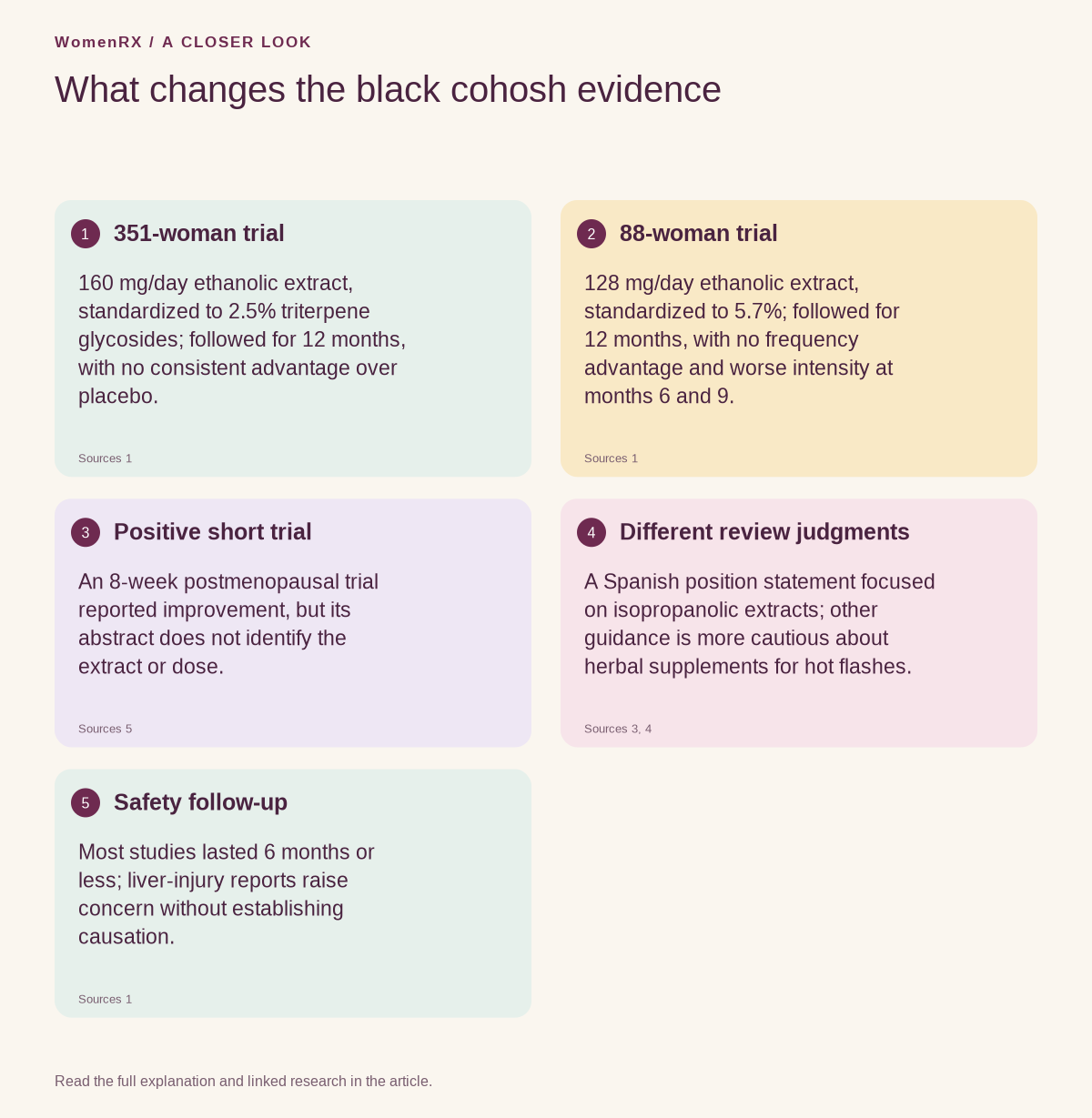
351-woman trial: 160 mg/day ethanolic extract, standardized to 2.5% triterpene glycosides; followed for 12 months, with no consistent advantage over placebo.1
88-woman trial: 128 mg/day ethanolic extract, standardized to 5.7%; followed for 12 months, with no frequency advantage and worse intensity at months 6 and 9.1
Positive short trial: An 8-week postmenopausal trial reported improvement, but its abstract does not identify the extract or dose.5
Different review judgments: A Spanish position statement focused on isopropanolic extracts; other guidance is more cautious about herbal supplements for hot flashes.34
Safety follow-up: Most studies lasted 6 months or less; liver-injury reports raise concern without establishing causation.1
Read the figure as text
Compare the extract and follow-up behind each finding before applying it to a supplement on a store shelf.- 351-woman trial: 160 mg/day ethanolic extract, standardized to 2.5% triterpene glycosides; followed for 12 months, with no consistent advantage over placebo.1
- 88-woman trial: 128 mg/day ethanolic extract, standardized to 5.7%; followed for 12 months, with no frequency advantage and worse intensity at months 6 and 9.1
- Positive short trial: An 8-week postmenopausal trial reported improvement, but its abstract does not identify the extract or dose.5
- Different review judgments: A Spanish position statement focused on isopropanolic extracts; other guidance is more cautious about herbal supplements for hot flashes.34
- Safety follow-up: Most studies lasted 6 months or less; liver-injury reports raise concern without establishing causation.1
More questions, answered
Does black cohosh increase estrogen?
That has not been established. Studies have reported inconsistent hormone findings, and black cohosh’s active constituents and mechanism of action remain uncertain. 1
Is there a proven safe length of time to take it?
No long-term safety period has been established. Most clinical studies examined use for six months or less. 1
Sources you can check
- Black Cohosh - Health Professional Fact SheetAccessed 2026-09-25Return to first citation
- The 2022 hormone therapy position statement of The North American Menopause Society.“The 2022 Hormone Therapy Position Statement of The North American Menopause Society” Advisory Panel. · Menopause (New York, N.Y.) · 2022Return to first citation
- The 2023 nonhormone therapy position statement of The North American Menopause Society.Menopause (New York, N.Y.) · 2023Return to first citation
- Black cohosh efficacy and safety for menopausal symptoms. The Spanish Menopause Society statement.Castelo-Branco C, Navarro C, Beltrán E, Losa F, Camacho M, on the behalf of the Natural Products Study Group of the Spanish Menopause Society. · Gynecological endocrinology : the official journal of the International Society of Gynecological Endocrinology · 2022Return to first citation
- Effect of black cohosh (cimicifuga racemosa) on vasomotor symptoms in postmenopausal women: a randomized clinical trial.Shahnazi M, Nahaee J, Mohammad-Alizadeh-Charandabi S, Bayatipayan S. · Journal of caring sciences · 2013Return to first citation
- Complementary therapies for management of menopausal symptoms: a systematic review to inform the update of the International Menopause Society recommendations on women's midlife health.Maunder A, Mardon AK, Rao V, Torkel S, Metri NJ, Liu J, Yang G, Giese N, Mantzioris E, Abdul Jafar NK, Rodrigues de Souza GE, Al-Kanini I, Romero L, Panay N, Pedder H, Ee C. · Climacteric : the journal of the International Menopause Society · 2026Return to first citation