Black Cohosh Safety: What Women Need to Know
Black cohosh may cause mild side effects, but product differences and uncertain liver reports make its safety harder to judge.
In menopause studies, black cohosh most often caused mild, short-lived stomach upset or rash, but the studies were generally short and products varied. Reports have linked black cohosh use with liver injury, though a cause-and-effect relationship hasn’t been established. Avoid it if you have a liver disorder, and stop taking it and seek medical advice for dark urine, yellowing skin or eyes, or abdominal pain. 1
The short-term picture is more reassuring than the long-term one
In clinical trials of black cohosh for menopause symptoms, reported side effects were uncommon; the most frequent were mild, temporary stomach upset and rashes. Breast discomfort, spotting, infections, and muscle or joint complaints were also reported, but at similar rates among women taking black cohosh and placebo. Most studies lasted six months or less, so they don’t establish what happens with longer use. 1
That’s a limited kind of reassurance: it describes selected products used in short studies, not every supplement on a store shelf or years of use.
Liver reports deserve attention, not assumptions
Reports from around the world have described at least 83 cases of liver damage associated with black cohosh use, ranging from abnormal liver tests to hepatitis and liver failure. These reports do not prove that black cohosh caused the injuries. The products might have contained impurities or different plant species, but the reported products weren’t independently tested to confirm that explanation either. So the cause remains uncertain, and the reports shouldn’t be dismissed. 1
The same uncertainty makes the product itself relevant. Black cohosh supplements can be made as powders or extracts, and their chemical composition varies. Researchers also don’t know which compounds, if any, account for symptom effects. A label saying “black cohosh” doesn’t mean the product matches the extract used in a particular trial. 1
If you have a liver disorder, a U.S. Pharmacopeia caution advises avoiding black cohosh. If you’re taking it and develop abdominal pain, dark urine, or yellowing of the skin or eyes (jaundice), stop taking it and contact a medical professional promptly for assessment. These symptoms can have causes other than a supplement, but they warrant medical attention. 1
Menopause relief and safety are separate questions
Whether black cohosh helps hot flashes is unsettled. A 2012 review of 16 trials involving 2,027 women found the studies too different in products, methods, and findings to support or rule out benefit. A later review also found no significant association with fewer hot flashes or better self-rated menopause symptoms. 1
A 2026 systematic review reports moderate-certainty evidence for black cohosh and menopause or vasomotor symptoms, a more favorable assessment than those earlier reviews. Its abstract doesn’t provide black-cohosh-specific trial details, so it can’t tell a reader which product, outcome, or duration supports that assessment. The shift is a reason to recognize that the evidence is evolving, not a guarantee that a product will work or that long-term safety is known. 41
For context, the North American Menopause Society’s 2023 position statement does not recommend supplements or herbal remedies for hot flashes, while identifying other evidence-based nonhormonal options. Hormone therapy remains the most effective treatment for hot flashes; whether it’s appropriate depends on individual health factors and preferences. 32
If symptoms are disrupting sleep or daily life, you don’t have to treat black cohosh as the only alternative to hormone therapy. Ask about options with better-established evidence and how their benefits and risks fit your situation.
A few decisions to make before using it
- If you have a liver disorder: avoid black cohosh, consistent with the U.S. Pharmacopeia advice reported in the NIH fact sheet. 1
- If you’re pregnant: safety hasn’t been rigorously evaluated; an herbal-products association advises against use except under a healthcare provider’s supervision. 1
- If you’re breastfeeding: the available menopause safety information doesn’t establish safety during breastfeeding. Don’t assume findings in midlife menopause studies apply to this different situation. 1
- If you take medicines: clinically relevant interactions aren’t known, but interactions haven’t been systematically studied. That isn’t the same as proving there are none, so review the exact product with a pharmacist or clinician before using it. 1
- If you’re considering long-term use: studies generally don’t answer that safety question. A short trial’s tolerability can’t establish safety over years. 1
Black cohosh is neither proven to cause every reported liver injury nor established as risk-free. Its short-term trial side effects were usually mild, but uncertain product identity, incomplete interaction data, and limited long-term evidence all matter when deciding whether to use it.
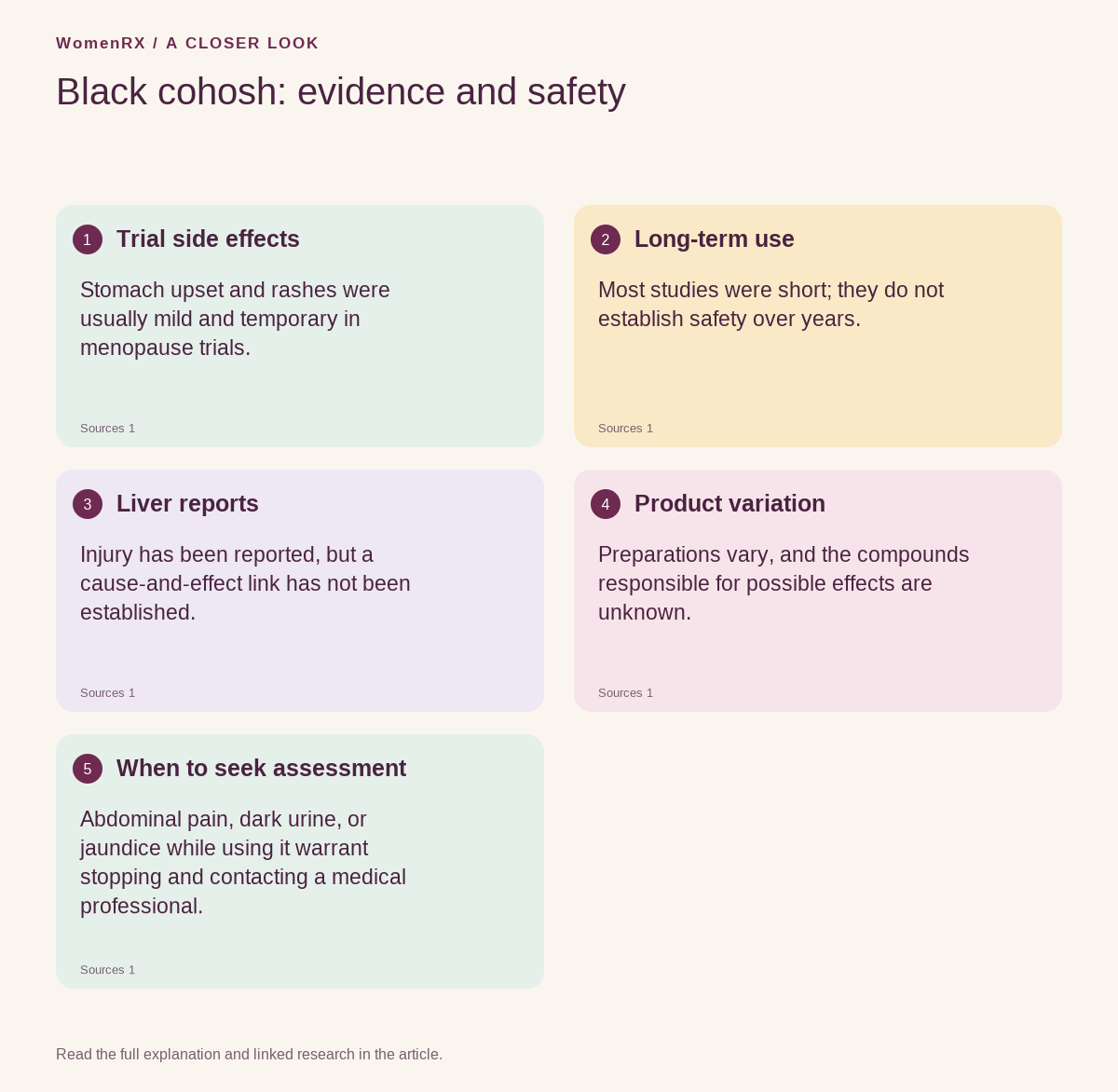
Black cohosh: evidence and safety
Trial side effects: Stomach upset and rashes were usually mild and temporary in menopause trials.1
Long-term use: Most studies were short; they do not establish safety over years.1
Liver reports: Injury has been reported, but a cause-and-effect link has not been established.1
Product variation: Preparations vary, and the compounds responsible for possible effects are unknown.1
When to seek assessment: Abdominal pain, dark urine, or jaundice while using it warrant stopping and contacting a medical professional.1
Read the figure as text
Separate what short-term studies and menopause guidance say from the uncertainties that affect a personal safety decision.- Trial side effects: Stomach upset and rashes were usually mild and temporary in menopause trials.1
- Long-term use: Most studies were short; they do not establish safety over years.1
- Liver reports: Injury has been reported, but a cause-and-effect link has not been established.1
- Product variation: Preparations vary, and the compounds responsible for possible effects are unknown.1
- When to seek assessment: Abdominal pain, dark urine, or jaundice while using it warrant stopping and contacting a medical professional.1
More questions, answered
Does black cohosh interact with medicines?
No clinically relevant medication interactions are known, but interactions haven’t been systematically studied. That uncertainty matters if you take prescription or over-the-counter medicines; have a pharmacist or clinician review the specific product rather than assuming it has no interactions. 1
What symptoms should prompt a check for liver problems?
While taking black cohosh, abdominal pain, dark urine, or yellowing of the skin or eyes are reasons to stop the supplement and contact a medical professional for assessment. 1
Sources you can check
- Black Cohosh - Health Professional Fact SheetAccessed 2026-09-25Return to first citation
- The 2022 hormone therapy position statement of The North American Menopause Society.“The 2022 Hormone Therapy Position Statement of The North American Menopause Society” Advisory Panel. · Menopause (New York, N.Y.) · 2022Return to first citation
- The 2023 nonhormone therapy position statement of The North American Menopause Society.Menopause (New York, N.Y.) · 2023Return to first citation
- Complementary therapies for management of menopausal symptoms: a systematic review to inform the update of the International Menopause Society recommendations on women's midlife health.Maunder A, Mardon AK, Rao V, Torkel S, Metri NJ, Liu J, Yang G, Giese N, Mantzioris E, Abdul Jafar NK, Rodrigues de Souza GE, Al-Kanini I, Romero L, Panay N, Pedder H, Ee C. · Climacteric : the journal of the International Menopause Society · 2026Return to first citation