Black Cohosh Side Effects: What to Watch For
Stomach upset and rash are the most commonly reported side effects in trials; liver injury reports call for caution, though causation hasn’t been established.
In menopause trials, the most commonly reported black cohosh side effects were mild, temporary stomach upset and rash. Liver injuries have also been reported, but black cohosh hasn’t been established as the cause. If you develop abdominal pain, dark urine, or yellowing of your skin or eyes, stop taking it and contact a clinician. Pregnancy, breastfeeding, and liver disease call for particular caution. 1 2
What women reported in menopause studies
Black cohosh is often sold for hot flashes and night sweats. In clinical trials, its most commonly reported side effects were gastrointestinal upset and rash, usually mild and temporary. Breast discomfort or enlargement, vaginal bleeding or spotting, infections, and muscle or joint complaints were also reported, but occurred at similar rates among women taking black cohosh and those taking placebo. That distinction matters: a symptom reported during a study wasn’t necessarily caused by the supplement. 1
Nausea, headache, dizziness, and vomiting appear in other reports of adverse reactions. If a symptom starts while you’re taking black cohosh, make a note of when it began and the exact product you used. A clinician or pharmacist can help assess a symptom that concerns you without assuming the supplement is responsible. 2 4
Why liver symptoms need a different response
Reports from around the world have described liver problems, including hepatitis and liver failure, in people who used black cohosh. These reports are concerning, but they don’t establish that black cohosh caused the injuries. Product impurities, adulterants, or a different Actaea species have been proposed as possible explanations for some cases, though the products weren’t independently analyzed to confirm those explanations. 1
There is still a clear action to take if you develop abdominal pain, dark urine, or yellowing of your skin or eyes while using it: stop taking black cohosh and contact a clinician. If you already have a liver disorder, U.S. Pharmacopeia advises avoiding black cohosh. These are different situations from a mild, short-lived stomach upset reported in a trial. 1
Consider the product and the reason you’re taking it
Black cohosh preparations vary considerably in chemical composition. Most studies examined use for six months or less, so their findings cannot establish long-term safety. A label that names or standardizes an extract doesn’t mean every black cohosh product is equivalent, and independent quality verification does not prove that a product is safe or effective for you. Keep the bottle or a clear photo of its full label if you want help assessing what you took. 1 2
The potential benefit belongs in the decision, too. A review of 16 trials involving women with menopausal symptoms found insufficient evidence either to support or oppose black cohosh for those symptoms; a later analysis found no significant benefit over placebo for hot flashes. If you’re weighing a possible side effect against relief you’re not getting, you don’t have to assume the supplement is helping just because it’s marketed for menopause. 1
When your health situation changes the conversation
If you’re pregnant, black cohosh shouldn’t be used without supervision from your pregnancy care clinician. Pregnancy safety hasn’t been rigorously evaluated, and concerns about possible labor-related effects rest on limited evidence. Breastfeeding is a separate gap: there are no established safety and efficacy data for nursing mothers or infants. Discuss its use before taking it while breastfeeding. 1 2 3
No clinically relevant medication interactions are known, but interactions haven’t been systematically studied. If you take medicines, bring your medication list and the black cohosh label to a clinician or pharmacist for an individualized review. That is more useful than assuming either that an interaction exists or that none is possible. 1 2
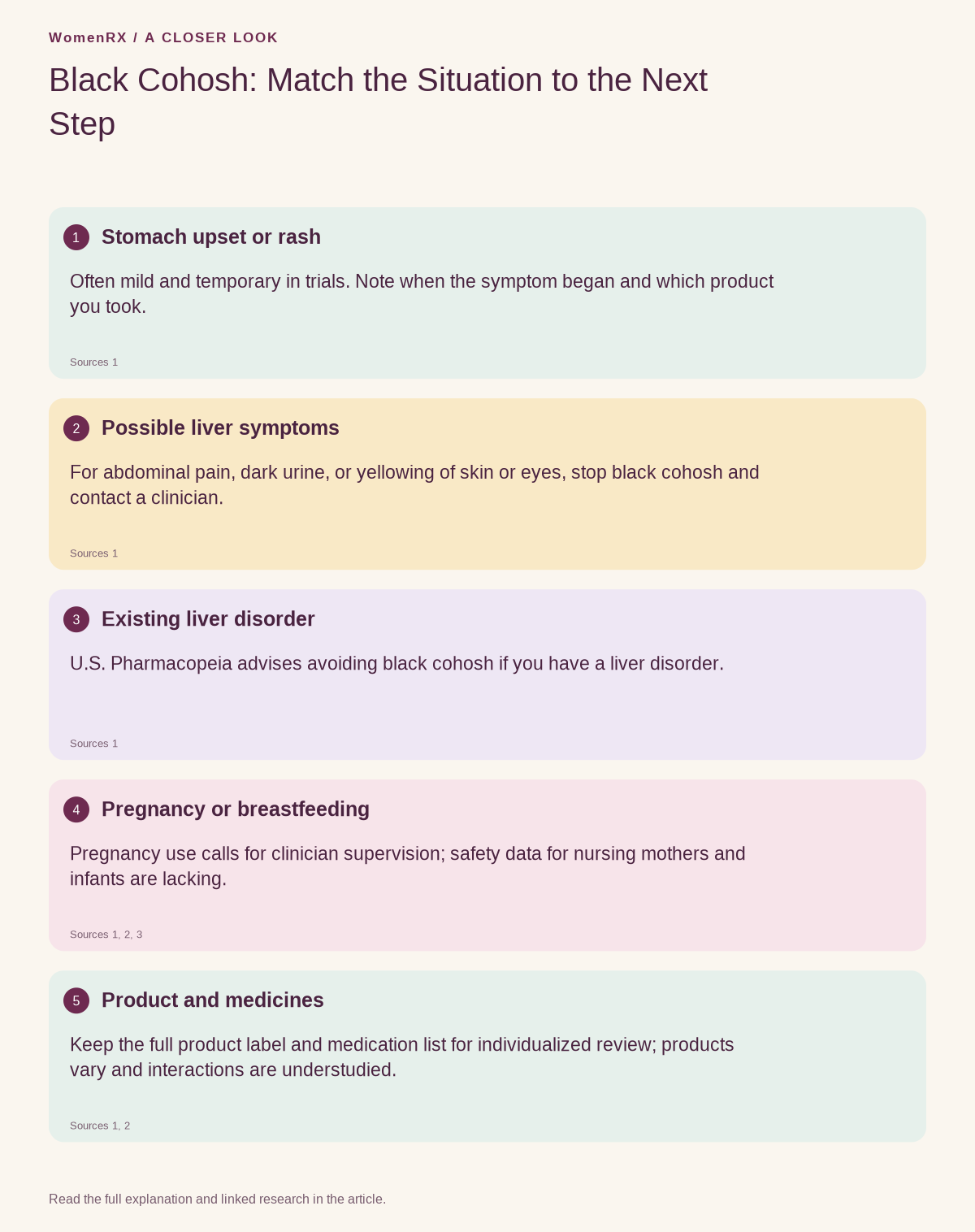
Black Cohosh: Match the Situation to the Next Step
Stomach upset or rash: Often mild and temporary in trials. Note when the symptom began and which product you took.1
Possible liver symptoms: For abdominal pain, dark urine, or yellowing of skin or eyes, stop black cohosh and contact a clinician.1
Existing liver disorder: U.S. Pharmacopeia advises avoiding black cohosh if you have a liver disorder.1
Pregnancy or breastfeeding: Pregnancy use calls for clinician supervision; safety data for nursing mothers and infants are lacking.123
Product and medicines: Keep the full product label and medication list for individualized review; products vary and interactions are understudied.12
Read the figure as text
This checklist separates reported trial symptoms from the liver symptoms with a specific stop-and-contact recommendation.- Stomach upset or rash: Often mild and temporary in trials. Note when the symptom began and which product you took.1
- Possible liver symptoms: For abdominal pain, dark urine, or yellowing of skin or eyes, stop black cohosh and contact a clinician.1
- Existing liver disorder: U.S. Pharmacopeia advises avoiding black cohosh if you have a liver disorder.1
- Pregnancy or breastfeeding: Pregnancy use calls for clinician supervision; safety data for nursing mothers and infants are lacking.123
- Product and medicines: Keep the full product label and medication list for individualized review; products vary and interactions are understudied.12
More questions, answered
Does a standardized black cohosh label guarantee safety?
No. Preparations can differ in composition, and results for one product may not apply to another. A label helps identify the product for review, but standardization or independent quality verification doesn’t establish that it’s safe or effective for you. 1 2
Sources you can check
- Black Cohosh - Health Professional Fact SheetAccessed 2026-09-25Return to first citation
- Black Cohosh2006Return to first citation
- Safety and efficacy of black cohosh (Cimicifuga racemosa) during pregnancy and lactation.Dugoua JJ, Seely D, Perri D, Koren G, Mills E. · The Canadian journal of clinical pharmacology = Journal canadien de pharmacologie clinique · 2006Return to first citation
- Black cohosh: an alternative therapy for menopause?Mahady GB, Fabricant D, Chadwick LR, Dietz B. · Nutrition in clinical care : an official publication of Tufts University · 2002Return to first citation