Black Cohosh for Menopause: Evidence, Products, and Safety
Black cohosh studies reach different conclusions, and a supplement’s milligram amount alone won’t tell you whether it resembles a studied extract.
Black cohosh has not shown consistent relief of hot flashes and night sweats across studies, although some reviews are more favorable than others. Products vary in how they’re prepared, so the amount on a label doesn’t establish that a supplement matches one used in a trial. Short-term side effects are usually mild, but long-term human safety remains uncertain. 145
What the evidence says about hot flashes
Black cohosh is made from the plant’s roots and rhizomes. You might be considering it for hot flashes or night sweats, but the research doesn’t point to one reliable answer. A 2012 review covered 16 trials involving 2,027 women. The products, methods, and findings varied enough that the reviewers concluded there was insufficient evidence to support or oppose black cohosh for menopausal symptoms. 1
Two randomized trials show what that uncertainty can look like. In one, 351 women ages 45 to 55 were assigned to black cohosh, other interventions, or placebo. The black-cohosh group did not differ from placebo in the number or intensity of hot flashes and night sweats at 3, 6, or 12 months. In another trial, 88 perimenopausal and postmenopausal women were assigned to black cohosh, other interventions, or placebo. Symptoms declined in all groups, but black cohosh did not significantly outperform placebo; symptom intensity was worse in the black-cohosh group at 6 and 9 months. 1
Other assessments are more positive. A 2022 Spanish Menopause Society statement concluded that black cohosh can relieve vasomotor symptoms, drawing largely on studies of an isopropanolic extract. A 2026 systematic review reported moderate-certainty evidence for black cohosh on vasomotor and menopausal symptoms. A separate 2026 review of non-soy herbal supplements reported no measurable effects in two trials using black cohosh and dong quai, without separating the results by herb in its abstract. Those findings don’t establish that any black-cohosh product will work. 456
For a treatment decision, the North American Menopause Society’s 2023 position statement does not recommend supplements or herbal remedies for hot flashes and night sweats. It does recommend evidence-supported nonhormone options, including cognitive behavioral therapy, clinical hypnosis, and certain prescription treatments. Hormone therapy remains the most effective treatment for these symptoms, though whether it’s a good fit depends on individual circumstances. 23
A study match takes more than milligrams
“Black cohosh” doesn’t describe a single recipe. Supplements may contain powdered plant material, liquid extract, or dried extract, and their chemical composition can vary. Researchers also don’t know which components, if any, are responsible for symptom relief. That’s why a study’s result may not transfer neatly to a bottle on a shelf. 1
If you want to compare a label with a study, check what each one actually identifies:
- Plant and part: Look for black cohosh and whether the product identifies the root or rhizome. 1
- Preparation: Is it powdered plant material or an extract? If it’s an extract, does the description name the extraction solvent, such as ethanol or isopropyl alcohol? 1
- Standardization: Some extracts specify a percentage or amount of triterpene glycosides. That helps describe the preparation; it doesn’t prove those compounds cause symptom relief. 1
- Amount and other ingredients: Compare the amount in the study with what the label says, but check whether the product also contains other herbs. Milligrams alone don’t identify an extract’s composition. 1
For example, one trial used a 160 mg daily amount of a 70% ethanolic extract standardized to 2.5% triterpene glycosides. Another used 128 mg daily of a 75% ethanolic extract standardized to 5.7%. These are descriptions of trial preparations, not suggested amounts to take. A label that says only “black cohosh” and a milligram amount doesn’t give you enough information to tell whether the product resembles either one. 1
Even a detailed label cannot prove that two products have identical contents or effects. The NIH Office of Dietary Supplements notes that independent analysis can help verify a product’s identity and composition. It also notes that a commercial preparation used in studies has been reformulated over time, another reason to be careful about assuming a familiar product name means an unchanged extract. 1
What the safety findings can tell you
In clinical trials, side effects were generally uncommon; stomach upset and rash were among those most often reported and were usually mild and temporary. Most studies examined use for six months or less, and published studies described by the NIH have not assessed long-term safety in humans. 1
Liver injuries, including hepatitis and liver failure, have been reported in association with black cohosh, but a causal link has not been established. Contamination, adulteration, or use of a different plant species have been suggested as possible explanations for some reports, but the products involved were not independently analyzed to confirm those possibilities. 1
If you have a liver disorder, the U.S. Pharmacopeia advises avoiding black cohosh. If you develop possible signs of liver trouble while taking it, such as dark urine, yellowing of the skin or eyes, or abdominal pain, stop taking it and contact a clinician. No clinically relevant medication interactions are known, but interactions have not been systematically studied. 1
Put the choice in context
Start with the symptom you want to address. Hot flashes and night sweats are the main focus of the black-cohosh evidence; it hasn’t been established as a treatment for every menopause-related concern. In one trial summarized by the NIH, most measured outcomes beyond hot flashes and night sweats, including insomnia, fatigue, mood changes, and sexual dysfunction, did not significantly differ between groups. 1
Then ask whether a product provides enough detail to compare it with a studied preparation. A close match still won’t settle the mixed benefit findings or the long-term safety question. If hot flashes or night sweats are disrupting your life, there are also better-supported options to weigh, both hormone and nonhormone. 123
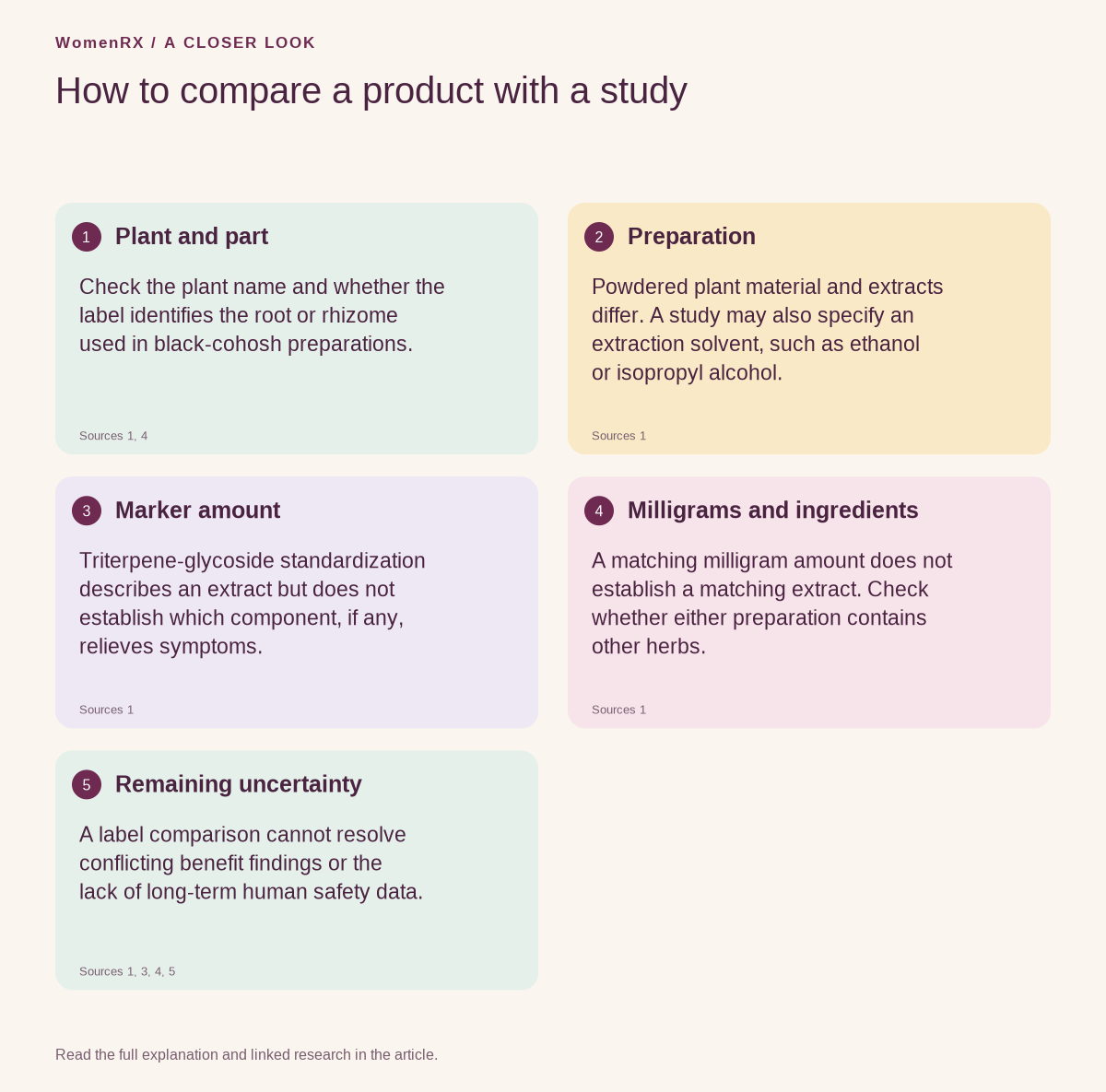
How to compare a product with a study
Plant and part: Check the plant name and whether the label identifies the root or rhizome used in black-cohosh preparations.14
Preparation: Powdered plant material and extracts differ. A study may also specify an extraction solvent, such as ethanol or isopropyl alcohol.1
Marker amount: Triterpene-glycoside standardization describes an extract but does not establish which component, if any, relieves symptoms.1
Milligrams and ingredients: A matching milligram amount does not establish a matching extract. Check whether either preparation contains other herbs.1
Remaining uncertainty: A label comparison cannot resolve conflicting benefit findings or the lack of long-term human safety data.1345
Read the figure as text
These details help you judge whether a label describes something like a studied preparation. A close description does not prove identical contents or effects.- Plant and part: Check the plant name and whether the label identifies the root or rhizome used in black-cohosh preparations.14
- Preparation: Powdered plant material and extracts differ. A study may also specify an extraction solvent, such as ethanol or isopropyl alcohol.1
- Marker amount: Triterpene-glycoside standardization describes an extract but does not establish which component, if any, relieves symptoms.1
- Milligrams and ingredients: A matching milligram amount does not establish a matching extract. Check whether either preparation contains other herbs.1
- Remaining uncertainty: A label comparison cannot resolve conflicting benefit findings or the lack of long-term human safety data.1345
More questions, answered
Does black cohosh balance estrogen?
That hasn’t been established. Studies have reported varying results on whether black cohosh affects estrogen or other hormone levels, and its active components and mechanism of action remain unknown. 1
Does a standardized extract mean a product is proven to work?
No. Standardization describes the amount of a selected marker in an extract. It doesn’t show that the marker causes relief or that products with a similar marker amount will have the same effects. 1
Sources you can check
- Black Cohosh - Health Professional Fact SheetAccessed 2026-09-25Return to first citation
- The 2022 hormone therapy position statement of The North American Menopause Society.“The 2022 Hormone Therapy Position Statement of The North American Menopause Society” Advisory Panel. · Menopause (New York, N.Y.) · 2022Return to first citation
- The 2023 nonhormone therapy position statement of The North American Menopause Society.Menopause (New York, N.Y.) · 2023Return to first citation
- Black cohosh efficacy and safety for menopausal symptoms. The Spanish Menopause Society statement.Castelo-Branco C, Navarro C, Beltrán E, Losa F, Camacho M, on the behalf of the Natural Products Study Group of the Spanish Menopause Society. · Gynecological endocrinology : the official journal of the International Society of Gynecological Endocrinology · 2022Return to first citation
- Complementary therapies for management of menopausal symptoms: a systematic review to inform the update of the International Menopause Society recommendations on women's midlife health.Maunder A, Mardon AK, Rao V, Torkel S, Metri NJ, Liu J, Yang G, Giese N, Mantzioris E, Abdul Jafar NK, Rodrigues de Souza GE, Al-Kanini I, Romero L, Panay N, Pedder H, Ee C. · Climacteric : the journal of the International Menopause Society · 2026Return to first citation
- The Effectiveness of Non-Soy Oral Herbal Supplements for Menopausal Symptoms: A Systematic Review.Jing G, Keane CM, Reynolds CM. · Nutrients · 2026Return to first citation