How to Compare Black Cohosh Products for Menopause
Look past the front-label promises: the plant part, extract details, added ingredients, and safety information all matter.
There isn’t enough product-level evidence to name a best black cohosh brand. Compare labels for the botanical name (Actaea racemosa, also called Cimicifuga racemosa), root or rhizome, extract form, and any stated extraction or standardization details. Those details help identify what’s in the bottle, but they don’t prove it will ease symptoms. Evidence of benefit is mixed, and liver concerns deserve attention. 1345
Start with what’s actually in the bottle
Black cohosh supplements are made from the plant’s roots and rhizomes, or underground stems. Products may contain powdered herb, liquid extract, or dried extract. Their chemical makeup can vary, and researchers haven’t established which compounds, if any, account for symptom relief. 1
When comparing labels, look for Actaea racemosa (also called Cimicifuga racemosa), the plant part, the form, and the amount per serving. If the label gives extraction details, such as the solvent, or says the extract is standardized to particular compounds, record that too. These details make products easier to compare; they don’t show that one brand works better. 15
A label that says “standardized” needs a closer look. Some extracts state an amount of triterpene glycosides, while a product used in several older studies was standardized by an amount equivalent to root and rhizome, not by its triterpene-glycoside content. Standardization can describe different things, so the word alone doesn’t tell you that two extracts match. 1
What the menopause studies can, and can’t, tell you
The findings aren’t consistent. In one randomized trial, 351 women ages 45 to 55 with hot flashes or night sweats received one of several treatments, including a specific black cohosh extract, a multi-ingredient herbal product, or placebo. The herbal groups did not have better symptom outcomes than the placebo group over 12 months. In a second trial of 88 perimenopausal and postmenopausal women, symptoms improved in all groups, but black cohosh did not outperform placebo; symptom intensity was worse in the black cohosh group at two measured follow-ups. 1
A 2012 review of 16 trials involving 2,027 women found the studies too varied in products, methods, and results to support or rule out black cohosh for menopause symptoms. A 2016 review also found no significant benefit for hot-flash frequency or self-reported symptom relief. More recently, a 2026 systematic review reported moderate-certainty evidence for black cohosh and menopausal or vasomotor symptoms, while describing the overall evidence for complementary therapies as limited. This newer assessment is a reason not to treat older uncertainty as the final word, but it doesn’t establish that every product, or a product with a similar-sounding label, will help. 14
The North American Menopause Society’s 2023 position statement did not recommend supplements or herbal remedies for vasomotor symptoms, based on the evidence it reviewed. Taken together, current summaries don’t provide a dependable way to predict an individual product’s benefit from its label alone. 34
A practical label comparison
For each product you’re considering, note:
- Plant identity: Does it name Actaea racemosa or Cimicifuga racemosa?
- Plant part and form: Does it specify root or rhizome, and whether it’s powdered herb or an extract?
- Extract description: Are the solvent and any standardization details stated? If so, what exactly is standardized?
- Other ingredients: Is it black cohosh alone, or one ingredient in a blend? A blend makes it harder to connect any effect to black cohosh itself.
- Safety information: Does the label mention liver concerns, and can you find clear ingredient and serving information?
These are comparison questions, not a scorecard for effectiveness. A study of one extract cannot establish that another extract with a different profile will produce the same result. Even the reporting of preparation details and harms has varied across black cohosh clinical trials. 15
Keep liver concerns in the comparison
Clinical trials have most often reported mild, short-lived stomach upset or rash. Separately, at least 83 reports worldwide have described liver injury associated with black cohosh use. Those reports do not establish that black cohosh caused the injuries, and the products involved were not independently analyzed to confirm what they contained. Human studies have generally been short, so long-term safety is not established. 1
If you develop possible liver symptoms such as abdominal pain, dark urine, or yellowing of the skin or eyes while taking black cohosh, stop taking it and contact a doctor. The NIH Office of Dietary Supplements also notes that people with liver disorders should avoid it. 1
Black cohosh is not known to have clinically relevant medication interactions, but interactions have not been studied systematically. That’s different from proving that interactions can’t happen. If you take medication, bring the specific product label to a pharmacist or doctor rather than relying on a general “no known interactions” statement. 1
The useful bottom line
Choose by transparency, not by a “best brand” claim: confirm the plant identity and part, understand the extract description, check whether it’s a blend, and read the safety information. Those steps help you compare products, but they can’t tell you that a particular bottle will relieve hot flashes or other menopause symptoms. If symptom relief is your main goal, evidence-supported treatment options are worth comparing separately with a clinician. 123
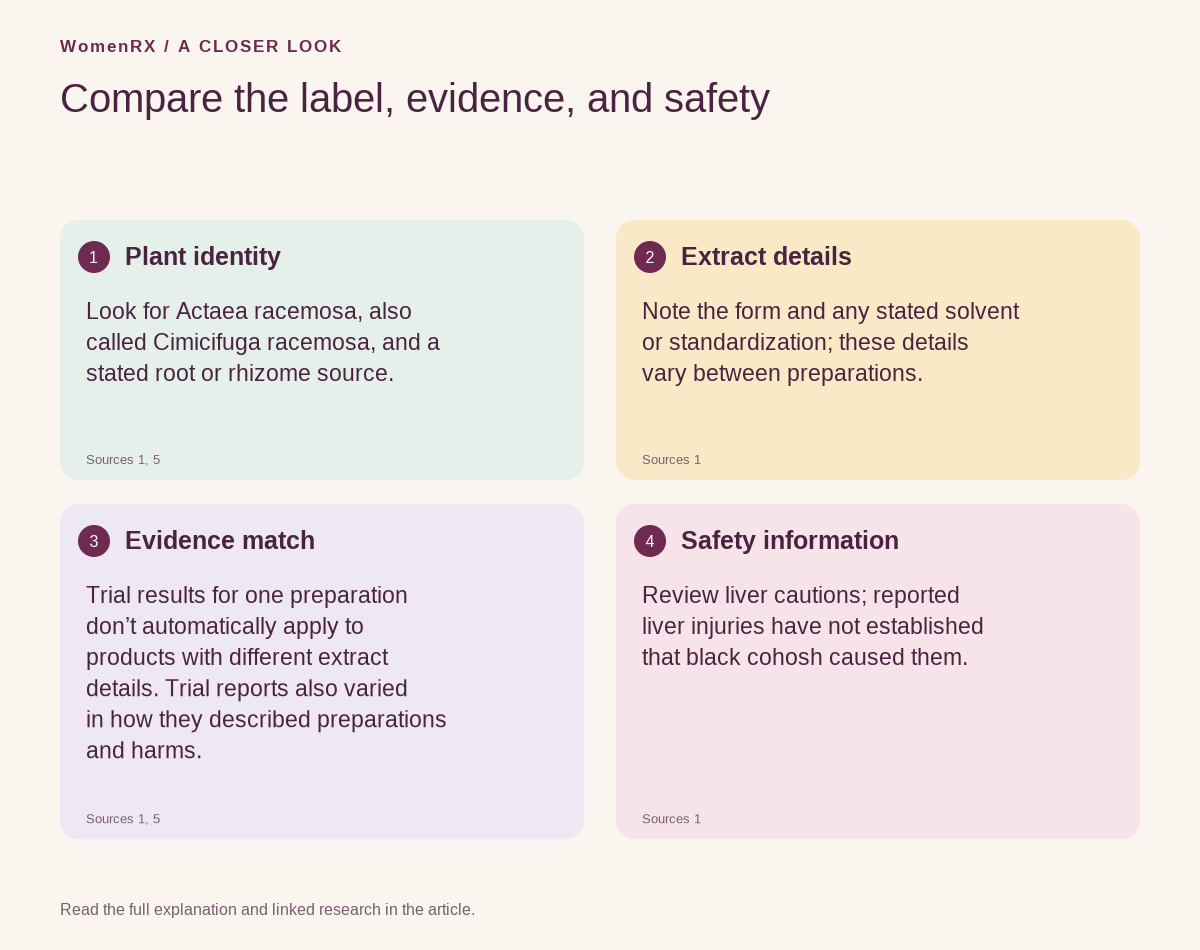
Compare the label, evidence, and safety
Plant identity: Look for Actaea racemosa, also called Cimicifuga racemosa, and a stated root or rhizome source.15
Extract details: Note the form and any stated solvent or standardization; these details vary between preparations.1
Evidence match: Trial results for one preparation don’t automatically apply to products with different extract details. Trial reports also varied in how they described preparations and harms.15
Safety information: Review liver cautions; reported liver injuries have not established that black cohosh caused them.1
Read the figure as text
A product label can tell you what preparation is being sold, but it cannot by itself predict symptom relief. Compare these separate questions.- Plant identity: Look for Actaea racemosa, also called Cimicifuga racemosa, and a stated root or rhizome source.15
- Extract details: Note the form and any stated solvent or standardization; these details vary between preparations.1
- Evidence match: Trial results for one preparation don’t automatically apply to products with different extract details. Trial reports also varied in how they described preparations and harms.15
- Safety information: Review liver cautions; reported liver injuries have not established that black cohosh caused them.1
More questions, answered
Does “standardized” mean two products are equivalent?
No. Labels may standardize extracts to different things, and the active compounds linked to possible symptom relief haven’t been established. A shared standardization term doesn’t show that products match or have the same clinical effect. 1
Are medication interactions ruled out?
No. Clinically relevant interactions aren’t known, but they haven’t been systematically studied. If you use medication, show a pharmacist or doctor the exact product and ingredient list. 1
Sources you can check
- Black Cohosh - Health Professional Fact SheetAccessed 2026-09-25Return to first citation
- The 2022 hormone therapy position statement of The North American Menopause Society.“The 2022 Hormone Therapy Position Statement of The North American Menopause Society” Advisory Panel. · Menopause (New York, N.Y.) · 2022Return to first citation
- The 2023 nonhormone therapy position statement of The North American Menopause Society.Menopause (New York, N.Y.) · 2023Return to first citation
- Complementary therapies for management of menopausal symptoms: a systematic review to inform the update of the International Menopause Society recommendations on women's midlife health.Maunder A, Mardon AK, Rao V, Torkel S, Metri NJ, Liu J, Yang G, Giese N, Mantzioris E, Abdul Jafar NK, Rodrigues de Souza GE, Al-Kanini I, Romero L, Panay N, Pedder H, Ee C. · Climacteric : the journal of the International Menopause Society · 2026Return to first citation
- Efficacy and safety of Actaea racemosa for relieving climacteric complaints.Curtis S, Moore A, Breakspear I. · Menopause (New York, N.Y.) · 2026Return to first citation