Black Cohosh Labels, Doses, and Safety
Black cohosh products can differ enough that a dose studied in one trial may not match the bottle you’re considering.
There isn’t one evidence-based dose that applies to every black cohosh product. Menopause studies used different extracts, amounts, and standardization methods, and two larger trials found no symptom benefit over placebo for the preparations they tested. Before considering a product, compare its plant identity, root or rhizome, extract details, and amount per daily serving, and review safety questions with your clinician. 1
Start with the preparation, not the milligrams
A front label that says “black cohosh” doesn’t tell you whether the product resembles one used in a study. Supplements may contain powdered root, liquid extract, or dried extract. Their chemical composition varies, and the compounds responsible for any possible symptom effect aren’t known. 1
When you read a label, look for Actaea racemosa (also called Cimicifuga racemosa) and whether the ingredient comes from the root or rhizome. Check whether it is a whole herb or an extract, how the extract was made if stated, and the amount in the full daily serving. These details help you describe the product accurately; they don’t establish that it will work. 12
Some products are standardized to a stated amount of triterpene glycosides. That can help identify a preparation, but it does not make all standardized products equivalent: researchers don’t know which constituents, if any, account for relief. A quality-verification seal may offer information about identity or quality, but it does not show that the product treats menopause symptoms or is safe for every person. 12
Why trial doses don’t create a universal dose
In two randomized trials, researchers tested quite different preparations. One assigned 351 women ages 45-55 to, among other groups, 160 mg per day of a 70% ethanolic extract standardized to 2.5% triterpene glycosides. Another trial tested 128 mg per day of a 75% ethanolic extract standardized to 5.7% triterpene glycosides in 88 perimenopausal and postmenopausal women. In both trials, the black cohosh group did not have better hot-flash or night-sweat outcomes than the placebo group. 1
Those amounts describe the specific study preparations, not a recommended dose for a product on a store shelf. A review of 16 trials found doses ranging from 8 to 160 mg per day, with different formulations and study methods; the reviewers judged the evidence insufficient to support or oppose use for menopause symptoms. A number on your label alone can’t tell you that your product is comparable. 1
The 2023 North American Menopause Society position statement does not recommend supplements or herbal remedies for vasomotor symptoms such as hot flashes and night sweats. If those symptoms are disrupting your life, it may be more useful to discuss options with evidence supporting their use than to keep adjusting an herbal dose. 6
What to know about side effects and liver reports
Clinical trials have most often reported mild, temporary stomach upset and rashes. Other symptoms, including breast discomfort and spotting, were reported at similar rates among participants taking black cohosh and placebo in the reviewed trials. Most studies lasted six months or less, so they don’t establish long-term safety. 1
Reports from around the world describe liver problems in people who used black cohosh, but a causal link has not been established. Differences in products, including possible impurities or incorrect plant species, have been raised as possible explanations, but the products in those reports were not independently analyzed to confirm this. If you develop abdominal pain, dark urine, or yellowing of the skin or eyes while taking it, stop using it and contact your clinician promptly. People with liver disorders are advised to avoid it. 1
No clinically relevant medication interactions are currently known, but interactions have not been systematically studied. That means “none known” isn’t the same as proving there are none. Bring the bottle or a clear photo of its label and tell your clinician what medicines and supplements you take. 1
Pregnancy and breastfeeding need a separate conversation
Menopause-product guidance shouldn’t be carried over to pregnancy or breastfeeding. Black cohosh hasn’t been rigorously evaluated during pregnancy; guidance advises against taking it in pregnancy except under a health care provider’s supervision. Evidence during breastfeeding is also limited, with no established safety or efficacy data for nursing mothers or infants. If you’re pregnant, trying to conceive, or breastfeeding, get individualized advice before using it. 1234
A practical label check
Before you decide, write down the exact plant name, plant part, extract type, any stated standardization, and amount per daily serving. Add the other ingredients, how long you’re considering using it, your medicines and other supplements, and any symptoms you’ve noticed. This gives your clinician something specific to assess, without assuming a dose from a different product applies to yours.
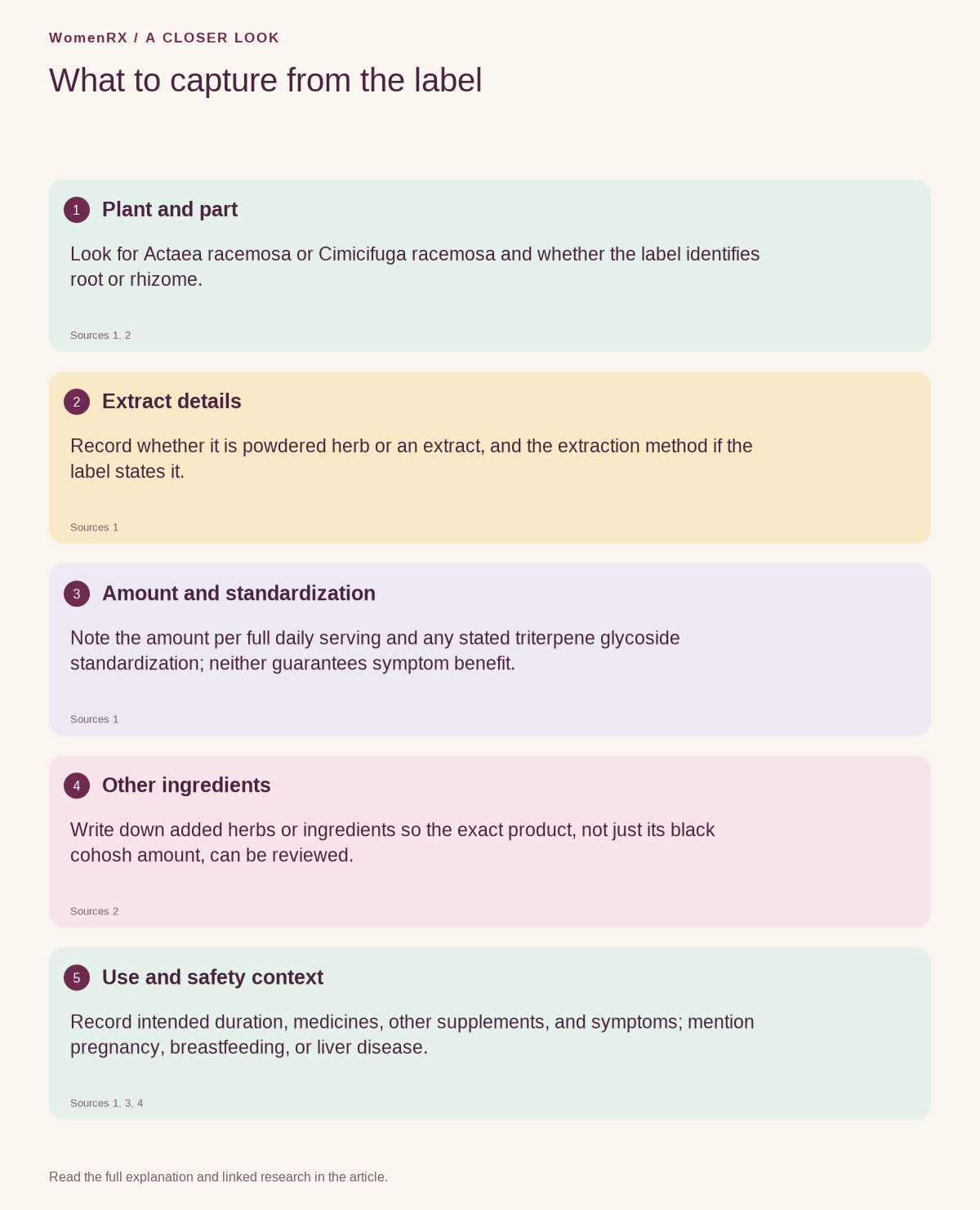
What to capture from the label
Plant and part: Look for Actaea racemosa or Cimicifuga racemosa and whether the label identifies root or rhizome.12
Extract details: Record whether it is powdered herb or an extract, and the extraction method if the label states it.1
Amount and standardization: Note the amount per full daily serving and any stated triterpene glycoside standardization; neither guarantees symptom benefit.1
Other ingredients: Write down added herbs or ingredients so the exact product, not just its black cohosh amount, can be reviewed.2
Use and safety context: Record intended duration, medicines, other supplements, and symptoms; mention pregnancy, breastfeeding, or liver disease.134
Read the figure as text
These details help you identify the preparation and discuss how well the evidence and safety information apply to it.- Plant and part: Look for Actaea racemosa or Cimicifuga racemosa and whether the label identifies root or rhizome.12
- Extract details: Record whether it is powdered herb or an extract, and the extraction method if the label states it.1
- Amount and standardization: Note the amount per full daily serving and any stated triterpene glycoside standardization; neither guarantees symptom benefit.1
- Other ingredients: Write down added herbs or ingredients so the exact product, not just its black cohosh amount, can be reviewed.2
- Use and safety context: Record intended duration, medicines, other supplements, and symptoms; mention pregnancy, breastfeeding, or liver disease.134
More questions, answered
Does a standardized label mean a black cohosh product is proven to work?
No. Standardization describes a stated amount of selected compounds, but the active constituents for menopause relief are unknown, and the clinical evidence does not show that standardization guarantees symptom benefit. 1
Are black cohosh and hormone therapy interchangeable?
No. The North American Menopause Society identifies hormone therapy as the most effective treatment for vasomotor symptoms, while its 2023 statement does not recommend herbal supplements for those symptoms. Whether hormone therapy is appropriate depends on individual circumstances. 56
Sources you can check
- Black Cohosh - Health Professional Fact SheetAccessed 2026-09-25Return to first citation
- Black Cohosh2006Return to first citation
- Safety of Popular Herbal Supplements in Lactating Women.Amer MR, Cipriano GC, Venci JV, Gandhi MA. · Journal of human lactation : official journal of International Lactation Consultant Association · 2015Return to first citation
- Safety and efficacy of black cohosh (Cimicifuga racemosa) during pregnancy and lactation.Dugoua JJ, Seely D, Perri D, Koren G, Mills E. · The Canadian journal of clinical pharmacology = Journal canadien de pharmacologie clinique · 2006Return to first citation
- The 2022 hormone therapy position statement of The North American Menopause Society.“The 2022 Hormone Therapy Position Statement of The North American Menopause Society” Advisory Panel. · Menopause (New York, N.Y.) · 2022Return to first citation
- The 2023 nonhormone therapy position statement of The North American Menopause Society.Menopause (New York, N.Y.) · 2023Return to first citation