Black Cohosh for Menopause: What the Evidence Shows
Black cohosh has been studied for hot flashes and other menopause symptoms, but results vary and a product’s formulation matters.
Black cohosh may be worth discussing if hot flashes or night sweats are bothering you, but the evidence doesn’t establish it as a reliable treatment. Some studies and a recent systematic review report possible benefit, while other trials and menopause guidance find insufficient or inconsistent support. Results from one extract can’t automatically be applied to every supplement labeled black cohosh. 1 3 6
Start with the symptom you want to change
Black cohosh has mainly been studied for vasomotor symptoms: hot flashes and night sweats. Some trials also measured broader menopause symptoms, such as mood, sleep, fatigue, or vaginal dryness. Those outcomes shouldn’t be treated as interchangeable. In two larger trials summarized by the NIH Office of Dietary Supplements, black cohosh didn’t reliably improve hot-flash or night-sweat outcomes compared with placebo. Most secondary symptoms also showed no significant difference between groups. 1
There are positive findings, too. In one randomized, double-blind, placebo-controlled trial of 84 postmenopausal women, researchers reported between-group differences in hot-flash number and vasomotor-symptom severity after four and eight weeks. The abstract doesn’t give enough detail to tell how large or noticeable those differences were, or to establish whether they would apply to a different product or to people in perimenopause. 5
That mix of results is why “black cohosh works” and “black cohosh never works” are both too simple. The practical question is whether evidence for a specific, studied preparation is relevant to the product you’re considering and to the symptom you most want help with.
Why studies reach different conclusions
A 2012 Cochrane review summarized 16 randomized trials involving 2,027 women. The trials varied in their duration, methods, and black cohosh preparations; the review concluded that there wasn’t enough evidence to support or oppose its use for menopause symptoms. A 2016 review and meta-analysis likewise found no significant association with fewer vasomotor symptoms or better self-reported menopause symptom scores. 1
Other reviews are more favorable. A 2022 statement from the Spanish Menopause Society concluded that black cohosh was effective for vasomotor symptoms, drawing largely on studies of an isopropanolic extract. A 2026 systematic review reported moderate-certainty evidence that black cohosh may improve vasomotor or menopause symptoms, while also concluding that overall evidence for complementary therapies remains limited and more rigorous research is needed. 4 6
These conclusions aren’t identical, and they shouldn’t be flattened into a single promise. Reviews may include different studies, preparations, and outcomes. The 2026 review’s abstract doesn’t specify which black cohosh products or symptom measures account for its moderate-certainty finding, so it can’t establish that any particular store-bought product will help you. Meanwhile, the North American Menopause Society’s 2023 statement does not recommend supplements and herbal remedies for vasomotor symptoms, based on the evidence it reviewed. 3 6
The label matters, but doesn’t settle the question
Black cohosh supplements can contain powdered herb or different types of extract. Their chemical composition varies, and the substances responsible for any effect are not known. A research finding with a particular extract therefore doesn’t prove that another extract, combination formula, or product with the same plant name has the same effect. Standardization details may help you see whether a product resembles one used in research, but they don’t show that it works. 1
It’s also worth separating black cohosh from products that combine it with other herbs or ingredients. A result from a multi-ingredient product cannot show that black cohosh alone caused the change. In one large trial summarized by the NIH, herbal interventions did not generally outperform placebo on hot flashes and night sweats. The combination of a multibotanical product and soy foods was associated with worse symptom intensity than placebo at 12 months. 1
What to weigh before trying it
If you’re considering black cohosh, a useful conversation is about your main symptom, the exact product and extract, and what would count as enough improvement to make continuing worthwhile. Ask how the evidence for that preparation compares with other options for your symptom. This is especially relevant if you’re in perimenopause: studies include women at different stages, but results from postmenopausal participants alone may not answer your question.
For bothersome hot flashes and night sweats, hormone therapy remains the most effective treatment according to the North American Menopause Society. Whether it fits depends on individual circumstances and preferences; black cohosh hasn’t been shown to be equivalent to it. The same Society’s nonhormone guidance identifies several options supported by evidence, but doesn’t recommend herbal supplements for vasomotor symptoms. 2 3
Short-term trials have generally reported few adverse effects, most often mild, temporary digestive upset or rash. Reports of liver injury have been associated with black cohosh use, but a causal relationship hasn’t been established; product contamination or misidentification has been raised as a possible explanation. Long-term human safety hasn’t been assessed in the studies summarized by the NIH. If you develop abdominal pain, dark urine, or yellowing of the skin or eyes while taking it, stop taking the supplement and contact a clinician. 1
black cohosh is a reasonable topic to raise, not a dependable answer to assume. Its possible benefits remain uncertain, particularly when a product differs from those studied. Weigh that uncertainty against the symptom you want to relieve and the better-supported options available to you.
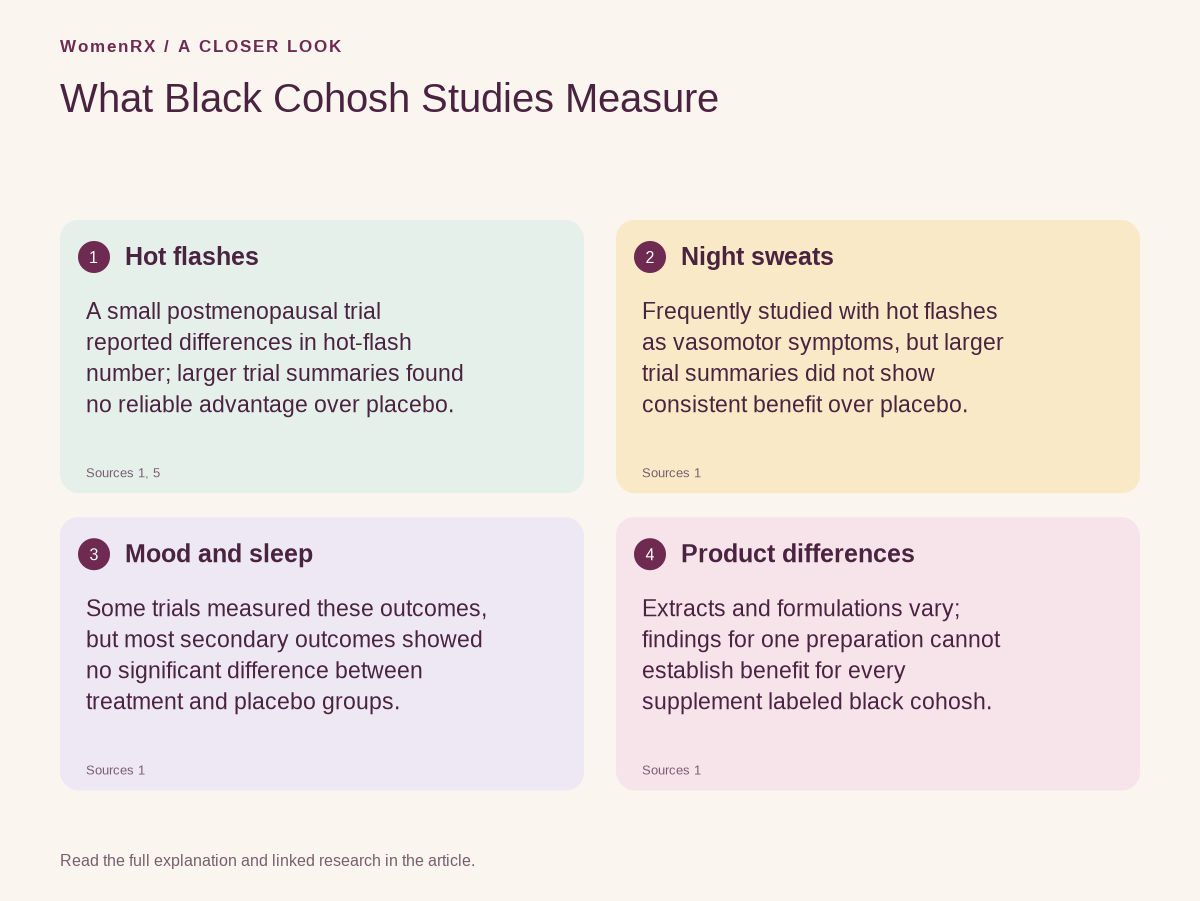
What Black Cohosh Studies Measure
Hot flashes: A small postmenopausal trial reported differences in hot-flash number; larger trial summaries found no reliable advantage over placebo.15
Night sweats: Frequently studied with hot flashes as vasomotor symptoms, but larger trial summaries did not show consistent benefit over placebo.1
Mood and sleep: Some trials measured these outcomes, but most secondary outcomes showed no significant difference between treatment and placebo groups.1
Product differences: Extracts and formulations vary; findings for one preparation cannot establish benefit for every supplement labeled black cohosh.1
Read the figure as text
The evidence is not equally clear for every symptom. These findings distinguish commonly studied outcomes from broader symptoms and show why product-specific conclusions remain limited.- Hot flashes: A small postmenopausal trial reported differences in hot-flash number; larger trial summaries found no reliable advantage over placebo.15
- Night sweats: Frequently studied with hot flashes as vasomotor symptoms, but larger trial summaries did not show consistent benefit over placebo.1
- Mood and sleep: Some trials measured these outcomes, but most secondary outcomes showed no significant difference between treatment and placebo groups.1
- Product differences: Extracts and formulations vary; findings for one preparation cannot establish benefit for every supplement labeled black cohosh.1
More questions, answered
Is black cohosh equivalent to hormone therapy?
No. The North American Menopause Society identifies hormone therapy as the most effective treatment for vasomotor symptoms. Research has not established black cohosh as equally effective. 2 3
Does evidence for one black cohosh product apply to all brands?
Not necessarily. Black cohosh preparations vary in composition, and the active constituents are unknown. A study of one extract or combination product does not establish the effects of another. 1
Sources you can check
- Black Cohosh - Health Professional Fact SheetAccessed 2026-09-25Return to first citation
- The 2022 hormone therapy position statement of The North American Menopause Society.“The 2022 Hormone Therapy Position Statement of The North American Menopause Society” Advisory Panel. · Menopause (New York, N.Y.) · 2022Return to first citation
- The 2023 nonhormone therapy position statement of The North American Menopause Society.Menopause (New York, N.Y.) · 2023Return to first citation
- Black cohosh efficacy and safety for menopausal symptoms. The Spanish Menopause Society statement.Castelo-Branco C, Navarro C, Beltrán E, Losa F, Camacho M, on the behalf of the Natural Products Study Group of the Spanish Menopause Society. · Gynecological endocrinology : the official journal of the International Society of Gynecological Endocrinology · 2022Return to first citation
- Effect of black cohosh (cimicifuga racemosa) on vasomotor symptoms in postmenopausal women: a randomized clinical trial.Shahnazi M, Nahaee J, Mohammad-Alizadeh-Charandabi S, Bayatipayan S. · Journal of caring sciences · 2013Return to first citation
- Complementary therapies for management of menopausal symptoms: a systematic review to inform the update of the International Menopause Society recommendations on women's midlife health.Maunder A, Mardon AK, Rao V, Torkel S, Metri NJ, Liu J, Yang G, Giese N, Mantzioris E, Abdul Jafar NK, Rodrigues de Souza GE, Al-Kanini I, Romero L, Panay N, Pedder H, Ee C. · Climacteric : the journal of the International Menopause Society · 2026Return to first citation