Black Cohosh and Hormones: What the Evidence Measures
Some human studies measured hormone levels as well as symptoms, and the results don’t show that black cohosh “balances” hormones.
In human studies, researchers have measured both menopausal symptoms and blood hormone levels. In a randomized trial of breast cancer survivors, black cohosh did not produce different FSH or LH changes from placebo. A review of trials in women treated for endometriosis likewise found no significant changes in estradiol or LH, even though some symptoms improved. Symptom relief and hormone change are separate outcomes. 1 2
A product claim that black cohosh “balances hormones” suggests a measurable shift in hormone levels. The human evidence here does not establish that effect. Some studies measured hormone levels directly, while also asking about symptoms. Those measures didn’t necessarily move together.
What the studies actually measured
In a randomized trial, 85 breast cancer survivors were assigned to black cohosh or placebo. Participants recorded hot flashes and completed symptom questionnaires; researchers also measured follicle-stimulating hormone (FSH) and luteinizing hormone (LH) in a subset. FSH and LH changes did not differ between groups. Hot flashes and other symptoms improved in both groups, but the differences between groups were not statistically significant for most symptoms. 1
A systematic review of seven trials involving 745 women with endometriosis looked at black cohosh extracts added to treatment with a GnRH agonist after surgery. The review found no significant difference in estradiol or LH levels between groups. It did report improvement in some low-estrogen-related symptoms, including hot flashes and sweating, insomnia, fatigue, and vaginal dryness. That finding applies to this specific treatment context, not automatically to people going through natural perimenopause or menopause. 2
Symptoms aren’t a hormone test
A person can report fewer hot flashes without a study showing a change in measured hormone levels. That’s what makes symptom results and hormone results distinct: one describes how someone feels; the other describes specific lab measurements. Neither outcome, by itself, proves a product restores or “balances” hormones.
The results also don’t mean that every possible hormone effect has been ruled out. The breast cancer trial tested FSH and LH in only a subset, and the endometriosis review focused on estradiol and LH in women receiving a particular medical treatment. These findings answer questions about those measurements and settings, not every hormone or every black cohosh product. 1 2
Be careful with combination-product claims
One placebo-controlled trial in postmenopausal women tested a product containing black cohosh alongside soy isoflavone, chasteberry, and evening primrose oil. It reported symptom improvements but no significant hormone-level differences between the groups. Because the product had four ingredients, its results can’t show that black cohosh alone caused the symptom changes. 3
When reading a hormone claim, check what was actually assessed: a named blood hormone, a symptom questionnaire, or both. Also check whether the product contained black cohosh alone or a blend, and whether the participants’ circumstances resemble yours. The most useful conclusion from these studies is a narrow one: measured hormone levels did not significantly differ in the cited trials, while symptom findings varied by study and population.
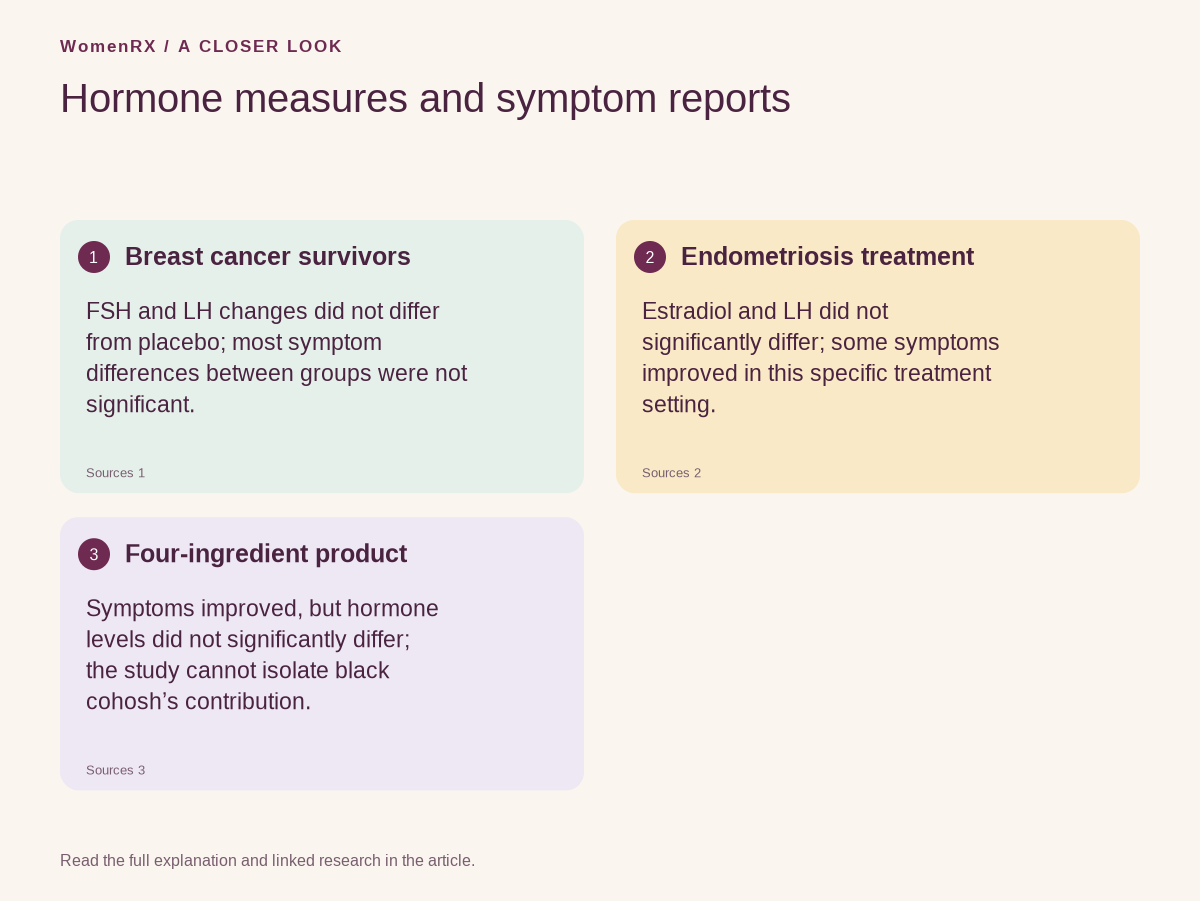
Hormone measures and symptom reports
Breast cancer survivors: FSH and LH changes did not differ from placebo; most symptom differences between groups were not significant.1
Endometriosis treatment: Estradiol and LH did not significantly differ; some symptoms improved in this specific treatment setting.2
Four-ingredient product: Symptoms improved, but hormone levels did not significantly differ; the study cannot isolate black cohosh’s contribution.3
Read the figure as text
These study findings show why symptom changes and measured hormone changes should be read as separate outcomes.- Breast cancer survivors: FSH and LH changes did not differ from placebo; most symptom differences between groups were not significant.1
- Endometriosis treatment: Estradiol and LH did not significantly differ; some symptoms improved in this specific treatment setting.2
- Four-ingredient product: Symptoms improved, but hormone levels did not significantly differ; the study cannot isolate black cohosh’s contribution.3
More questions, answered
Does feeling better mean my hormone levels changed?
No. Symptoms and blood hormone measurements are different outcomes. In the cited trials, some symptom findings occurred without significant differences in measured hormone levels. 2 3
Sources you can check
- Randomized trial of black cohosh for the treatment of hot flashes among women with a history of breast cancer.Jacobson JS, Troxel AB, Evans J, Klaus L, Vahdat L, Kinne D, Lo KM, Moore A, Rosenman PJ, Kaufman EL, Neugut AI, Grann VR. · Journal of clinical oncology : official journal of the American Society of Clinical Oncology · 2001Return to first citation
- [Efficacy of black cohosh extracts for improving low estrogen status induced by postoperative GnRHa treatment in patients with endometriosis: a systematic review].Peng J, Xu W, Li X, Wu Q. · Zhejiang da xue xue bao. Yi xue ban = Journal of Zhejiang University. Medical sciences · 2020Return to first citation
- Efficacy and Safety of Nutraceutical on Menopausal Symptoms in Post-Menopausal Women: A Randomized, Double-Blind, Placebo-Controlled Clinical Trial.Rattanatantikul T, Maiprasert M, Sugkraroek P, Bumrungpert A. · Journal of dietary supplements · 2022Return to first citation