Black Cohosh for Menopause: Evidence by Symptom
Larger trials haven’t found dependable hot-flash relief, and claims about sleep, mood, or vaginal symptoms have less support.
Black cohosh hasn’t reliably eased hot flashes or night sweats in larger, year-long trials, although a smaller eight-week study reported improvement with a different extract. Sleep and mood haven’t been established as separate benefits, and a trial found no significant improvement in vaginal dryness or measured reproductive hormones. Because preparations vary, a finding for one extract can’t be assumed to apply to another. 14568
Black cohosh is often promoted for several menopause symptoms at once, but those claims don’t all rest on the same evidence. Hot flashes and night sweats have been studied most. Sleep, mood, and vaginal symptoms have less direct evidence, and the preparation used matters when you compare results. 1
Hot flashes and night sweats: larger trials found little benefit
In a one-year randomized trial of 351 women ages 45 to 55, black cohosh alone didn’t reduce the frequency or intensity of hot flashes and night sweats more than placebo. Just over half the participants were in the menopause transition; the others were postmenopausal. Researchers tested a 70% ethanolic extract standardized to 2.5% triterpene glycosides. 15
Another year-long randomized trial enrolled perimenopausal and postmenopausal women with frequent hot flashes and night sweats. Symptom frequency fell in the black cohosh group, but it also fell in the placebo group, with no significant advantage for black cohosh. This trial used a different ethanolic extract, standardized to 5.7% triterpene glycosides. A decrease from the start of a study isn’t, by itself, evidence that the supplement caused it. 14
There are positive findings too. An eight-week placebo-controlled study reported fewer and less severe hot flashes among postmenopausal participants, though its abstract doesn’t identify the extract preparation. Another report from the same investigator group describes 84 early postmenopausal participants and improvement on a broad menopause symptom scale, including its vasomotor subscale, with a dried-root extract. Both reports describe 84 participants; their abstracts don’t establish whether these were distinct groups of women. It would be misleading to count them as two independent confirmations. 78
The mixed results haven’t added up to a dependable benefit. A review of 16 randomized trials involving 2,027 women judged the evidence too varied in preparations, methods, and findings to support or oppose black cohosh for menopause symptoms. The North American Menopause Society’s 2023 position statement does not recommend herbal supplements for hot flashes and night sweats. 13
Sleep and mood: a hot-flash result can’t answer both
One year-long trial assessed insomnia, fatigue, depression, and anxiety as secondary outcomes. Most of those outcomes didn’t differ significantly between treatment groups. The smaller dried-root-extract study reported improvement on a broad psychiatric symptoms subscale, but that isn’t the same as showing that black cohosh treats insomnia, depression, or anxiety individually. 18
If broken sleep or mood changes are what bother you most, the evidence for hot flashes shouldn’t be treated as proof of a benefit for those symptoms.
Vaginal dryness and hormones: no significant effect found
A separate analysis of the 351-woman trial examined vaginal findings and reproductive hormones. The herbal interventions didn’t significantly improve vaginal dryness or vaginal tissue findings compared with placebo. Among the postmenopausal participants whose hormones were measured, they also didn’t significantly change the measured hormone outcomes. That doesn’t support using black cohosh to relieve vaginal dryness or to ‘rebalance’ estrogen. 6
Why the extract on the label matters
Black cohosh products can differ considerably in chemical composition, and researchers don’t know which compounds, if any, account for symptom relief. The two larger negative trials tested differently standardized ethanolic extracts. The smaller positive report specified a dried-root extract. These are descriptions of study products, not suggested amounts to take. A promising finding for one preparation doesn’t establish that a different bottle will work the same way. 1458
If hot flashes are disrupting your life, you don’t have to rely on an uncertain supplement effect. Hormone therapy is the most effective treatment for hot flashes and night sweats for appropriate candidates, and evidence-backed nonhormonal options are available too. Which option makes sense depends on your health history and preferences. 23
Black cohosh trials have commonly reported mild, short-lived stomach upset or rash, but long-term safety hasn’t been established. Liver injuries have been reported in people taking it, without proof that black cohosh caused them. If you develop dark urine, yellowing of the skin or eyes, or abdominal pain while taking it, stop using it and seek medical advice. 1
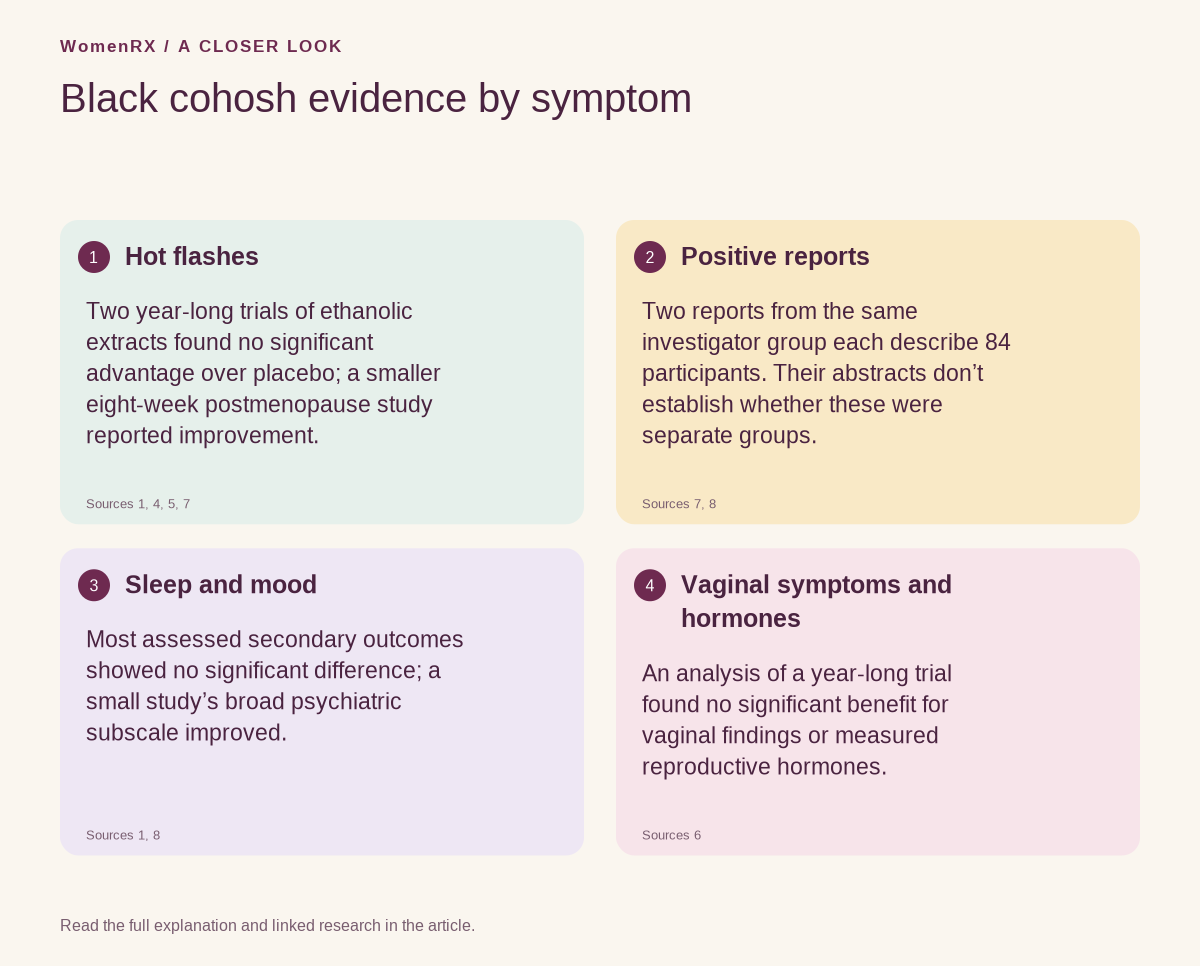
Black cohosh evidence by symptom
Hot flashes: Two year-long trials of ethanolic extracts found no significant advantage over placebo; a smaller eight-week postmenopause study reported improvement.1457
Positive reports: Two reports from the same investigator group each describe 84 participants. Their abstracts don’t establish whether these were separate groups.78
Sleep and mood: Most assessed secondary outcomes showed no significant difference; a small study’s broad psychiatric subscale improved.18
Vaginal symptoms and hormones: An analysis of a year-long trial found no significant benefit for vaginal findings or measured reproductive hormones.6
Read the figure as text
The findings differ by symptom and by the preparation studied.- Hot flashes: Two year-long trials of ethanolic extracts found no significant advantage over placebo; a smaller eight-week postmenopause study reported improvement.1457
- Positive reports: Two reports from the same investigator group each describe 84 participants. Their abstracts don’t establish whether these were separate groups.78
- Sleep and mood: Most assessed secondary outcomes showed no significant difference; a small study’s broad psychiatric subscale improved.18
- Vaginal symptoms and hormones: An analysis of a year-long trial found no significant benefit for vaginal findings or measured reproductive hormones.6
Sources you can check
- Black Cohosh - Health Professional Fact SheetAccessed 2026-09-25Return to first citation
- The 2022 hormone therapy position statement of The North American Menopause Society.“The 2022 Hormone Therapy Position Statement of The North American Menopause Society” Advisory Panel. · Menopause (New York, N.Y.) · 2022Return to first citation
- The 2023 nonhormone therapy position statement of The North American Menopause Society.Menopause (New York, N.Y.) · 2023Return to first citation
- Safety and efficacy of black cohosh and red clover for the management of vasomotor symptoms: a randomized controlled trial.Geller SE, Shulman LP, van Breemen RB, Banuvar S, Zhou Y, Epstein G, Hedayat S, Nikolic D, Krause EC, Piersen CE, Bolton JL, Pauli GF, Farnsworth NR. · Menopause (New York, N.Y.) · 2009Return to first citation
- Treatment of vasomotor symptoms of menopause with black cohosh, multibotanicals, soy, hormone therapy, or placebo: a randomized trial.Newton KM, Reed SD, LaCroix AZ, Grothaus LC, Ehrlich K, Guiltinan J. · Annals of internal medicine · 2006Return to first citation
- Vaginal, endometrial, and reproductive hormone findings: randomized, placebo-controlled trial of black cohosh, multibotanical herbs, and dietary soy for vasomotor symptoms: the Herbal Alternatives for Menopause (HALT) Study.Reed SD, Newton KM, LaCroix AZ, Grothaus LC, Grieco VS, Ehrlich K. · Menopause (New York, N.Y.) · 2008Return to first citation
- Effect of black cohosh (cimicifuga racemosa) on vasomotor symptoms in postmenopausal women: a randomized clinical trial.Shahnazi M, Nahaee J, Mohammad-Alizadeh-Charandabi S, Bayatipayan S. · Journal of caring sciences · 2013Return to first citation
- Efficacy of black cohosh (Cimicifuga racemosa L.) in treating early symptoms of menopause: a randomized clinical trial.Mohammad-Alizadeh-Charandabi S, Shahnazi M, Nahaee J, Bayatipayan S. · Chinese medicine · 2013Return to first citation