Black Cohosh After 40: What the Evidence Can Tell You
Black cohosh has been studied mainly for hot flashes and night sweats, but the evidence for taking it on its own remains uncertain.
Black cohosh may be relevant if hot flashes or night sweats are the symptoms you want to address, but studies of the herb alone haven’t shown consistent benefit over placebo. Menopause guidance recommends against herbal supplements for these symptoms, while established hormone and nonhormone options are available. Your age alone isn’t a reason to take the supplement. 1 4
Start with the symptom you want to change
Black cohosh has mostly been studied for hot flashes and night sweats, often grouped as vasomotor symptoms. Some studies also measured sleep, mood, vaginal dryness, or broader menopause symptom scores, but results for those outcomes were generally not better with black cohosh than with placebo. That means the herb’s evidence is a poor match if your main concern is, for example, vaginal dryness or low mood rather than hot flashes. 1
The studies involved women experiencing menopausal symptoms, including perimenopausal and postmenopausal women. They don’t establish that being over 40, by itself, is a reason to use black cohosh. Menopause is defined by the end of menstrual periods, and the typical age cited by the NIH Office of Dietary Supplements is about 51. 1
What trials of black cohosh alone found
The results are mixed overall, but the better-known placebo-controlled trials don’t show a reliable advantage for the herb. In one trial, 351 women aged 45 to 55 with hot flashes or night sweats were assigned to black cohosh, other supplement regimens, hormone therapy, or placebo. After 3, 6, and 12 months, the black-cohosh group’s symptom number and intensity did not differ from placebo. 1
A second trial enrolled 88 peri- and postmenopausal women who had at least 35 hot flashes and night sweats a week. Symptoms fell in every group, including placebo, but black cohosh did not outperform placebo for symptom number. Symptom intensity was worse in the black-cohosh group at two study time points. 1
A Cochrane review of 16 trials, involving 2,027 women, found that the studies differed substantially in products, methods, and duration, and concluded that the evidence was insufficient to support or oppose black cohosh for menopause symptoms. A later meta-analysis of four trials also found no significant benefit for hot-flash frequency or self-reported overall symptoms. 1
There is a newer, more encouraging result, but it doesn’t answer whether black cohosh alone works. A 2025 randomized trial in 96 postmenopausal women tested a combination of black cohosh, soy isoflavones, and SDG lignans against placebo for 90 days. The supplement combination improved symptom-rating scores, but because it contained three ingredients, the study can’t show whether black cohosh contributed to the result. 5
How that compares with established options
The North American Menopause Society’s 2023 position statement does not recommend supplements or herbal remedies for vasomotor symptoms. It identifies cognitive behavioral therapy, clinical hypnosis, and several prescription medicines as evidence-supported nonhormone options. Menopausal hormone therapy remains the most effective treatment for hot flashes and night sweats. 4
Whether hormone therapy fits depends on your health and preferences. The Society’s 2022 statement says the benefit-risk balance is generally favorable for women under 60 or within 10 years of menopause onset who have no contraindications, but risks vary by the type and duration of treatment and other factors. That’s a reason for an individualized discussion, not a one-size-fits-all recommendation. 3
A practical comparison is: black cohosh is an uncertain supplement option; hormone therapy is the most effective treatment for vasomotor symptoms for many appropriate candidates; and evidence-supported nonhormone treatments offer alternatives if you prefer not to use hormones or aren’t a suitable candidate. 3 4
The product and safety tradeoffs
“Black cohosh” doesn’t mean one identical product. Supplements may use different extracts and preparations, and the compounds responsible for any effect have not been established. That variation makes it difficult to apply results from one trial to every bottle on a store shelf. 1
Short clinical trials have most often reported mild, temporary stomach upset or rash. Longer-term safety has not been assessed in published human studies, and reports of liver injury have been associated with use, although a cause-and-effect link has not been established. If you take black cohosh and develop symptoms such as dark urine, yellowing of the skin or eyes, or abdominal pain, stop taking it and contact a health professional. People with liver disorders are advised to avoid it. 1
The NIH fact sheet says clinically relevant medication interactions are not known, but interactions have not been systematically studied. If you take medication, include the supplement when reviewing what you use with a clinician or pharmacist. 1
A useful way to decide
If hot flashes or night sweats are disrupting your life, it’s reasonable to compare options rather than assume a supplement is the gentlest or most effective choice. Ask what the evidence says for your specific symptom, whether the product you’re considering matches the preparations studied, and what established hormone or nonhormone approaches might fit your situation. Current menopause guidance does not recommend black cohosh for vasomotor symptoms, so trying it should not delay considering options with stronger support. 1 3 4
If you’ve gone 12 months without a period, any vaginal bleeding afterward, even a single episode of spotting, needs evaluation rather than treatment with a supplement. 2
Match the symptom to the evidence
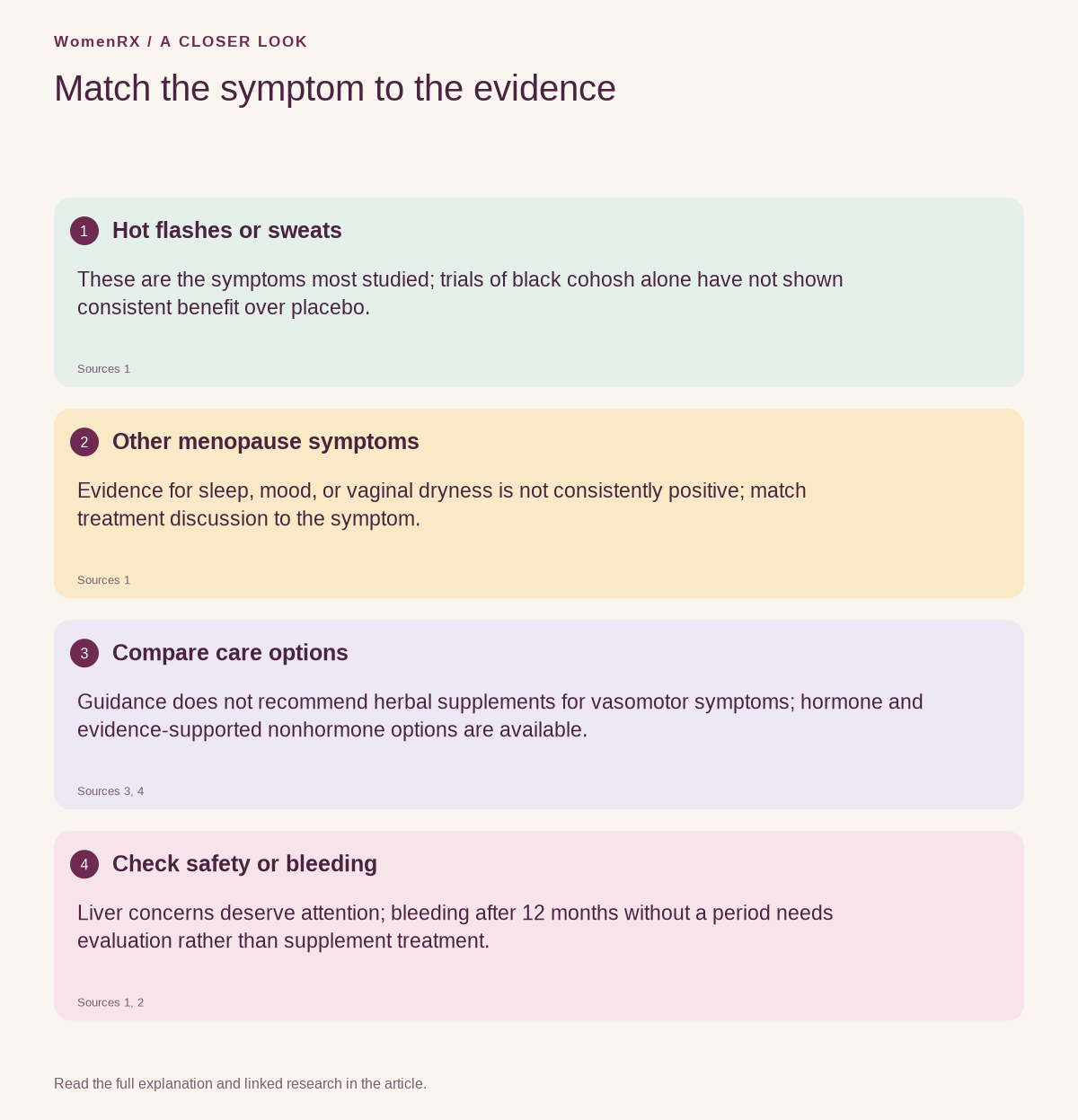
Hot flashes or sweats: These are the symptoms most studied; trials of black cohosh alone have not shown consistent benefit over placebo.1
Other menopause symptoms: Evidence for sleep, mood, or vaginal dryness is not consistently positive; match treatment discussion to the symptom.1
Compare care options: Guidance does not recommend herbal supplements for vasomotor symptoms; hormone and evidence-supported nonhormone options are available.34
Check safety or bleeding: Liver concerns deserve attention; bleeding after 12 months without a period needs evaluation rather than supplement treatment.12
Read the figure as text
Use the symptom you want to address to see where black cohosh evidence is most relevant, what alternatives have stronger support, and when an issue needs evaluation.- Hot flashes or sweats: These are the symptoms most studied; trials of black cohosh alone have not shown consistent benefit over placebo.1
- Other menopause symptoms: Evidence for sleep, mood, or vaginal dryness is not consistently positive; match treatment discussion to the symptom.1
- Compare care options: Guidance does not recommend herbal supplements for vasomotor symptoms; hormone and evidence-supported nonhormone options are available.34
- Check safety or bleeding: Liver concerns deserve attention; bleeding after 12 months without a period needs evaluation rather than supplement treatment.12
More questions, answered
Does black cohosh help with vaginal dryness?
Studies have measured vaginal dryness and other symptoms, but they generally have not shown a consistent benefit from black cohosh. For bothersome genitourinary symptoms, menopause guidance describes other treatment options, including low-dose vaginal estrogen for appropriate patients. 1 3
Is a supplement blend stronger evidence than black cohosh alone?
A 2025 trial found improved symptom scores with a blend of black cohosh, soy isoflavones, and SDG lignans, but it could not identify which ingredient, if any, produced the benefit. It doesn’t establish that black cohosh alone works. 5
Sources you can check
- Black Cohosh - Health Professional Fact SheetAccessed 2026-09-25Return to first citation
- Postmenopausal bleeding - NHSAccessed 2026-09-25Return to first citation
- The 2022 hormone therapy position statement of The North American Menopause Society.“The 2022 Hormone Therapy Position Statement of The North American Menopause Society” Advisory Panel. · Menopause (New York, N.Y.) · 2022Return to first citation
- The 2023 nonhormone therapy position statement of The North American Menopause Society.Menopause (New York, N.Y.) · 2023Return to first citation
- Assessing the combined effects of Black Cohosh, Soy Isoflavones, and SDG Lignans on menopausal symptoms: a randomized, double-blind, placebo-controlled clinical trial.Pokushalov E, Ponomarenko A, Garcia C, Kasimova L, Pak I, Shrainer E, Romanova A, Kudlay D, Johnson M, Miller R. · European journal of nutrition · 2025Return to first citation