Black Cohosh for Menopause: What to Track and When
There’s no established time when black cohosh should start helping, and the best-studied hot-flash outcomes have not shown a consistent benefit over placebo.
If you’re considering black cohosh, track the specific symptom you hope to change, such as hot flashes or night sweats, rather than a general sense of feeling better. There’s no proven time-to-benefit. A check-in around four to eight weeks can be a practical review point, but it isn’t a validated cutoff or proof the supplement works. 1 4 5
Look for change in the symptom you want to ease
Before starting, choose one or two symptoms that matter most to you. For hot flashes, you could record how often they happen and how disruptive they feel. For night sweats, note whether they wake you and affect your sleep. Keep the same simple record over time so you’re comparing like with like. This is a practical way to review your experience, not a validated test of whether black cohosh is working.
Don’t assume that a change in one symptom means the supplement helps with all menopause symptoms. Research has mainly examined hot flashes and broader symptom-rating scales. Evidence for outcomes such as vaginal dryness, sexual symptoms, and night sweats is limited or inconclusive. 5
What the studies say about timing
There isn’t a reliable, established number of days or weeks by which black cohosh should work. One randomized trial in 84 early postmenopausal women reported improvement in overall symptom scores and several symptom categories at four and eight weeks. That’s a result from one small study, not a dependable prediction for other women or other products. 4
Other findings are less encouraging for hot flashes. In a one-year randomized trial of 351 women in the menopausal transition or after menopause, black cohosh did not reduce hot-flash and night-sweat frequency or intensity more than placebo at three, six, or twelve months. 3 A Cochrane review of 16 trials involving 2,027 perimenopausal and postmenopausal women also found no significant difference from placebo in hot-flash frequency or overall menopause symptom scores, while noting substantial variation among studies and limitations in trial reporting. 5
Taken together, those mixed findings don’t support promising a particular time to benefit. The 2023 North American Menopause Society position statement does not recommend supplements or herbal remedies for vasomotor symptoms such as hot flashes and night sweats. 2
Set a review point, not a promised deadline
If you and your clinician decide to try black cohosh, agree in advance on what you’ll track and when you’ll review it. Four to eight weeks is a practical checkpoint because one trial assessed symptoms at those points, but it is not an evidence-based rule for how long to take the supplement or how quickly it should work. 4
At that review, ask: Did the symptom I chose improve in a noticeable way? Is the change meaningful enough to you to consider continuing? Have side effects appeared? If there’s no worthwhile change, don’t assume you simply need to wait longer: studies do not establish that extending use will bring a benefit. Most safety studies were short, typically six months or less. 1
Check the exact product, not just the name
Black cohosh products include powders and different kinds of extracts. Their chemical composition can vary, and researchers don’t know which compounds, if any, account for symptom relief. That means a study of one extract does not establish the benefit or safety of every product labeled black cohosh. 1
Bring the bottle or a clear photo of its label to a clinician or pharmacist. Note the listed plant name, extract type, amount, and any added ingredients. This matters especially for combination supplements: a result from a product containing other herbs or soy cannot show what black cohosh alone did. 1 3
Include safety in the review
Clinical trials have most often reported mild, short-lived stomach upset or rash. Reports of liver injury have been associated with black cohosh use, but they do not establish that the supplement caused the injury; product contamination or incorrect plant identity may have played a role in some cases. 1
If you develop possible signs of liver trouble, including yellowing of the skin or eyes, dark urine, or abdominal pain, stop taking the supplement and contact a clinician promptly. 1
No clinically relevant medication interactions are known, but interactions have not been systematically studied. Share the specific product and your medication list with a clinician or pharmacist rather than assuming a general interaction check covers every formulation. 1
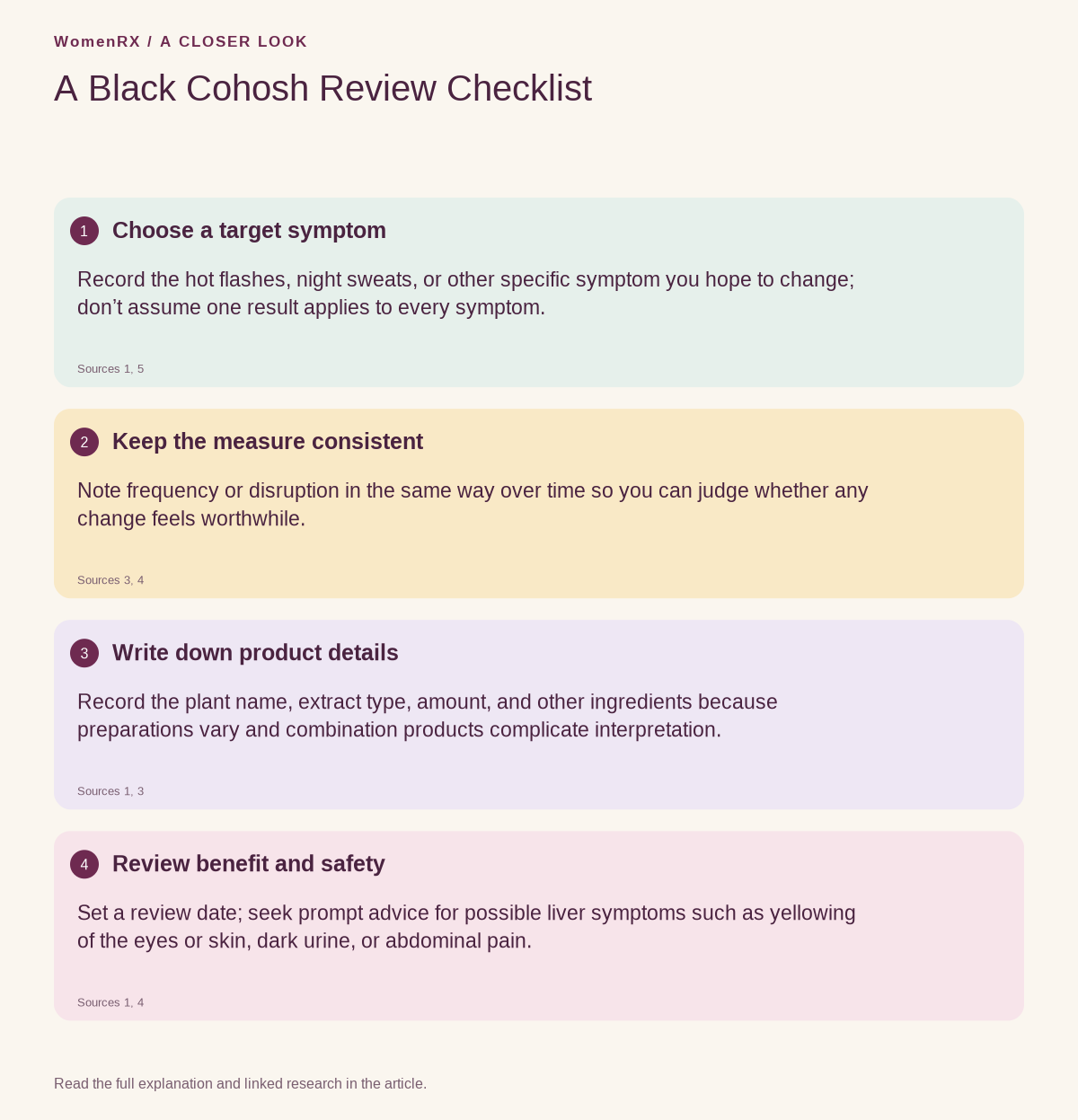
A Black Cohosh Review Checklist
Choose a target symptom: Record the hot flashes, night sweats, or other specific symptom you hope to change; don’t assume one result applies to every symptom.15
Keep the measure consistent: Note frequency or disruption in the same way over time so you can judge whether any change feels worthwhile.34
Write down product details: Record the plant name, extract type, amount, and other ingredients because preparations vary and combination products complicate interpretation.13
Review benefit and safety: Set a review date; seek prompt advice for possible liver symptoms such as yellowing of the eyes or skin, dark urine, or abdominal pain.14
Read the figure as text
Use these prompts to keep symptom tracking, product details, and safety in view. Four to eight weeks is a practical check-in point, not a proven deadline for benefit.- Choose a target symptom: Record the hot flashes, night sweats, or other specific symptom you hope to change; don’t assume one result applies to every symptom.15
- Keep the measure consistent: Note frequency or disruption in the same way over time so you can judge whether any change feels worthwhile.34
- Write down product details: Record the plant name, extract type, amount, and other ingredients because preparations vary and combination products complicate interpretation.13
- Review benefit and safety: Set a review date; seek prompt advice for possible liver symptoms such as yellowing of the eyes or skin, dark urine, or abdominal pain.14
More questions, answered
Does a change in mood or vaginal dryness show that black cohosh is working?
Not necessarily. Trials have not established consistent benefits across menopause symptoms. Track the particular symptom you care about, and don’t treat improvement in one area as proof of a benefit in others. 1 5
Are all black cohosh supplements interchangeable?
No. Products can differ in preparation and composition, and the active compounds are not known. Evidence for a particular extract or combination product cannot automatically be applied to every product with black cohosh on its label. 1
Sources you can check
- Black Cohosh - Health Professional Fact SheetAccessed 2026-09-25Return to first citation
- The 2023 nonhormone therapy position statement of The North American Menopause Society.Menopause (New York, N.Y.) · 2023Return to first citation
- Treatment of vasomotor symptoms of menopause with black cohosh, multibotanicals, soy, hormone therapy, or placebo: a randomized trial.Newton KM, Reed SD, LaCroix AZ, Grothaus LC, Ehrlich K, Guiltinan J. · Annals of internal medicine · 2006Return to first citation
- Efficacy of black cohosh (Cimicifuga racemosa L.) in treating early symptoms of menopause: a randomized clinical trial.Mohammad-Alizadeh-Charandabi S, Shahnazi M, Nahaee J, Bayatipayan S. · Chinese medicine · 2013Return to first citation
- Black cohosh (Cimicifuga spp.) for menopausal symptoms.Leach MJ, Moore V. · The Cochrane database of systematic reviews · 2012Return to first citation