Black Cohosh for Menopause: What the Dose Evidence Shows
Black cohosh has been studied in several different extracts and doses, but trials haven’t established one dependable dose for menopause symptoms.
There isn’t a proven daily dose of black cohosh for menopause symptoms. The 2012 Cochrane review covered extracts from 8 to 160 mg a day; a separate trial studied 6.5 mg. These are study doses, not recommendations. Extracts differ, so milligrams alone don’t make products interchangeable. Evidence for hot flashes and broader symptoms is inconsistent, and liver-injury reports have not established cause and effect. 1 4 6
The number on the bottle doesn’t tell the whole story
Black cohosh supplements come as powdered whole herb and as liquid or dried extracts. Their chemical makeup can vary, and researchers don’t know which compounds, if any, account for symptom relief. Some extracts are standardized to a stated amount of triterpene glycosides; others are not. A milligram amount on one product therefore can’t be assumed to match the same amount on another. 1
In trials included in a Cochrane review, women took 8 to 160 mg a day of different extracts. The median was 40 mg a day, and treatment lasted an average of about 23 weeks. Those figures describe what researchers studied, not a dose shown to work or a recommendation for what to take. 1 4
The extract details matter. For example, two trials used different ethanolic extracts: one studied 160 mg daily, standardized to 2.5% triterpene glycosides, and another studied 128 mg daily, standardized to 5.7%. These are not interchangeable amounts simply because both are labeled black cohosh. 1
What happened to hot flashes and other symptoms?
The larger evidence picture doesn’t show reliable relief. The Cochrane review included 16 randomized trials with 2,027 perimenopausal or postmenopausal women. In the trials that could be combined, black cohosh did not significantly differ from placebo in daily hot-flash frequency or overall menopause symptom scores. The reviewers concluded that the evidence was insufficient to support its use. The studies varied in preparation, design, duration, and quality, which limits certainty about any particular extract. 4
Individual trials help explain why people may encounter mixed claims. In a 12-month randomized trial, women taking a standardized black cohosh extract had a 34% reduction in vasomotor symptoms, compared with 63% in the placebo group; the difference between black cohosh and placebo was not statistically significant. The study included perimenopausal and postmenopausal women, but its result doesn’t establish whether either group benefits differently. 1 5
A smaller trial reached a more positive result. Among 84 early postmenopausal women, a study of 6.5 mg daily of dried-root extract reported greater improvement in total symptom scores than placebo after four and eight weeks. That result applies to that specific trial and preparation. It differs from the larger pooled evidence, and it doesn’t establish that other products or doses will produce the same outcome. 6
Symptoms beyond hot flashes are less well established, too. The Cochrane review found too little pooled information to draw conclusions about outcomes such as vaginal dryness, night sweats, quality of life, and sexual function. In a larger trial, most assessed secondary outcomes, including sleep-related and mood symptoms, did not differ significantly between groups. 1 4
Check the exact preparation, not just the herb name
If you’re comparing labels, look for the stated botanical name, whether the product is root or rhizome, the extract form or extraction method, the amount per serving, and whether standardization is described. These details help you see whether a product resembles one used in a study; they don’t show that it works. The compounds responsible for any possible effect remain uncertain, and preparations vary. 1
For instance, the NIH fact sheet describes a commercial extract used in several studies as equivalent to 40 mg of black cohosh root and rhizome per daily dose. That product was not standardized to triterpene glycoside content, and it has been reformulated over time. Even a familiar product name or a label that resembles a trial description shouldn’t be treated as proof of equivalence to the research preparation. 1
What the safety evidence can and can’t say
Trials have most often reported mild, short-lived digestive upset or rash. But many studies lasted six months or less, and the available evidence doesn’t establish long-term safety. In the 12-month randomized trial, chemically and biologically standardized extracts were described as safe as administered in that study; that finding doesn’t settle safety for every product or for longer use. 1 5
Reports from around the world have described at least 83 cases of liver injury associated with black cohosh, including hepatitis and liver failure. That is a count of reported cases, not a rate of risk, and a causal relationship has not been established. The products involved weren’t independently analyzed to confirm whether impurities, adulterants, or incorrect plant species contributed. People with liver disorders are advised to avoid black cohosh; if you develop abdominal pain, dark urine, or yellowing of the skin or eyes while taking it, stop and contact your doctor. 1
Black cohosh is not known to have clinically relevant medication interactions, but interactions have not been studied systematically. If you take medicines or have a liver condition, check the exact product with your clinician or pharmacist rather than assuming the supplement is safe because it’s herbal. 1
If hot flashes are disrupting your life
You don’t have to settle for a supplement with uncertain benefit. The Menopause Society’s 2023 evidence-based statement does not recommend supplements or herbal remedies for vasomotor symptoms. It lists evidence-supported nonhormonal options, including certain prescription medicines, cognitive behavioral therapy, and clinical hypnosis. Hormone therapy remains the most effective treatment for hot flashes; whether it fits depends on your health and preferences. 2 3
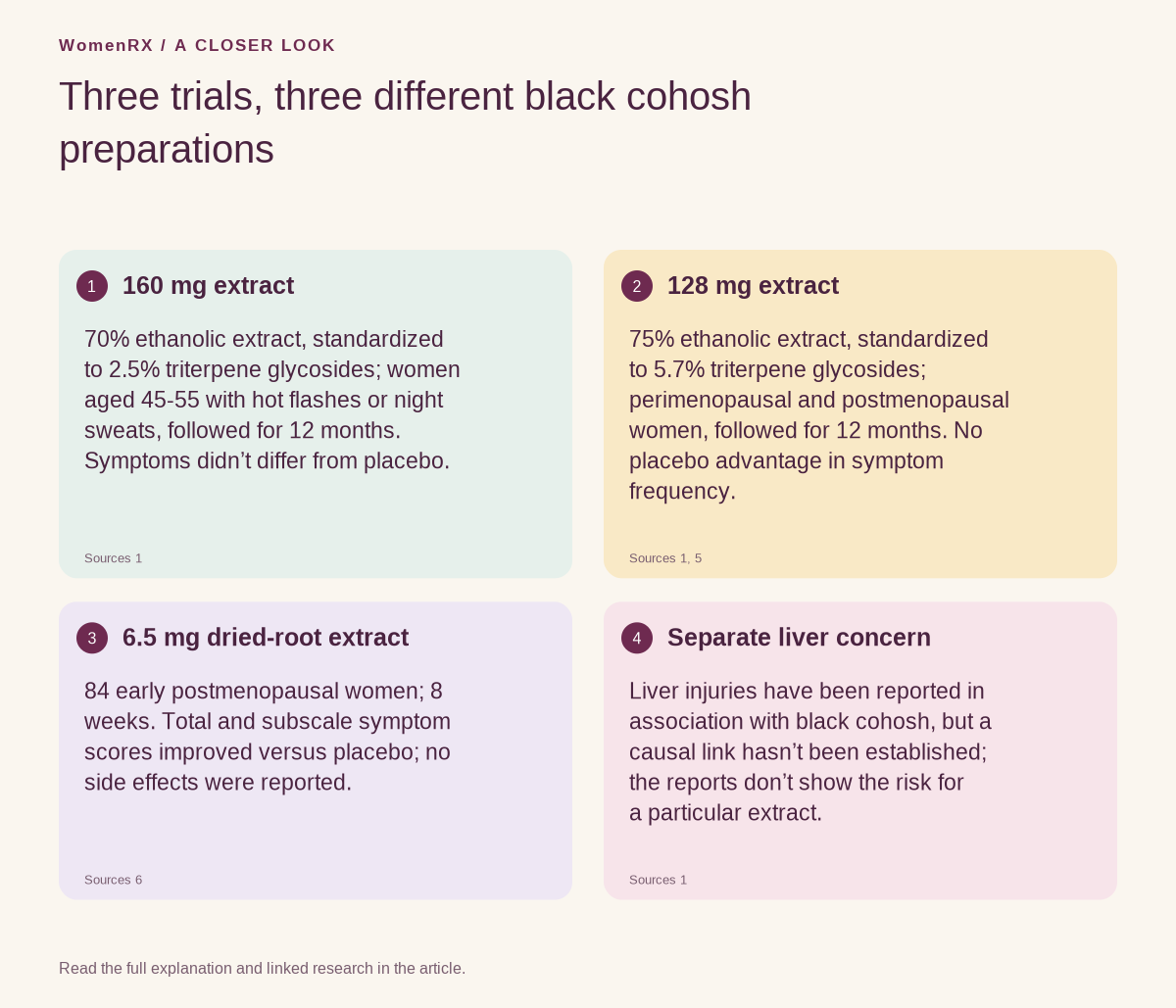
Three trials, three different black cohosh preparations
160 mg extract: 70% ethanolic extract, standardized to 2.5% triterpene glycosides; women aged 45-55 with hot flashes or night sweats, followed for 12 months. Symptoms didn’t differ from placebo.1
128 mg extract: 75% ethanolic extract, standardized to 5.7% triterpene glycosides; perimenopausal and postmenopausal women, followed for 12 months. No placebo advantage in symptom frequency.15
6.5 mg dried-root extract: 84 early postmenopausal women; 8 weeks. Total and subscale symptom scores improved versus placebo; no side effects were reported.6
Separate liver concern: Liver injuries have been reported in association with black cohosh, but a causal link hasn’t been established; the reports don’t show the risk for a particular extract.1
Read the figure as text
These trials tested distinct extracts in different menopausal populations and measured symptoms over different periods. Their doses aren’t interchangeable, and a symptom result doesn’t establish long-term safety.- 160 mg extract: 70% ethanolic extract, standardized to 2.5% triterpene glycosides; women aged 45-55 with hot flashes or night sweats, followed for 12 months. Symptoms didn’t differ from placebo.1
- 128 mg extract: 75% ethanolic extract, standardized to 5.7% triterpene glycosides; perimenopausal and postmenopausal women, followed for 12 months. No placebo advantage in symptom frequency.15
- 6.5 mg dried-root extract: 84 early postmenopausal women; 8 weeks. Total and subscale symptom scores improved versus placebo; no side effects were reported.6
- Separate liver concern: Liver injuries have been reported in association with black cohosh, but a causal link hasn’t been established; the reports don’t show the risk for a particular extract.1
More questions, answered
Is 40 mg a day the standard dose?
No. Forty milligrams was the median daily dose across varied trials, not a proven or recommended dose. Extracts differed in composition and standardization, so that number can’t identify an equivalent product. 1 4
Does the 12-month trial mean black cohosh is safe long term?
No. That trial found its standardized extracts safe as used during the study, but most black cohosh trials were shorter, and long-term safety hasn’t been established. 1 5
Sources you can check
- Black Cohosh - Health Professional Fact SheetAccessed 2026-09-25Return to first citation
- The 2022 hormone therapy position statement of The North American Menopause Society.“The 2022 Hormone Therapy Position Statement of The North American Menopause Society” Advisory Panel. · Menopause (New York, N.Y.) · 2022Return to first citation
- The 2023 nonhormone therapy position statement of The North American Menopause Society.Menopause (New York, N.Y.) · 2023Return to first citation
- Black cohosh (Cimicifuga spp.) for menopausal symptoms.Leach MJ, Moore V. · The Cochrane database of systematic reviews · 2012Return to first citation
- Safety and efficacy of black cohosh and red clover for the management of vasomotor symptoms: a randomized controlled trial.Geller SE, Shulman LP, van Breemen RB, Banuvar S, Zhou Y, Epstein G, Hedayat S, Nikolic D, Krause EC, Piersen CE, Bolton JL, Pauli GF, Farnsworth NR. · Menopause (New York, N.Y.) · 2009Return to first citation
- Efficacy of black cohosh (Cimicifuga racemosa L.) in treating early symptoms of menopause: a randomized clinical trial.Mohammad-Alizadeh-Charandabi S, Shahnazi M, Nahaee J, Bayatipayan S. · Chinese medicine · 2013Return to first citation