Red Clover Supplements: What the Evidence Says
Red clover isoflavones have been studied for some menopause symptoms, but the findings are mixed and don’t establish the supplement as hormone therapy or a way to prevent long-term health problems.
Red clover supplements contain isoflavones, plant compounds that can interact with estrogen receptors, but their effects aren’t the same as estrogen therapy. Menopause research has tested symptoms and some health markers, with mixed results and little information about long-term outcomes. Because estrogen-like activity doesn’t tell us whether a product is safe for your particular health history or medicines, review those details before deciding to use it. 1 2
Red clover is often marketed for hot flashes and other menopause concerns. Its main isoflavones, including biochanin A and formononetin, are plant compounds with estrogen-like activity. That makes them different from ordinary vitamins, but it doesn’t make red clover equivalent to menopausal hormone therapy. Isoflavones can act differently at estrogen receptors than estrogen does. 2 3
The practical takeaway: some human studies suggest a possible benefit for certain menopause symptoms, but that doesn’t establish red clover as a dependable treatment, a substitute for hormone therapy, or a way to protect long-term health.
What menopause studies have actually tested
One six-month randomized, placebo-controlled trial studied 75 postmenopausal women who also had dyslipidemia. The 39 women assigned red clover isoflavones had improved Menopause Rating Scale scores over the study, and several lipid measures improved compared with placebo. This is a promising result in a specific group, not proof that red clover helps every woman with menopause symptoms or prevents heart disease. The study authors also called for more research on long-term safety. 1
The results aren’t uniformly positive across outcomes. In a separate randomized, placebo-controlled trial of fermented red clover extract for overactive bladder, 33 postmenopausal women were included in the analysis. Most urinary symptom measures did not improve significantly with red clover; the placebo group improved on some measures. A small change in how bothersome urgency felt doesn’t establish the supplement as a treatment for bladder symptoms. 2
These findings are about particular products, populations, and outcomes. They don’t show that all red clover supplements work alike, and they don’t establish benefits for perimenopause, pregnancy, or postpartum concerns.
Isoflavones aren’t the same as hormone therapy
A plant compound that interacts with an estrogen receptor isn’t automatically interchangeable with estrogen or with a prescribed treatment. Red clover isoflavones can have different receptor activity from estrogen; the urinary study describes them as having both estrogen-like and blocking activity at different receptors. So “natural estrogen” is an oversimplification, not a reliable guide to what a supplement will do in your body. 2
That distinction matters when you’re weighing options. These studies don’t compare red clover directly with menopausal hormone therapy, establish that it controls symptoms as reliably, or show that it can replace an existing treatment. If symptoms are disrupting your sleep or daily life, a supplement shouldn’t delay a conversation about approaches that are better matched to your symptoms and health history.
Symptom changes aren’t long-term health benefits
Short-term changes in a symptom score or blood test are not the same as showing fewer heart attacks, fractures, or other health problems over time. The six-month trial measured symptoms and lipid levels, not whether red clover prevented cardiovascular events. Another small study in 10 healthy, sedentary early postmenopausal women tested fermented red clover for two weeks. It found a reduction in one blood marker of vascular inflammation compared with placebo, but did not establish a lasting health benefit. 1 4
So far, these findings don’t show that taking red clover prevents heart disease, protects bones, or provides other long-term benefits. A change in a marker can be worth studying without being proof of a meaningful health outcome.
What to review before considering a product
Red clover products aren’t necessarily interchangeable. The plant’s isoflavone content can vary by variety and plant part, and the urinary trial describes a fermented extract with a particular isoflavone profile. Results from one preparation therefore may not apply to another supplement with a different extract or formulation. 2 3
These studies don’t establish specific medicine interactions or settle safety for every health history. That’s not the same as proving there are no interactions. Before starting a product, take its label to a pharmacist or the clinician who manages your care, especially if you use hormone-related medicines or have a condition for which estrogen-like activity matters. Ask whether the exact product is appropriate for you, not whether “red clover” in general is safe.
Pregnancy and breastfeeding are another unanswered question in the menopause studies described here: they focus on postmenopausal women and can’t establish safety during pregnancy or while nursing. Don’t treat a menopause supplement as automatically suitable for those stages.
A useful product check is to note the exact extract, the amount of isoflavones listed on the label, and any added ingredients. Share that information with the person reviewing your medicines and health history. Keep the goal specific, too: a short-term symptom trial is a different question from replacing treatment or trying to prevent a future disease.
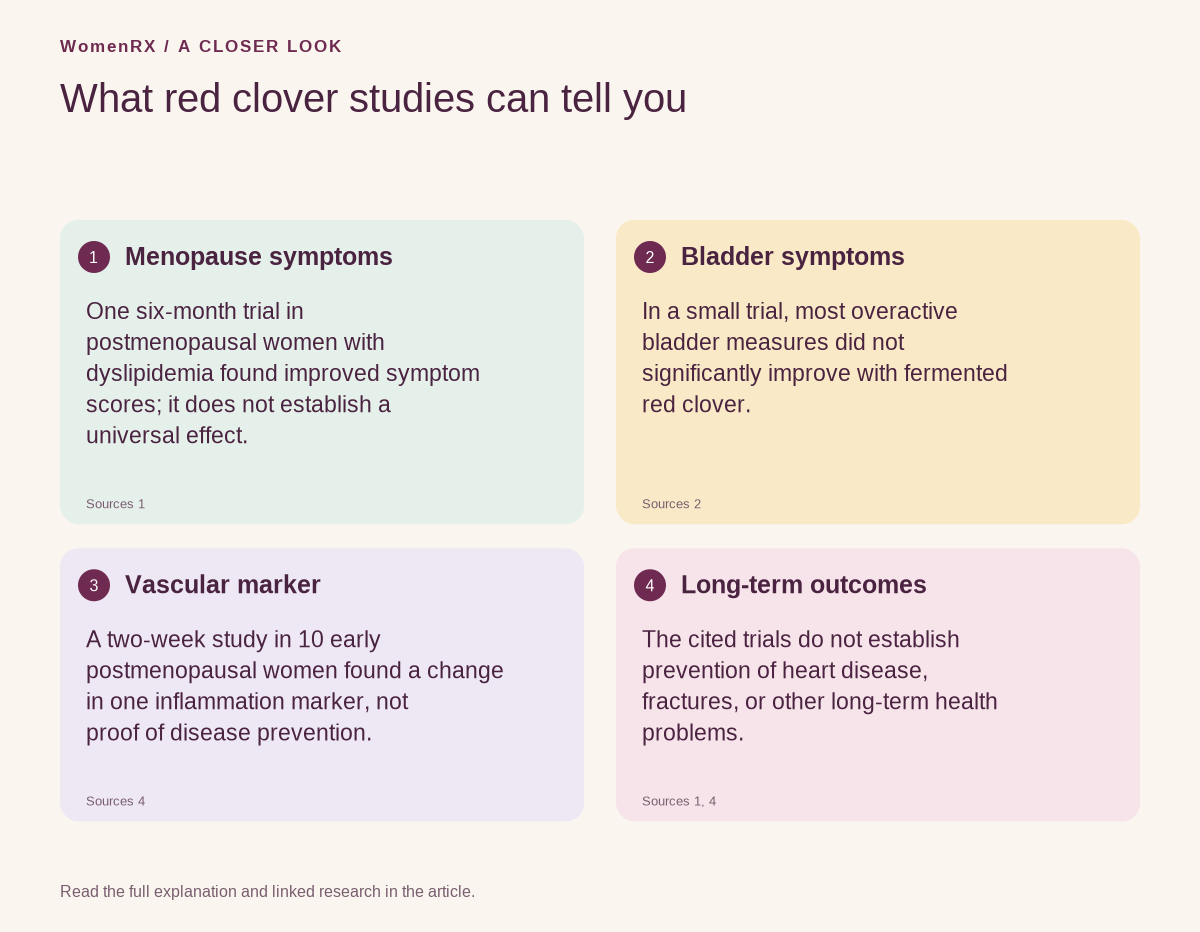
What red clover studies can tell you
Menopause symptoms: One six-month trial in postmenopausal women with dyslipidemia found improved symptom scores; it does not establish a universal effect.1
Bladder symptoms: In a small trial, most overactive bladder measures did not significantly improve with fermented red clover.2
Vascular marker: A two-week study in 10 early postmenopausal women found a change in one inflammation marker, not proof of disease prevention.4
Long-term outcomes: The cited trials do not establish prevention of heart disease, fractures, or other long-term health problems.14
Read the figure as text
These findings concern specific preparations and outcomes; a short-term symptom or marker result is not proof of long-term protection.- Menopause symptoms: One six-month trial in postmenopausal women with dyslipidemia found improved symptom scores; it does not establish a universal effect.1
- Bladder symptoms: In a small trial, most overactive bladder measures did not significantly improve with fermented red clover.2
- Vascular marker: A two-week study in 10 early postmenopausal women found a change in one inflammation marker, not proof of disease prevention.4
- Long-term outcomes: The cited trials do not establish prevention of heart disease, fractures, or other long-term health problems.14
More questions, answered
Does red clover work for hot flashes?
A randomized trial in postmenopausal women with dyslipidemia found improved overall menopause symptom scores with red clover over six months, but it studied a specific group and product. That result doesn’t establish a consistent effect for every woman or every supplement. 1
Is red clover safe during pregnancy or breastfeeding?
The menopause studies described here don’t answer that question because they studied postmenopausal women. They can’t establish safety during pregnancy or breastfeeding.
Sources you can check
- Isoflavones obtained from red clover improve both dyslipidemia and menopausal symptoms in menopausal women: a prospective randomized placebo-controlled trial.Yigit E, Unsal S. · Climacteric : the journal of the International Menopause Society · 2024Return to first citation
- Use of Fermented Red Clover Isoflavones in the Treatment of Overactive Bladder in Postmenopausal Women: A Randomized, Double-Blinded, Placebo-Controlled Trial.Villadsen AB, Holm-Jacobsen JN, Prabhala BK, Bundgaard-Nielsen C, Huntjens P, Kornum JB, Glavind K, Leutscher PDC, Christensen LP, Jeppesen PB, Sørensen S, Arenholt LTS. · Nutrients · 2023Return to first citation
- Phytochemical Composition of Different Red Clover Genotypes Based on Plant Part and Genetic Traits.Mikulić M, Atanacković Krstonošić M, Kladar N, Vasiljević S, Katanski S, Mamlić Z, Rakić D, Cvejić J. · Foods (Basel, Switzerland) · 2023Return to first citation
- Short-Term Supplementation With Fermented Red Clover Extract Reduces Vascular Inflammation in Early Post-menopausal Women.Wickham KA, Nørregaard LB, Oxfeldt M, Cheung SS, Gliemann L, Hansen M, Hellsten Y. · Frontiers in cardiovascular medicine · 2022Return to first citation