How to Compare Red Clover Supplements for Menopause
A useful label separates the weight of red clover extract from the amount and type of isoflavones it provides.
Compare the stated isoflavone amount per serving, serving size, and any disclosed extract or compound details. Extract weight alone doesn’t tell you how much isoflavone you’re getting, and a detailed label can’t prove symptom relief. Red clover research includes mixed findings, while menopause guidance does not recommend supplements and herbal remedies for hot flashes. 2 3
Start with the isoflavone amount
A label might list milligrams of red clover extract, milligrams of isoflavones, or both. Those numbers describe different things. Extract weight alone doesn’t show how much isoflavone a serving contains. If the label gives no isoflavone amount, you can’t compare that measure with a product that does.
Check what the number applies to: one capsule, a full serving, or a daily serving. Then note how many capsules make up that serving. Red clover’s major isoflavones include formononetin and biochanin A, and the mix can vary with the plant material and preparation. 4 5
This makes “500 mg red clover” a less useful comparison than a label that also states the isoflavone amount and serving size. If a product names individual isoflavones or explains how its extract is prepared, record those details too. They tell you more about what’s disclosed, not whether it will work.
A clear label doesn’t settle the symptom question
For hot flashes and other vasomotor symptoms, the North American Menopause Society’s 2023 position statement does not recommend supplements or herbal remedies. 2 A randomized trial published in 2024 reported improved menopause rating scores with red clover isoflavones, but it studied a specific group: postmenopausal women with dyslipidemia. There were 39 participants in the red clover group and 36 in the placebo group, followed for six months. 3
Those findings don’t establish that red clover will ease symptoms for women generally, or that a retail product matches the study preparation. The trial is a reason to describe the research as mixed, not to call a particular brand proven. A product’s isoflavone figure can help you compare labels, but it doesn’t predict symptom relief.
Compare extract details without overreading them
Red clover extracts can differ in their isoflavone composition and form. One study used a fermented extract with high concentrations of aglycone isoflavones and measured its contents using laboratory analysis. That describes the study product; it doesn’t show that all fermented products are better or that fermentation guarantees menopause relief. 4
For each product, note the extract amount, stated isoflavone amount, serving size, named compounds, and any explanation of the preparation. If the manufacturer provides batch-specific testing information, you can compare what that testing says about the product’s contents. Analytical methods can identify isoflavones in supplement samples, but identifying ingredients is not evidence of symptom benefit. 4 6
If key details aren’t disclosed, the product is harder to compare. That alone doesn’t prove it is ineffective or unsafe; it means the label answers fewer questions.
Keep safety and treatment claims in proportion
Red clover isoflavones are phytoestrogens, compounds with estrogen-like activity, but their receptor activity and physiological effects can differ from estrogen. 4 Research cited here doesn’t establish whether a particular red clover product is safe for someone with a hormone-sensitive condition or someone using hormone therapy. If either applies to you, discuss the exact label and product with the clinician managing your care rather than assuming “natural” means compatible.
Red clover also isn’t a substitute for hormone therapy. Menopause guidance identifies hormone therapy as the most effective treatment for vasomotor symptoms, with its benefits and risks depending on individual circumstances. 1 2
A quick side-by-side check
For each bottle, write down the extract weight, isoflavone amount per serving, number of capsules per serving, named compounds, preparation details, and any product-specific testing information. You’ll have a clearer comparison of what each label discloses, while keeping that separate from the harder question of whether it will help your symptoms.
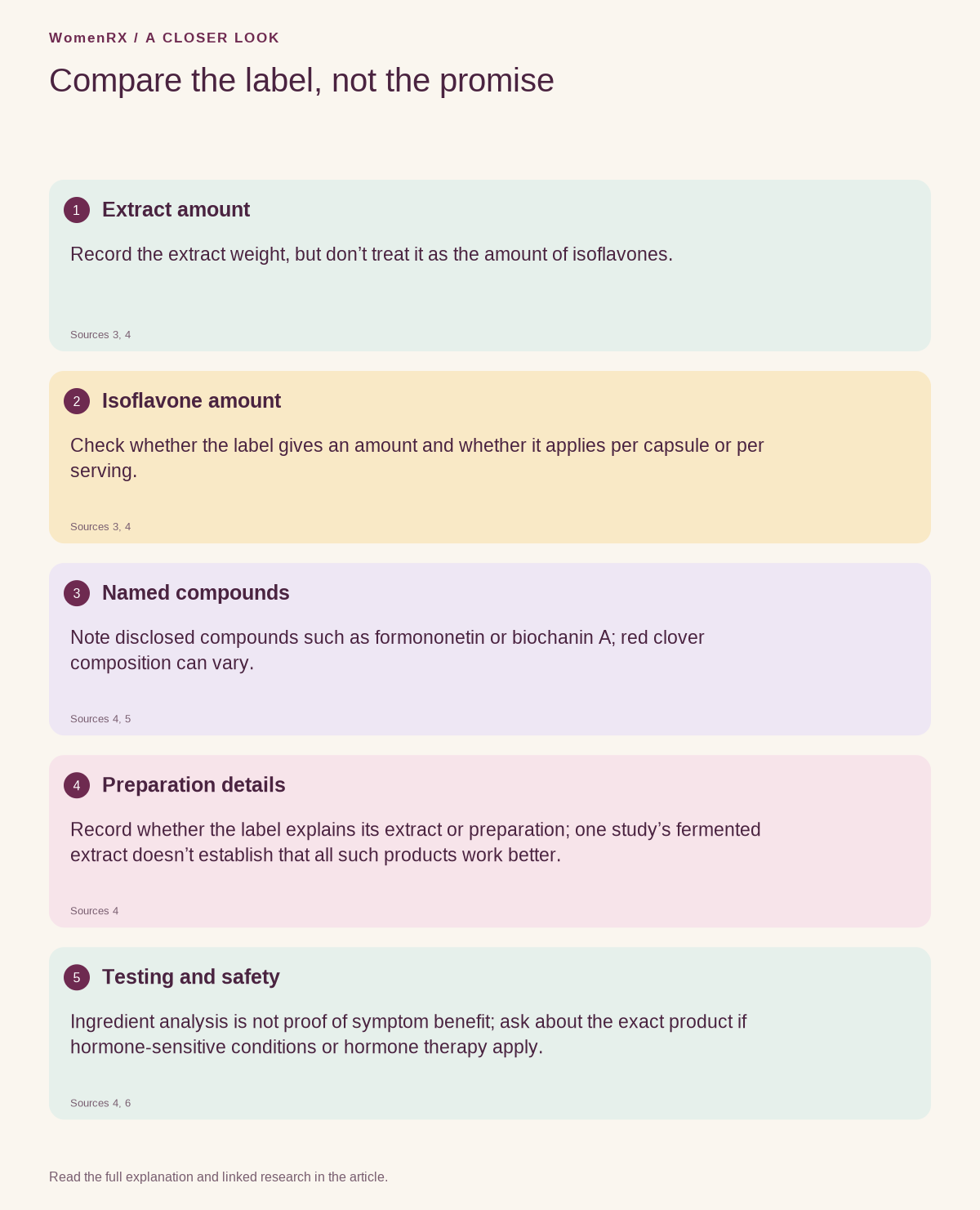
Compare the label, not the promise
Extract amount: Record the extract weight, but don’t treat it as the amount of isoflavones.34
Isoflavone amount: Check whether the label gives an amount and whether it applies per capsule or per serving.34
Named compounds: Note disclosed compounds such as formononetin or biochanin A; red clover composition can vary.45
Preparation details: Record whether the label explains its extract or preparation; one study’s fermented extract doesn’t establish that all such products work better.4
Testing and safety: Ingredient analysis is not proof of symptom benefit; ask about the exact product if hormone-sensitive conditions or hormone therapy apply.46
Read the figure as text
Use these checks to compare disclosed product details while keeping them separate from evidence of symptom relief.- Extract amount: Record the extract weight, but don’t treat it as the amount of isoflavones.34
- Isoflavone amount: Check whether the label gives an amount and whether it applies per capsule or per serving.34
- Named compounds: Note disclosed compounds such as formononetin or biochanin A; red clover composition can vary.45
- Preparation details: Record whether the label explains its extract or preparation; one study’s fermented extract doesn’t establish that all such products work better.4
- Testing and safety: Ingredient analysis is not proof of symptom benefit; ask about the exact product if hormone-sensitive conditions or hormone therapy apply.46
More questions, answered
Does more red clover extract mean more isoflavones?
Not necessarily. Extract weight and isoflavone content are separate amounts. If the label doesn’t state the isoflavone amount, extract weight alone can’t tell you how much isoflavone a serving provides.
Is fermented red clover proven to work better?
No. A study used one fermented extract with a particular isoflavone profile, but that doesn’t establish that fermentation improves symptom relief across products. 4
Sources you can check
- The 2022 hormone therapy position statement of The North American Menopause Society.“The 2022 Hormone Therapy Position Statement of The North American Menopause Society” Advisory Panel. · Menopause (New York, N.Y.) · 2022Return to first citation
- The 2023 nonhormone therapy position statement of The North American Menopause Society.Menopause (New York, N.Y.) · 2023Return to first citation
- Isoflavones obtained from red clover improve both dyslipidemia and menopausal symptoms in menopausal women: a prospective randomized placebo-controlled trial.Yigit E, Unsal S. · Climacteric : the journal of the International Menopause Society · 2024Return to first citation
- Use of Fermented Red Clover Isoflavones in the Treatment of Overactive Bladder in Postmenopausal Women: A Randomized, Double-Blinded, Placebo-Controlled Trial.Villadsen AB, Holm-Jacobsen JN, Prabhala BK, Bundgaard-Nielsen C, Huntjens P, Kornum JB, Glavind K, Leutscher PDC, Christensen LP, Jeppesen PB, Sørensen S, Arenholt LTS. · Nutrients · 2023Return to first citation
- Phytochemical Composition of Different Red Clover Genotypes Based on Plant Part and Genetic Traits.Mikulić M, Atanacković Krstonošić M, Kladar N, Vasiljević S, Katanski S, Mamlić Z, Rakić D, Cvejić J. · Foods (Basel, Switzerland) · 2023Return to first citation
- Identification of isoflavones in the extract of supplements for menopause symptoms by direct infusion electrospray ionization tandem mass spectrometry.Beszterda M, Frański R. · Analytical science advances · 2020Return to first citation