Red Clover for Menopause: What the Trials Actually Show
Red clover studies have tested different preparations, and their results don’t establish a reliable timeline or a proven benefit for hot flashes.
There’s no dependable “time to work” for red clover: trials assessed different products over 12 weeks, and their results don’t agree. In the larger hot-flash trial, two red clover extracts didn’t provide a clinically important benefit over placebo. A smaller trial found improvement on a broad menopause-symptom scale, but that result doesn’t establish which symptoms might improve or when.
The short answer: no reliable response schedule
Red clover has been studied in menopausal women, but the trials don’t show a consistent, clinically meaningful effect or a predictable point when benefits should begin. Two 12-week studies used different preparations and measured symptoms differently, so their results can’t be treated as a schedule for an individual woman. 3 4
That distinction matters if you’re choosing something for a specific problem. A change in a total menopause-symptom score isn’t the same as proof that hot flashes, sleep, mood, or another symptom improved on its own.
Hot flashes: the larger trial was not persuasive
The most directly relevant hot-flash study randomized 252 symptomatic menopausal women, ages 45 to 60, to one of two red clover isoflavone extracts or placebo. Participants had at least 35 hot flashes per week and were followed for 12 weeks. At the end, the average daily hot-flash count had fallen by about five in each group: 5.1 with one extract, 5.4 with the other, and 5.0 with placebo. Neither supplement produced a clinically important advantage over placebo. 3
One extract was associated with a faster reduction over the study period than placebo, but the similar week-12 reductions show why that finding shouldn’t be read as a dependable response time or meaningful final benefit. The other extract did not show that faster reduction. 3
A systematic review of trials of isoflavones and related preparations found some positive results for hot flashes and other symptoms, including in red-clover trials. But the review called for larger studies and replication. Those findings are a reason to keep the evidence in view, not to assume that red clover works for everyone or for every symptom. 5
Broader symptom scores: a different kind of result
A smaller placebo-controlled study followed 72 healthy postmenopausal women for 12 weeks. It tested dried red clover leaves, rather than the two isoflavone extracts used in the larger hot-flash study, and measured symptoms with the Menopause Rating Scale. The red-clover group’s total score fell from 20.41 to 10.08; the placebo group’s fell from 20.77 to 17.20. The researchers reported a significant difference between groups, with changes in the scale’s physical and psychological categories. 4
This is a promising result for a broad symptom measure, but it comes from one small study of a different preparation. It doesn’t tell you which individual symptom accounted for the change, whether another red clover product would have the same effect, or when a person should expect to notice a difference. 4
Why the product and the symptom both matter
“Red clover” doesn’t identify one uniform intervention. Trials have tested concentrated isoflavone extracts and dried leaves, and their findings shouldn’t be assumed to apply to every supplement sold under that name. The studies also asked different questions: one counted hot flashes in daily diaries; the other compared scores across several menopause symptoms. 3 4
So start with the symptom you want help with. For hot flashes, the larger placebo-controlled trial found little reason to expect a clinically important benefit from the tested extracts. For overall symptom severity, one smaller study found a benefit with dried leaves, but it isn’t enough to establish a reliable result across products. These trials tested dietary supplements, not hormone therapy, so their findings are product-specific and don’t show that red clover can substitute for hormone therapy. 1 3 4 The North American Menopause Society’s 2023 position statement does not recommend supplements or herbal remedies for vasomotor symptoms based on its review of the evidence. 2
What the safety findings can and can’t tell you
In the 12-week hot-flash trial, reported adverse events were comparable among the two red clover groups and placebo. That provides limited information about short-term use of those particular extracts in the women studied; it does not establish long-term safety or safety for people with hormone-sensitive conditions or taking related medicines. 3
The trial evidence here doesn’t resolve those specific safety questions. If either applies to you, don’t assume a red clover product is safe based on the general trial results. Bring the product label and your medication list to a pharmacist or clinician so they can consider your specific situation.
If you’re weighing options for hot flashes, there are evidence-supported approaches beyond supplements. The 2023 menopause position statement identifies several nonhormonal options, while the North American Menopause Society describes hormone therapy as the most effective treatment for vasomotor symptoms, with suitability depending on the person. 1 2
What the red clover trials measured
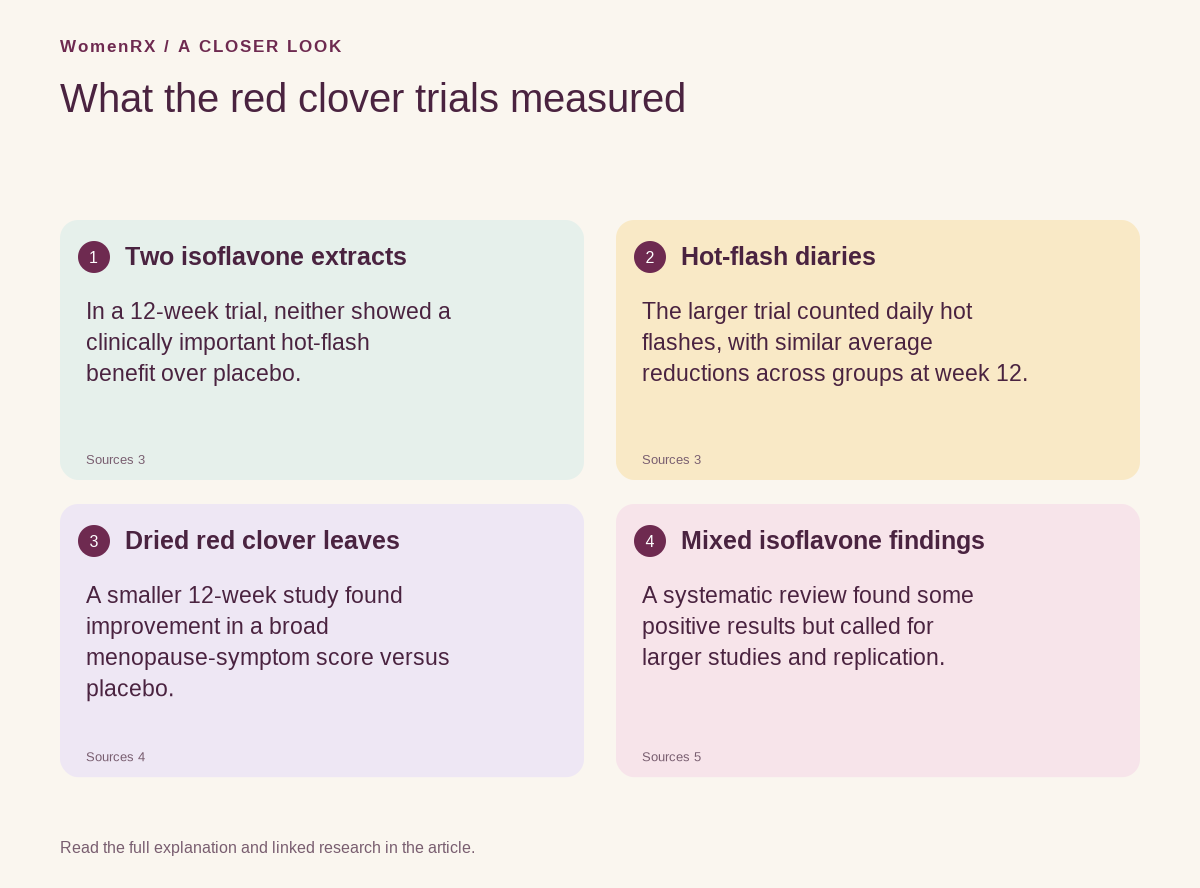
Two isoflavone extracts: In a 12-week trial, neither showed a clinically important hot-flash benefit over placebo.3
Hot-flash diaries: The larger trial counted daily hot flashes, with similar average reductions across groups at week 12.3
Dried red clover leaves: A smaller 12-week study found improvement in a broad menopause-symptom score versus placebo.4
Mixed isoflavone findings: A systematic review found some positive results but called for larger studies and replication.5
Read the figure as text
The studies differ in preparation, symptom measure, and what their results can tell you.- Two isoflavone extracts: In a 12-week trial, neither showed a clinically important hot-flash benefit over placebo.3
- Hot-flash diaries: The larger trial counted daily hot flashes, with similar average reductions across groups at week 12.3
- Dried red clover leaves: A smaller 12-week study found improvement in a broad menopause-symptom score versus placebo.4
- Mixed isoflavone findings: A systematic review found some positive results but called for larger studies and replication.5
More questions, answered
How long should you try red clover before deciding whether it helps?
The cited trials assessed participants over 12 weeks, but they don’t establish a recommended personal trial period or a dependable point when benefits should begin. Their results also varied by product and symptom measure. 3 4
Does a menopause symptom-score improvement prove hot flashes improved?
No. A total score combines multiple symptoms. The small dried-leaf trial reported changes in the overall scale and its categories, while the larger trial measured hot-flash counts directly and found no clinically important advantage over placebo. 3 4
Sources you can check
- The 2022 hormone therapy position statement of The North American Menopause Society.“The 2022 Hormone Therapy Position Statement of The North American Menopause Society” Advisory Panel. · Menopause (New York, N.Y.) · 2022Return to first citation
- The 2023 nonhormone therapy position statement of The North American Menopause Society.Menopause (New York, N.Y.) · 2023Return to first citation
- Phytoestrogen supplements for the treatment of hot flashes: the Isoflavone Clover Extract (ICE) Study: a randomized controlled trial.Tice JA, Ettinger B, Ensrud K, Wallace R, Blackwell T, Cummings SR. · JAMA · 2003Return to first citation
- Effectiveness of red clover in alleviating menopausal symptoms: a 12-week randomized, controlled trial.Shakeri F, Taavoni S, Goushegir A, Haghani H. · Climacteric : the journal of the International Menopause Society · 2015Return to first citation
- Effects of isoflavones and amino acid therapies for hot flashes and co-occurring symptoms during the menopausal transition and early postmenopause: a systematic review.Thomas AJ, Ismail R, Taylor-Swanson L, Cray L, Schnall JG, Mitchell ES, Woods NF. · Maturitas · 2014Return to first citation