What Do We Know About Long-Term Red Clover Safety?
Red clover has been studied for months, but evidence is too limited to give a clear answer about taking a supplement for years.
A six-month trial of red clover isoflavones in postmenopausal women did not establish long-term safety. Earlier trials offered some short-term reassurance, but a review found no long-term red clover safety data. Findings about isoflavones more broadly cannot settle the question for your product, especially if you have a hormone-sensitive condition or take related medicines. 1 3 5
Red clover contains isoflavones, plant compounds that can interact with estrogen pathways. That doesn’t make a supplement equivalent to estrogen treatment, but it does make your health history relevant when deciding whether to keep taking it. 2 4
What six months of research can tell you
In a 2024 randomized trial, 39 postmenopausal women with dyslipidemia took red clover isoflavones and 36 took placebo for six months. The researchers assessed menopause symptoms and blood lipids and reported improvements in the red clover group. They also called for more research on long-term safety. The trial abstract does not give detailed adverse-event results, so its findings should not be read as proof that no adverse effects occurred. 1
An earlier review of red clover trials found no apparent evidence of adverse events during short-term use, while noting that long-term safety data were unavailable. A separate consensus statement discussed intake lasting at least three years, but it assessed isoflavones broadly, not the long-term safety of every red clover formulation. These are different kinds of reassurance: neither gives a dependable answer about years of use with the particular bottle you have. 3 5
That distinction matters because red clover products can contain different proportions of isoflavones. A systematic review describes variation among commercial extracts. Results from one preparation cannot automatically be applied to another, particularly a blend that contains other ingredients. 2
Is there enough benefit to justify continuing?
If you started red clover for hot flashes, the benefit is less certain than supplement marketing may suggest. A meta-analysis found a small, borderline result compared with placebo and could not establish whether the difference would matter to women taking it. Another review found contradictory trial results, while the newer six-month trial reported improved symptom scores in its specific group of postmenopausal women with dyslipidemia. Together, these findings do not establish red clover as a reliable menopause treatment. 1 3 7
For example, if you’ve taken it for several months and cannot tell whether your hot flashes have changed, there may be little identifiable benefit to weigh against the unanswered long-term safety question. If you have noticed a change, that experience still cannot establish that the supplement caused it or that continuing indefinitely is safe.
When your health history changes the decision
Breast cancer or another hormone-sensitive concern: A systematic review found limited red clover-specific evidence relevant to breast-cancer risk. The available studies did not show clear evidence of harm, but that is not proof of safety for someone with breast cancer or a history of it. Findings about soy foods should not be used as a stand-in for red clover supplements. 2
Tamoxifen or an aromatase inhibitor: Reviews reach different cautions here. One advises avoiding isoflavone-containing botanicals, including red clover, during these treatments because of a possible conflict with therapy. A separate consensus statement describes more reassuring findings for isoflavones broadly. Neither establishes that a particular red clover product is safe to combine with your medicine. Before continuing it, discuss the exact product with the clinician managing your treatment. 5 6
Unexpected bleeding: Reports of postmenopausal bleeding have been described with phytoestrogen-containing products. Those reports do not establish that red clover caused the bleeding or show how often it happens. If you have bleeding after menopause, have it assessed rather than assuming it is an expected supplement effect. 4
If you take other medicines, the most useful detail to bring to a pharmacist or prescribing clinician is the exact product label, including any additional herbs. A broad statement about isoflavones cannot answer whether your specific supplement is a good fit with your medicines and conditions.
Pregnancy and breastfeeding are separate questions
The six-month trial involved postmenopausal women. Its findings cannot establish safety during pregnancy or breastfeeding, when the person exposed, and during pregnancy the developing baby, differ from the trial population. Don’t use menopause findings as reassurance for either situation. 1
For a decision about continuing, put three things side by side: the benefit you can actually identify, the ingredients in your bottle, and any hormone-sensitive condition, bleeding, or related treatment that makes uncertainty more consequential. That gives you a more useful question than whether red clover is simply “safe” or “unsafe.”
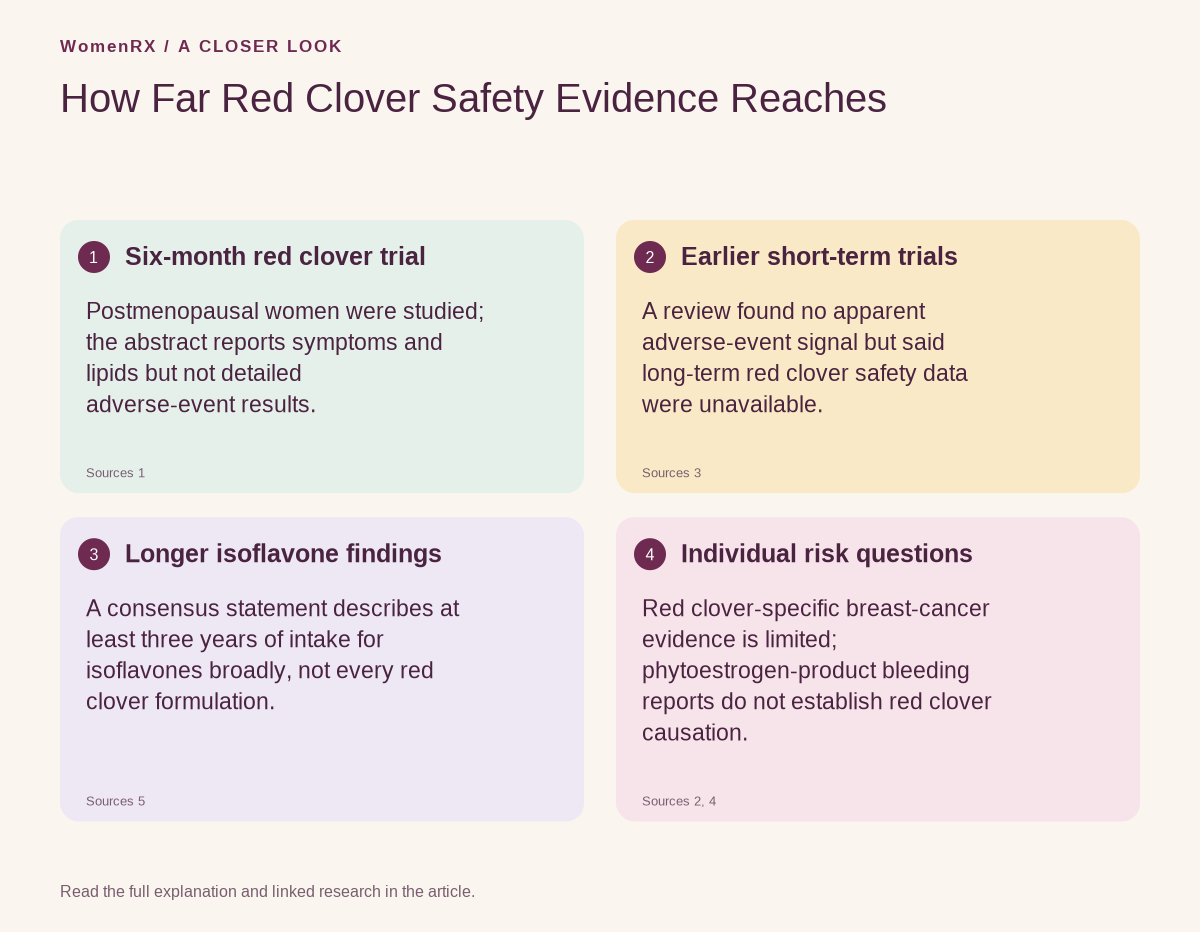
How Far Red Clover Safety Evidence Reaches
Six-month red clover trial: Postmenopausal women were studied; the abstract reports symptoms and lipids but not detailed adverse-event results.1
Earlier short-term trials: A review found no apparent adverse-event signal but said long-term red clover safety data were unavailable.3
Longer isoflavone findings: A consensus statement describes at least three years of intake for isoflavones broadly, not every red clover formulation.5
Individual risk questions: Red clover-specific breast-cancer evidence is limited; phytoestrogen-product bleeding reports do not establish red clover causation.24
Read the figure as text
Study duration, product type, and the outcomes reported all affect what a safety finding can tell you.- Six-month red clover trial: Postmenopausal women were studied; the abstract reports symptoms and lipids but not detailed adverse-event results.1
- Earlier short-term trials: A review found no apparent adverse-event signal but said long-term red clover safety data were unavailable.3
- Longer isoflavone findings: A consensus statement describes at least three years of intake for isoflavones broadly, not every red clover formulation.5
- Individual risk questions: Red clover-specific breast-cancer evidence is limited; phytoestrogen-product bleeding reports do not establish red clover causation.24
Sources you can check
- Isoflavones obtained from red clover improve both dyslipidemia and menopausal symptoms in menopausal women: a prospective randomized placebo-controlled trial.Yigit E, Unsal S. · Climacteric : the journal of the International Menopause Society · 2024Return to first citation
- Soy, red clover, and isoflavones and breast cancer: a systematic review.Fritz H, Seely D, Flower G, Skidmore B, Fernandes R, Vadeboncoeur S, Kennedy D, Cooley K, Wong R, Sagar S, Sabri E, Fergusson D. · PloS one · 2013Return to first citation
- Trifolium pratense isoflavones in the treatment of menopausal hot flushes: a systematic review and meta-analysis.Coon JT, Pittler MH, Ernst E. · Phytomedicine : international journal of phytotherapy and phytopharmacology · 2007Return to first citation
- Daidzein and Genistein: Natural Phytoestrogens with Potential Applications in Hormone Replacement Therapy.Intharuksa A, Arunotayanun W, Na Takuathung M, Chaichit S, Prasansuklab A, Chaikhong K, Sirichanchuen B, Chupradit S, Koonrungsesomboon N. · International journal of molecular sciences · 2025Return to first citation
- Consensus: soy isoflavones as a first-line approach to the treatment of menopausal vasomotor complaints.Schmidt M, Arjomand-Wölkart K, Birkhäuser MH, Genazzani AR, Gruber DM, Huber J, Kölbl H, Kreft S, Leodolter S, Linsberger D, Metka M, Simoncini T, Vrabic Dezman L. · Gynecological endocrinology : the official journal of the International Society of Gynecological Endocrinology · 2016Return to first citation
- Non-estrogen conventional and phytochemical treatments for vasomotor symptoms: what needs to be known for practice.Villaseca P. · Climacteric : the journal of the International Menopause Society · 2012Return to first citation
- Menopause: a review of botanical dietary supplements.Low Dog T. · The American journal of medicine · 2005Return to first citation