Red Clover Safety: Side Effects and Interactions
Short-term studies haven’t established a clear side-effect pattern, but they don’t prove red clover is safe for long-term use or with every medicine.
In studies of red clover for menopause symptoms, short-term use showed no apparent adverse events, but long-term safety is unclear. Red clover is a source of phytoestrogens, and lab findings raise possible medication-interaction questions without proving a clinical interaction. A guideline advises avoiding phytoestrogens for women with breast cancer; a past diagnosis calls for individualized review, not an assumption that the same guidance applies. 123
What’s known about side effects
Red clover isoflavones have been studied in women for menopause symptoms, but the safety evidence is limited. A systematic review of five randomized trials found no apparent adverse events during short-term use. The reviewers also said that long-term safety data weren’t available. That finding doesn’t mean side effects can’t happen; it means the trials didn’t establish a reliable pattern of them. 1
A later placebo-controlled trial studied 39 postmenopausal women with dyslipidemia who took red clover isoflavones and 36 who took placebo for six months. It reported changes in menopause symptoms and blood lipids. Those results describe this group and timeframe, but don’t establish long-term safety or answer safety questions for other populations. 4
If you’re considering a product, check its full label and bring it to a pharmacist or clinician. The exact ingredients and amount listed help them review the product you’re considering, rather than red clover in the abstract.
Interactions: a plausible concern isn’t a proven one
Red clover contains phytoestrogens, plant compounds with estrogen-like activity. That gives a reason to ask about hormone-sensitive health conditions and hormone treatments, but it doesn’t show that red clover will have a particular effect in your body or interact with a specific medicine. 23
For tamoxifen, a human interaction hasn’t been established. One clinical guideline advises avoiding phytoestrogens in women with breast cancer and flags potential concerns about medicines that interact with CYP2D6 in people taking tamoxifen. A red clover study found no significant change in tamoxifen or its active metabolite in rats. In laboratory tests using human liver preparations, the extract affected the activity of some drug-metabolizing enzymes, including CYP3A4, CYP1A2, and CYP2C9. Those lab results don’t show that taking red clover changes medication levels or treatment outcomes in people. 23
If you take tamoxifen or another cancer treatment, don’t use the rat result as reassurance that a combination is safe. Ask your oncology team or pharmacist before starting red clover, and show them the exact product label. The same check is sensible if you use menopausal hormone therapy: a red clover interaction with hormone therapy hasn’t been established, so a medication-specific review matters more than guessing from the word “hormone.”
When your situation calls for a closer check
- Current breast cancer: The cited menopause guideline advises against phytoestrogens for women with breast cancer. If you’ve had breast cancer in the past, that guideline doesn’t establish that the same recommendation applies to you; ask your oncology team to review your situation before using red clover. 3
- Pregnancy or breastfeeding: Research in menopausal women doesn’t establish whether red clover supplements are safe in either situation. Don’t assume that a plant-based product is suitable; ask your pregnancy or breastfeeding care team before using it. 14
- Menopause treatment or other prescriptions: Bring your complete medicine and supplement list to a pharmacist or prescriber. Lab enzyme findings are a reason to check for possible interactions, not proof that a particular prescription will be affected. 2
Before the conversation, note the product’s ingredients, the amount listed on the label, how often you plan to take it, and why you’re considering it. Include prescription medicines, over-the-counter products, and other supplements. These details help someone assess the actual combination rather than red clover in the abstract.
Red Clover: What to Review First
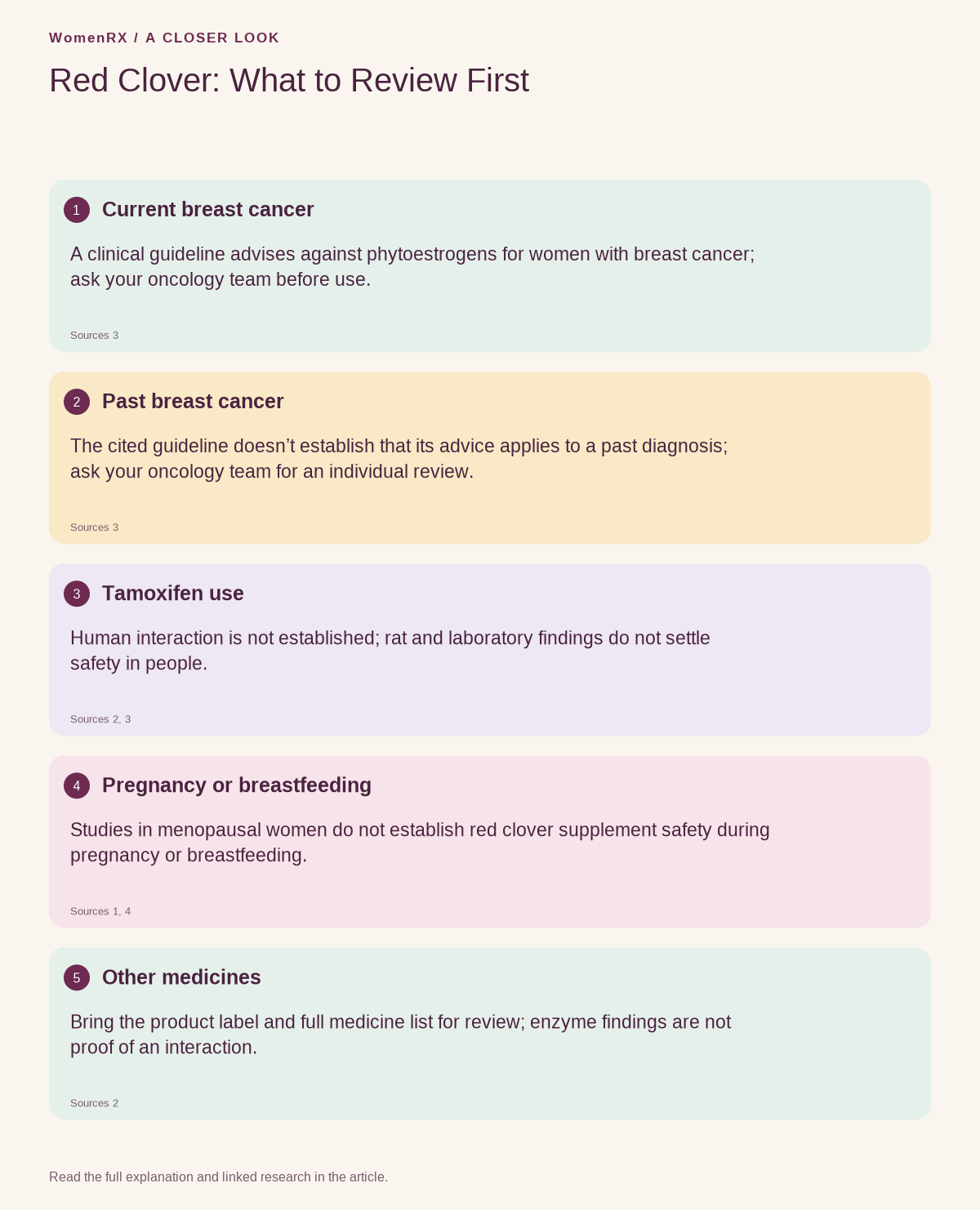
Current breast cancer: A clinical guideline advises against phytoestrogens for women with breast cancer; ask your oncology team before use.3
Past breast cancer: The cited guideline doesn’t establish that its advice applies to a past diagnosis; ask your oncology team for an individual review.3
Tamoxifen use: Human interaction is not established; rat and laboratory findings do not settle safety in people.23
Pregnancy or breastfeeding: Studies in menopausal women do not establish red clover supplement safety during pregnancy or breastfeeding.14
Other medicines: Bring the product label and full medicine list for review; enzyme findings are not proof of an interaction.2
Read the figure as text
Use this checklist to separate a guideline precaution from questions where evidence is still incomplete.- Current breast cancer: A clinical guideline advises against phytoestrogens for women with breast cancer; ask your oncology team before use.3
- Past breast cancer: The cited guideline doesn’t establish that its advice applies to a past diagnosis; ask your oncology team for an individual review.3
- Tamoxifen use: Human interaction is not established; rat and laboratory findings do not settle safety in people.23
- Pregnancy or breastfeeding: Studies in menopausal women do not establish red clover supplement safety during pregnancy or breastfeeding.14
- Other medicines: Bring the product label and full medicine list for review; enzyme findings are not proof of an interaction.2
More questions, answered
Does red clover have a proven interaction with tamoxifen?
A human interaction hasn’t been established. A study found no significant change in tamoxifen or its active metabolite in rats, while laboratory testing found effects on some drug-metabolizing enzymes. Because neither result settles what happens in people, ask your oncology team or pharmacist before combining them. 23
Are red clover supplements safe to take long term?
Long-term safety hasn’t been established. A systematic review found no apparent adverse events in short-term studies but reported no available long-term safety data. 1
Sources you can check
- Trifolium pratense isoflavones in the treatment of menopausal hot flushes: a systematic review and meta-analysis.Coon JT, Pittler MH, Ernst E. · Phytomedicine : international journal of phytotherapy and phytopharmacology · 2007Return to first citation
- No effect on pharmacokinetics of tamoxifen and 4-hydroxytamoxifen by multiple doses of red clover capsule in rats.Raju KS, Taneja I, Valicherla GR, Challagundla MK, Rashid M, Syed AA, Gayen JR, Singh SP, Wahajuddin M. · Scientific reports · 2015Return to first citation
- [Non-hormonal alternatives for the management of menopausal hot flushes. Postmenopausal women management: CNGOF and GEMVi clinical practice guidelines].Raccah-Tebeka B, Boutet G, Plu-Bureau G. · Gynecologie, obstetrique, fertilite & senologie · 2021Return to first citation
- Isoflavones obtained from red clover improve both dyslipidemia and menopausal symptoms in menopausal women: a prospective randomized placebo-controlled trial.Yigit E, Unsal S. · Climacteric : the journal of the International Menopause Society · 2024Return to first citation