Red Clover for Menopause: What Safety Evidence Can Tell You
Red clover may help some menopause symptoms, but the evidence is limited and doesn’t settle its safety with hormone-sensitive conditions or medicines.
Red clover supplements contain isoflavones, plant compounds with estrogen-like activity. 3 A small six-month trial in postmenopausal women found improvement in symptom scores, but that doesn’t establish long-term safety or prove the benefit applies broadly. 2 If you have a history of an estrogen-sensitive cancer or take hormone-related medicine, show the exact product to the clinician managing that care before trying it. The concern is uncertainty, not proof of harm. 4
What red clover might do for menopause symptoms
Red clover (Trifolium pratense) contains isoflavones, plant compounds with estrogen-like activity. That description helps explain why it’s marketed for menopause, but it doesn’t mean a supplement works like prescription estrogen or has the same benefits and risks. 3
The human evidence for symptom relief is mixed and limited. A 2006 clinical-study review found insufficient evidence that red clover extracts relieve vasomotor symptoms. 4 In a later randomized, placebo-controlled trial, 75 postmenopausal women with dyslipidemia were assigned to red clover isoflavones or placebo for six months. The red clover group’s menopause symptom scores improved, but one relatively small study in this specific group can’t establish how well the supplement works for other women or whether benefits last. 2
The North American Menopause Society’s 2023 position statement does not recommend supplements and herbal remedies for vasomotor symptoms such as hot flashes, based on its evidence review. That’s a reason not to assume red clover is a proven treatment, even when a particular study looks promising. 1 If hot flashes are disrupting daily life, the statement describes other options with stronger evidence, including cognitive behavioral therapy, clinical hypnosis, and certain prescription medicines. 1
What’s known, and what isn’t, about safety
The most useful distinction is between an established danger and an unanswered safety question. Available evidence here doesn’t establish that red clover causes harm in every person with a hormone-sensitive condition. It also doesn’t establish that it’s safe for people with a history of breast or endometrial cancer. A review of clinical studies specifically noted that safety in people with those cancers had not been established. 4
Long-term safety is also uncertain. The six-month trial can’t answer questions about longer use, and the researchers called for further research to establish long-term safety. 2 Lack of a well-established risk is not the same as proof of safety.
If you take menopausal hormone therapy or treatment for a hormone-sensitive cancer, or have had such a cancer, a practical next step is to discuss red clover with the clinician managing that care before trying it. Bring the exact product and ingredient list so you can discuss the specific supplement you’re considering.
A practical way to weigh the choice
Before trying red clover, consider three questions:
- What symptom are you hoping to improve? The evidence is mainly about menopause symptom scores, and it doesn’t show that red clover is a dependable fix for every symptom.
- What else affects your decision? A history of breast or endometrial cancer raises a specific unanswered safety question. 4 If you use hormone-related medicine, discuss the exact supplement with the clinician managing it before adding it to your care.
- What’s the alternative if symptoms are bothersome? Evidence-based options are available; the right choice depends on your symptoms, health history, and preferences. The menopause society’s guidance lists several nonhormone options and does not recommend supplements or herbal remedies for hot flashes. 1
Red clover may sound like a gentle middle ground because it comes from a plant. But “plant-based” doesn’t answer whether it will help you, how long-term use affects health, or whether it fits with your medical history. The evidence supports asking those questions, not treating the supplement as either proven safe or proven dangerous for everyone.
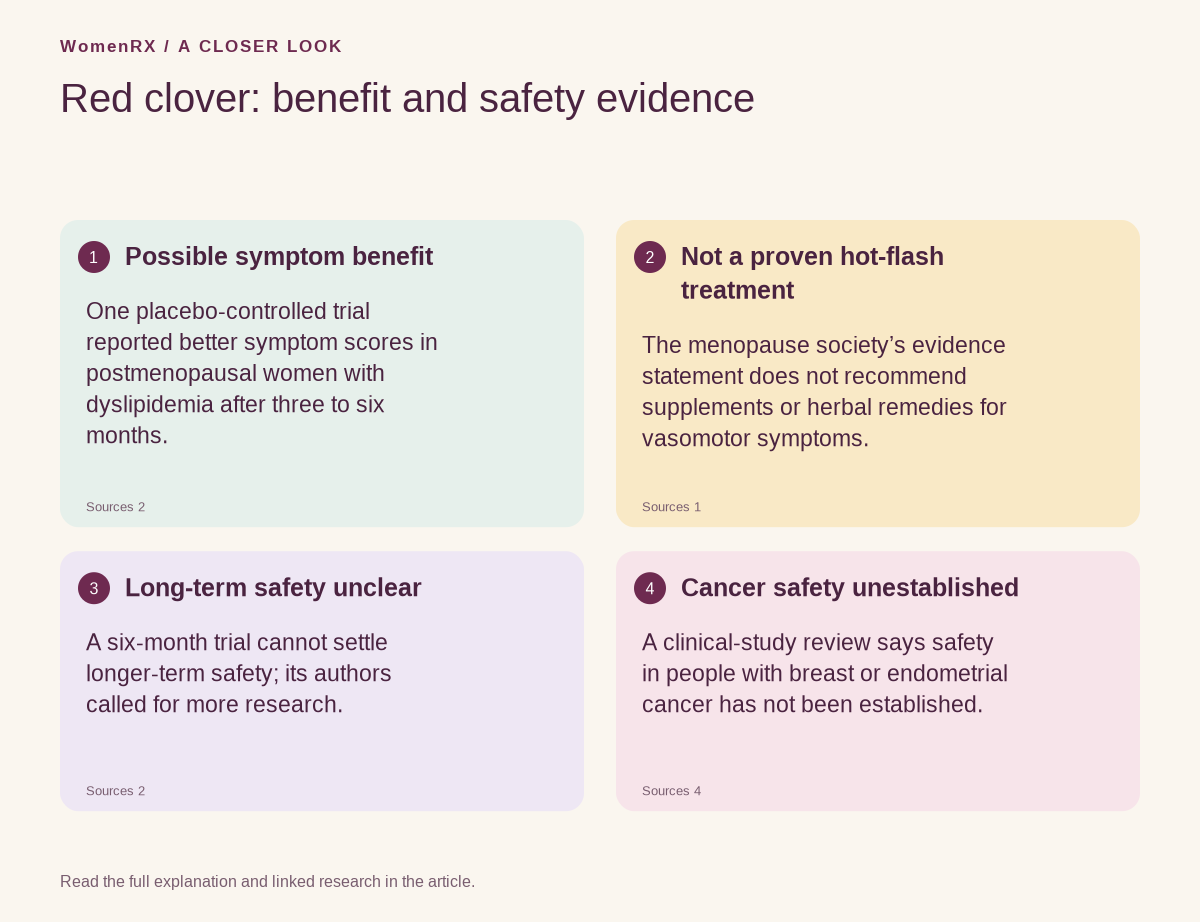
Red clover: benefit and safety evidence
Possible symptom benefit: One placebo-controlled trial reported better symptom scores in postmenopausal women with dyslipidemia after three to six months.2
Not a proven hot-flash treatment: The menopause society’s evidence statement does not recommend supplements or herbal remedies for vasomotor symptoms.1
Long-term safety unclear: A six-month trial cannot settle longer-term safety; its authors called for more research.2
Cancer safety unestablished: A clinical-study review says safety in people with breast or endometrial cancer has not been established.4
Read the figure as text
The symptom findings and safety questions come from different kinds of evidence and answer different questions.- Possible symptom benefit: One placebo-controlled trial reported better symptom scores in postmenopausal women with dyslipidemia after three to six months.2
- Not a proven hot-flash treatment: The menopause society’s evidence statement does not recommend supplements or herbal remedies for vasomotor symptoms.1
- Long-term safety unclear: A six-month trial cannot settle longer-term safety; its authors called for more research.2
- Cancer safety unestablished: A clinical-study review says safety in people with breast or endometrial cancer has not been established.4
More questions, answered
Does red clover work like hormone therapy?
Red clover has not been established as equivalent to hormone therapy. It contains isoflavones with estrogen-like activity, but that alone doesn’t establish that the supplement has the same effects, effectiveness, or risks as hormone therapy. 1 3
Is red clover proven safe after breast or endometrial cancer?
No. A review of clinical studies said safety in people with breast or endometrial cancer had not been established. That uncertainty isn’t proof that red clover causes harm, but it’s a reason to discuss it with the clinician managing your cancer care before use. 4
Sources you can check
- The 2023 nonhormone therapy position statement of The North American Menopause Society.Menopause (New York, N.Y.) · 2023Return to first citation
- Isoflavones obtained from red clover improve both dyslipidemia and menopausal symptoms in menopausal women: a prospective randomized placebo-controlled trial.Yigit E, Unsal S. · Climacteric : the journal of the International Menopause Society · 2024Return to first citation
- Combination of Red Clover and Hops Extract Improved Menopause Symptoms in an Ovariectomized Rat Model.Kim MR, Kim HJ, Yu SH, Lee BS, Jeon SY, Lee JJ, Lee YC. · Evidence-based complementary and alternative medicine : eCAM · 2020Return to first citation
- Clinical studies of red clover (Trifolium pratense) dietary supplements in menopause: a literature review.Booth NL, Piersen CE, Banuvar S, Geller SE, Shulman LP, Farnsworth NR. · Menopause (New York, N.Y.) · 2006Return to first citation