Red Clover for Menopause: What the Evidence Actually Shows
Red clover has shown mixed results for hot flashes, and a few promising findings for other symptoms haven’t been confirmed well enough to count on.
Red clover isn’t a proven treatment for menopause symptoms. Some small studies found fewer hot flashes or improvements in other symptoms, but results vary, and a review pooling 11 trials did not find a statistically clear reduction in hot-flash frequency. The North American Menopause Society does not recommend supplements or herbal remedies for hot flashes because the evidence is limited or inconsistent. 2 4
The short version: possible benefit, uncertain payoff
If hot flashes are the main reason you’re considering red clover, the evidence doesn’t give a reliable answer that it will help you. A review of 11 randomized trials in peri- and postmenopausal women found that hot-flash frequency was, on average, lower with red clover than with control, but the difference was not statistically clear. The reviewers also flagged methodological problems and substantial differences among studies. 4
That mixed record matters in everyday terms: a favorable result in one study doesn’t tell you whether a red clover product you see today will reduce your symptoms, or by how much. The North American Menopause Society’s 2023 position statement does not recommend supplements or herbal remedies for menopause-related hot flashes, citing limited or inconsistent evidence. 2
What the studies suggest, symptom by symptom
Hot flashes: Results differ across trials. The 2015 review reported positive results in some studies, but its pooled estimate for frequency did not reach statistical significance. Individual findings for intensity also varied, and some reported changes were not supported by a clear comparison between treatment and control groups. 4
Mood, pain, and thinking: A systematic review of studies on isoflavones found that one red clover trial reported improvements in hot flashes, mood, pain, and cognitive symptoms. That’s a potentially interesting result, not proof that red clover reliably treats those concerns: the review called for larger studies and better outcome measurement. 3
Sleep: The same review described sleep benefits for a different isoflavone preparation, not red clover. It shouldn’t be counted as evidence that red clover improves sleep. 3
Overall menopause symptoms: A 2024 review included six studies of red-clover-derived supplements among a much larger group of trials on different plant products. Its pooled results covered multiple kinds of supplements together, so they can’t establish that red clover itself improves overall symptoms. The authors also noted that evidence quality and study methods varied. 5
Why the preparation changes the comparison
“Red clover” doesn’t identify one uniform study treatment. Trials used particular red clover isoflavone preparations, while later reviews included a range of plant-derived products. A result for one preparation and study outcome can’t automatically be transferred to another supplement on a store shelf. 3 4 5
The studies also didn’t all ask the same question. Some measured how often hot flashes occurred; others looked at their intensity or used broader symptom measures. When outcomes and products vary, combining the results can make it harder to know what a specific person might experience. The red-clover review specifically noted differences among studies and limitations in how they were conducted. 4
Weigh it against options with stronger evidence
For bothersome hot flashes, hormone therapy remains the most effective treatment, according to the North American Menopause Society. Whether it’s a fit depends on an individual’s health and circumstances; the society describes a generally favorable benefit-risk balance for many healthy women younger than 60 or within 10 years of menopause onset who have no contraindications. 1
If hormone therapy isn’t a fit or isn’t your preference, the society’s nonhormone statement recommends several options supported by evidence, including cognitive behavioral therapy, clinical hypnosis, and certain prescription medicines. That gives you alternatives to discuss rather than assuming a supplement is the only next step. 2
A practical conversation before trying it
Bring the exact product name or a photo of its label, and be ready to say which symptom you most want to improve. Ask whether the research on that preparation measures that outcome, and how you’ll decide whether it’s helping.
Also mention any hormone-sensitive condition or history, and bring a current list of medicines and supplements. The menopause trials and reviews summarized here don’t establish red clover’s safety for every medical history or provide a dependable list of medicine interactions. That uncertainty isn’t proof of a particular danger or interaction; it’s a reason not to assume a plant-based product is automatically risk-free.
A useful bottom line: red clover has some positive study signals, but it isn’t a dependable, evidence-supported choice for hot flashes, and its other possible benefits remain uncertain. If symptoms are affecting your sleep or daily life, it’s reasonable to compare it with options that have clearer evidence.
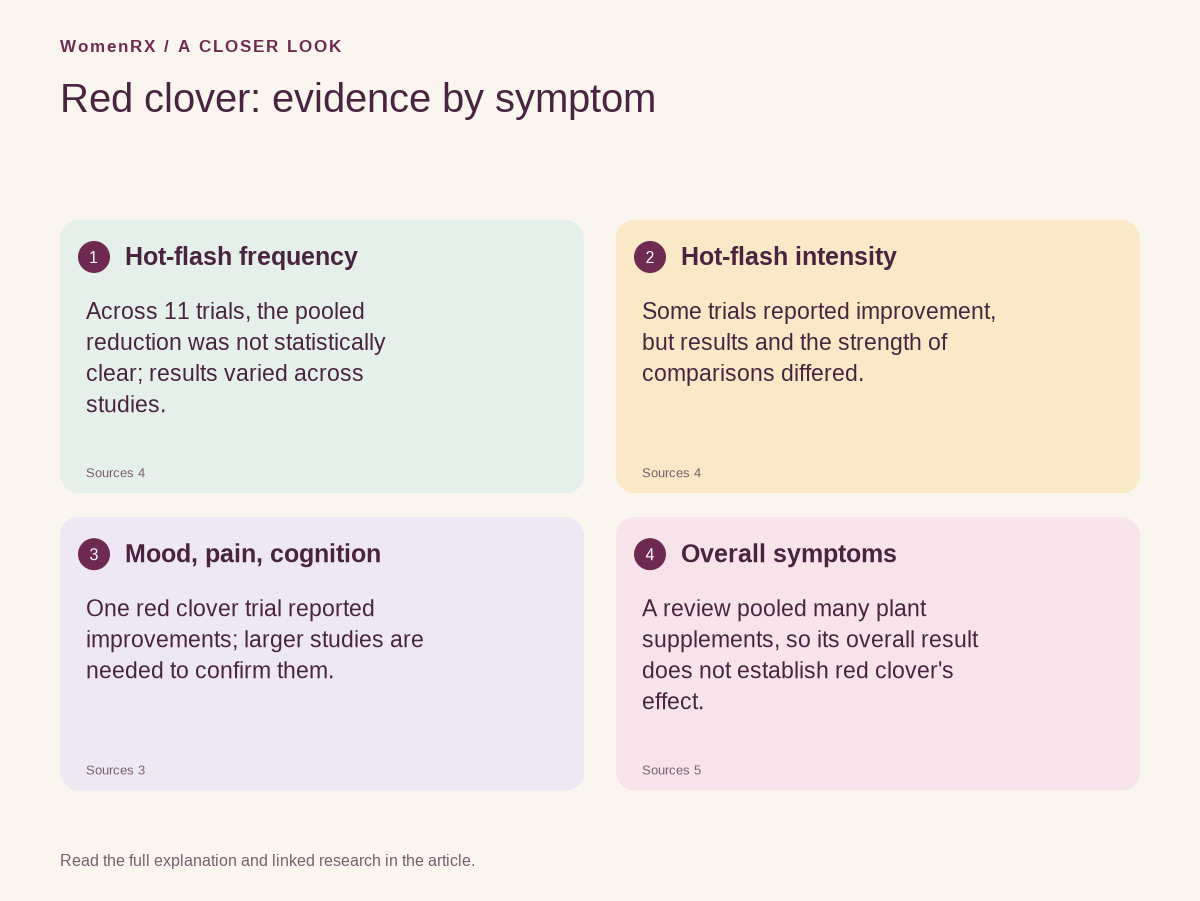
Red clover: evidence by symptom
Hot-flash frequency: Across 11 trials, the pooled reduction was not statistically clear; results varied across studies.4
Hot-flash intensity: Some trials reported improvement, but results and the strength of comparisons differed.4
Mood, pain, cognition: One red clover trial reported improvements; larger studies are needed to confirm them.3
Overall symptoms: A review pooled many plant supplements, so its overall result does not establish red clover's effect.5
Read the figure as text
The findings differ by the symptom measured and by whether a result comes from red clover specifically or from a larger group of plant supplements.- Hot-flash frequency: Across 11 trials, the pooled reduction was not statistically clear; results varied across studies.4
- Hot-flash intensity: Some trials reported improvement, but results and the strength of comparisons differed.4
- Mood, pain, cognition: One red clover trial reported improvements; larger studies are needed to confirm them.3
- Overall symptoms: A review pooled many plant supplements, so its overall result does not establish red clover's effect.5
More questions, answered
Is red clover the same as hormone therapy?
No. Red clover supplements and hormone therapy are different treatments, and the available evidence doesn’t establish red clover as an equivalent substitute. The North American Menopause Society identifies hormone therapy as the most effective treatment for hot flashes. 1 2
Does a red clover study apply to every supplement?
Not necessarily. Trials used specific preparations, and products can differ. A finding for one studied preparation doesn’t establish the effect of another product. 3 4 5
Sources you can check
- The 2022 hormone therapy position statement of The North American Menopause Society.“The 2022 Hormone Therapy Position Statement of The North American Menopause Society” Advisory Panel. · Menopause (New York, N.Y.) · 2022Return to first citation
- The 2023 nonhormone therapy position statement of The North American Menopause Society.Menopause (New York, N.Y.) · 2023Return to first citation
- Effects of isoflavones and amino acid therapies for hot flashes and co-occurring symptoms during the menopausal transition and early postmenopause: a systematic review.Thomas AJ, Ismail R, Taylor-Swanson L, Cray L, Schnall JG, Mitchell ES, Woods NF. · Maturitas · 2014Return to first citation
- Effects of red clover on hot flash and circulating hormone concentrations in menopausal women: a systematic review and meta-analysis.Ghazanfarpour M, Sadeghi R, Latifnejad Roudsari R, Mirzaii Najmabadi K, Mousavi Bazaz M, Abdolahian S, Khadivzadeh T. · Avicenna journal of phytomedicine · 2015Return to first citation
- Efficacy of plant-derived dietary supplements in improving overall menopausal symptoms in women: An updated systematic review and meta-analysis.Oh MR, Park JH, Park SK, Park SH. · Phytotherapy research : PTR · 2024Return to first citation